Essex Police have given Reform UK leader Nigel Farage a free pass on his alleged overspending in his campaign in Clacton in the 2024 general election. No details have been released about the scale of the overspending. The police have declared that too much time has elapsed for the case to be pursued.
Farage, the main front-man of the Brexit campaign — who also allegedly applied for German citizenship the day after the leave vote and has never denied doing so or, indeed, obtaining one — won the Clacton seat after Keir Starmer nobbled Labour’s hugely popular candidate Jovan Owusu-Nepaul.
Farage repaid the favour. Of the 98 seats in which Reform came second, Labour won 89. This is more than Starmer’s eventual parliamentary majority of 86 seats. Reform allegedly ran non-existent candidates in around sixty seats. It used AI-generated images and fake bios, with at least one confirmed. Police took no action on those either.
The more than 280,000 votes gathered by these phantoms often had a huge impact in seats previously held by Tory MPs. In South Dorset — where a fake candidate ‘stood’ — the combined Tory-Reform vote far outstripped Labour’s narrow ‘winner.’ Reform voters would be most likely to vote Tory in the absence of their own. This almost certainly would have prevented Labour’s win:

Like Starmer over Savile, ‘Beergate‘, Assange and so much more, Nigel Farage seems to lead a charmed, you might even say protected, life.
Featured image via the Canary
By Skwawkbox
From Canary via This RSS Feed.
Journalist Mohammad Faraj has gone missing after arriving at Queen Alia International Airport in Jordan.
Faraj, a journalist and a close friend of the Canary, was reportedly escorted away by officers of the Jordanian General Intelligence Department shortly after landing. That was over a week ago — on Friday 12 December 2025.
Since then, he has effectively vanished.
Repeated attempts by his family, friends, colleagues, and comrades to locate or visit him have gone unanswered. No official confirmation has been given. Charges have not been announced. No information has been provided about his health, his whereabouts, or even the legal basis for his detention.
Mohammad Faraj — disappeared after arriving to Jordan
Mohammad Faraj’s family does not know if he is safe.
Numerous attempts have been made by his family, friends, colleagues and comrades to visit him, but all the requests remain unanswered. His family hasn’t received any updates or information about his health, whereabouts or even reasons for his arrest.
That a journalist can simply disappear in this manner is chilling — especially in a country that routinely claims to respect freedom of expression and the protection of journalists.

Mohammad Faraj’s wife, fellow journalist Rana Abi Jomaa, has expressed deep and mounting concern. On an interview with Al Mayadeen she said:
All we want right now is just to know Mohammad is okay. We also would like to know why he’s been arrested?
Rana continued:
We were on a family visit during the holidays before coming back to Lebanon for the new year. I don’t want to analyse too much or read too much into this right now. Some people are saying this is a crackdown on free speech. Others say that this is a targeted intimidation of journalists.
I don’t want to get into that right now. All I want is to know if he’s okay. Any news about Mohammad would be great.
Rana’s restraint is understandable. Her priority is her husband’s safety.
But allow us, then, Rana to do the analysis you have chosen not to.
Jordan’s intimidation of journalists
Mohammad Faraj’s disappearing cannot be viewed as anything other than intimidation. It is bullying by the Jordanian authorities, aimed solely at silencing voices that speak out against Jordan’s role in shielding Israel from accountability.
Jordan’s record in recent months speaks for itself. As Israel’s genocide in Gaza intensified, Jordan became a key logistical supply artery — providing vital supply routes through the so-called “land bridge” improvised after Yemen enforced a blockade on the genocidal state. Jordan has also intercepted Iranian drones bound for Israel, not only defending Israel’s airspace but doing so at the expense of its own population. Drone debris and shrapnel have fallen onto residential areas, injuring Jordanians in their own homes.
And now, faced with mounting domestic anger and regional outrage, Jordan appears to be naively attempting damage control. Not by changing policy, but by making an example of journalists who speak truth to power. Detaining Mohammad Faraj in silence, without explanation, is not law enforcement. It is a warning. Jordan is trying to make an example here.
But it will not work.
If the Jordanian authorities believe that disappearing journalists will help them regain control of a collapsing narrative — or whitewash their complicity over the past two years — they are deeply mistaken. We at the Canary will use every privilege and every protection afforded to us as a media organisation based in Britain to ensure this attempt at intimidation fails.
The Canary stands in full and unequivocal solidarity with Mohammad Faraj.
We demand immediate clarity on his whereabouts, his condition, and the legal grounds — if any exist — for his detention. And we call for his release without delay.
Our thoughts are with Rana, with Mohammad Faraj’s family, and with all journalists across the region who continue to speak truth to power despite the risks.
#Free_Mohammad_Faraj
Featured image via the Canary
By The Canary
From Canary via This RSS Feed.
Drop Site is a reader-funded, independent news outlet. Without your support, we can’t operate. Please consider making a 501(c)(3) tax-deductible donation today.
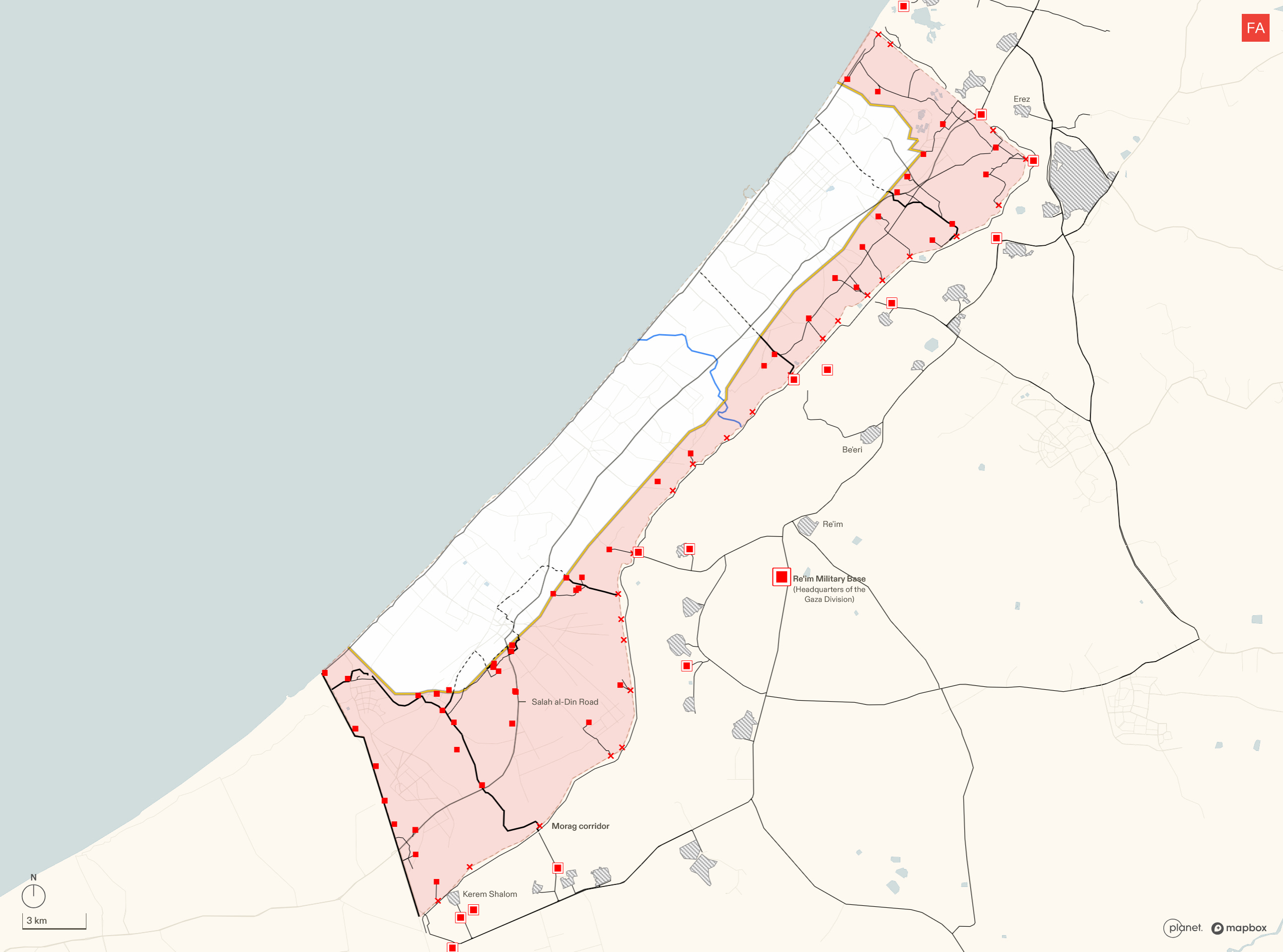
Israel is currently maintaining 48 military outposts east of the yellow line. Image by Forensic Architecture.
Since the so-called ceasefire came into effect in Gaza on October 10, Israel has been consolidating its control of over 50% of Gaza and—according to new research by Forensic Architecture—physically altering the geography of the land. Through a combination of the construction of military infrastructure alongside the destruction of existing buildings, Israel appears to be laying the groundwork to establish a permanent presence in the majority of the Gaza Strip.
Israel has constructed at least 13 new military outposts inside Gaza since the ceasefire—primarily located along the yellow line, in eastern Khan Younis, and near the border with Israel, according to analysis of satellite imagery by Forensic Architecture.
“Israel is doing what it always does, and what it historically has done best: establish ‘facts on the ground,’ incrementally rather than spectacularly, and make them permanent once those with influence to force it to reverse course either lose interest, decide that the cost of confronting Israel is not worth the price, or come out in open support of Israeli violations. Israel is in no rush and prepared to play the long game,” Mouin Rabbani, co-editor of Jadaliyya and a former UN official who worked as a senior analyst on Israel-Palestine for the International Crisis Group, told Drop Site after reviewing a summary of the Forensic Architecture findings.
The analysis also shows that, between October 10 and December 2, 2025, Israel has:
- Accelerated the growth and infrastructure development of 48 existing military outposts inside Gaza.
- Expanded a network of roads connecting military outposts inside Gaza to the Israeli road network, bases and settlements outside of Gaza.
- Continued construction that began in September 2025 of a new road in Khan Younis, re-routing the Magen Oz corridor to run within Israel’s area of control.
- Engaged in the systematic demolition and destruction of Palestinian property, particularly in eastern Khan Younis, targeting areas which haven’t already been destroyed. New military outposts and roads have emerged across this area.
“Augmenting multiple Israeli statements about extending its borders with buffer zones to the north, east, and south, this is indisputably an Israeli campaign to partition the Gaza Strip and thereby promote its long-term objective of moving the Palestinian population elsewhere,” Rabbani said. “At the same time, Israeli success is not a foregone conclusion. If it was, the Palestinian population of the Gaza Strip would have been ethnically cleansed years if not decades ago.”
As part of the initial phase of the ceasefire agreement, the Israeli military partially withdrew to what became known as the “yellow line,” with over half of Gaza under continued Israeli control. The term comes from a map that was distributed in late September as part of President Donald Trump’s 20-point ceasefire plan that depicted a phased withdrawal of Israeli troops, to an initial yellow line, followed by another withdrawal, until an eventual pullback to a “buffer zone” running inside Gaza along the border with Israel.
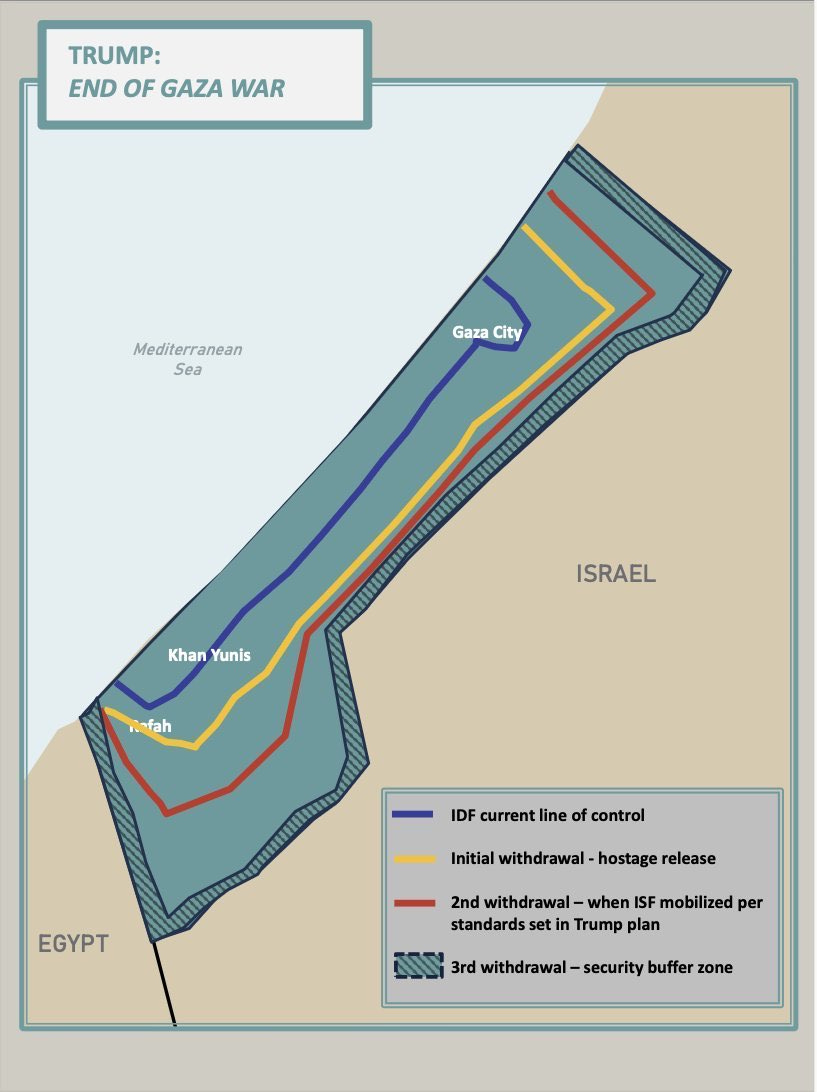
The original withdrawal map according to President Trump’s 20-point Gaza plan.
Trump then posted a new map showing the initial withdrawal line that left Israel in control of 58% of Gaza. After the ceasefire came into effect, an Israeli military spokesperson posted yet another map with the yellow line showing Israel in control of 53% of Gaza.
Since the ceasefire, Israel has seized more land by physically placing at least 27 yellow blocks (delineating its area of control) west of the yellow line marked in Israel’s own maps.
Point 16 of Trump’s 20-point plan explicitly states, “Israel will not occupy or annex Gaza. As the [International Stabilization Force (ISF)] establishes control and stability, the Israel Defense Forces (IDF) will withdraw based on standards, milestones, and timeframes linked to demilitarization.” It goes on to say, “Practically, the IDF will progressively hand over the Gaza territory it occupies to the ISF according to an agreement they will make with the transitional authority until they are withdrawn completely from Gaza, save for a security perimeter presence.”
While the “standards, milestones, and timeframes” around Israel’s withdrawal have been highly contentious, they are nevertheless the principal subject of ongoing negotiations. However, the analysis by Forensic Architecture clearly shows that Israel is consolidating its military presence on the ground east of the yellow line in a way that suggests no intention of a further withdrawal.
These findings come as the Trump administration is reportedly planning the construction of a number of residential compounds, dubbed “Alternative Safe Communities,” in areas east of the yellow line to provide housing to tens of thousands of Palestinians, with no construction allowed on the west side, that appear to be part of a plan to entrench the partition of Gaza and allow for permanent Israeli control over more than half of the enclave.
The Full Forensic Architecture Analysis
Israel’s network of military infrastructure
Within Gaza, Israel is currently maintaining 48 military outposts east of the yellow line. The outposts are connected to a network of roads which have been created, expanded or appropriated by the Israeli military. In turn, these link to Israeli bases, roads, and settlements outside of Gaza.

New Israeli military outposts
Since the ceasefire came into effect, Forensic Architecture observed three changes to Israeli military outposts east of the ‘yellow line’:
-
An increase in the number of outposts in locations strategic for occupation.
-
The expansion of outposts.
-
The development of outpost infrastructure.
Forensic Architecture documented 13 new outposts since the ceasefire. They are primarily located along the ‘yellow line’, in east Khan Younis, and near Gaza’s border.

Case study: New military outpost in Jabaliya
At a new outpost in Jabaliya, a densely populated tent area was dismantled, and Israel demolished the surrounding buildings. In their place, Israel carved a road, built berms, and constructed buildings on the outpost. The largest berms measure 75 by 65 meters.
The outpost was constructed on high ground, and is visible on 26 November in a ground-level photograph taken from the west side of the ‘yellow line’, where Palestinians have been forcibly displaced to. The two areas are separated by a strip of destruction. From this vantage point, you can see the berms making up the outpost, with lights atop them, and the vehicles likely used to construct the outpost.

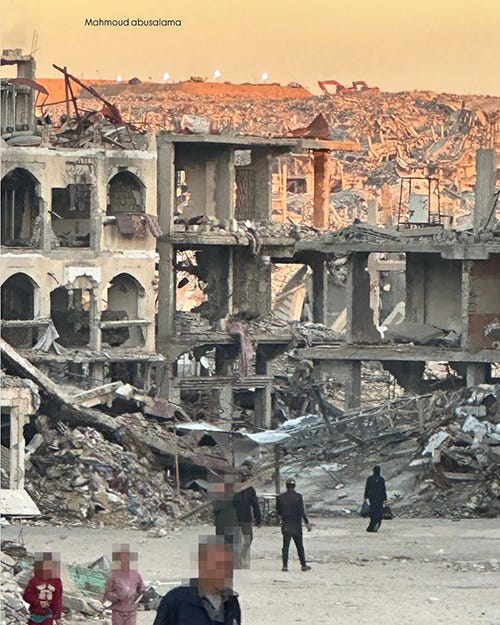
Photograph taken on 26 November 2025 in Jabaliya, west of the 'yellow line', looking towards an Israeli military outpost east of the 'yellow line. Source: @mahmoud__abusalama
Israel is rerouting existing military infrastructure to fall within its area of control
In mid-July 2025, the Israeli military announced the completion of the Magen Oz corridor, a 15-kilometer military road separating the city of Khan Younis into its eastern and western parts. Since September, Israel has been constructing a new road in Khan Younis, re-routing the Magen Oz corridor to run within its area of control.

Destruction in east Khan Younis
Military expansion is occurring alongside continued destruction east of the ‘yellow line’.
The largest body of land under Israel’s control is in the south of Gaza, and includes Rafah and eastern Khan Younis, which remains densely packed with private property. Here, since the ceasefire, Israel has been destroying buildings not previously destroyed, and constructed new military outposts and roads across the area.
Nearby, demolition vehicles (A) are visible on the border.

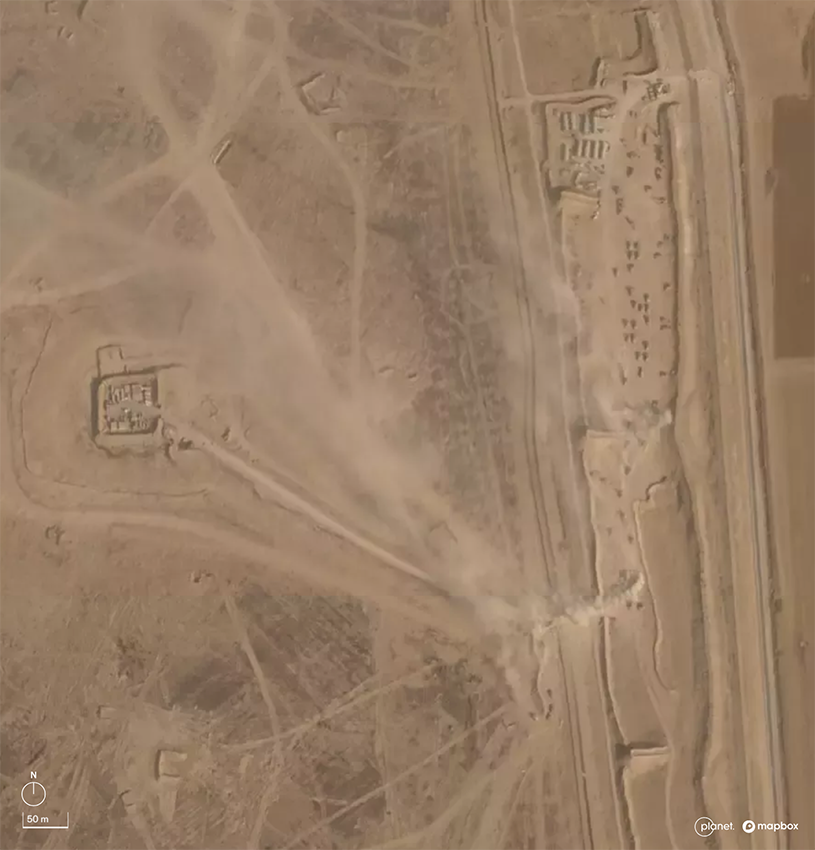
Military outpost in Khan Younis, on the border of Gaza, connected by road to a military crossing in which demolition and military vehicles are visible. 5 November 2025. Source: Planet Labs LBC.
For more detail, including additional maps and data, visit gaza.forensic-architecture.org/database or forensic-architecture.org/location/palestine
From Drop Site News via This RSS Feed.

The Pope Leo XIV consistory on January 7–8, 2026, marks a pivotal moment for Church communion, prayer, and global Catholic leadership after the Jubilee of Hope.
Related: Pope Leo XIV Calls for Ceasefire and Dialogue Between Thailand and Cambodia

El papa León XIV, hoy desde la Plaza de San Pedro del Vaticano. EFE/EPA/Vatican Media
The Pope Leo XIV consistory, set for January 7 and 8, 2026, in Vatican City, will be the first extraordinary gathering of cardinals under the new pontiff’s leadership—a moment charged with spiritual significance and institutional weight. Announced by the Holy See on Saturday, the two-day assembly aims to deepen communion between the Pope and the College of Cardinals while fostering collective discernment on the Church’s mission in a rapidly changing world.
This historic consistory follows immediately after the closing of the Jubilee of Hope, a year-long holy celebration that concludes on January 6 with the symbolic shutting of the Holy Door at St. Peter’s Basilica. The timing is deliberate: as one sacred chapter ends, another begins—not with spectacle, but with fraternal dialogue, shared reflection, and prayer.
According to the Vatican press office, the consistory will be “characterized by moments of communion and fraternity, as well as times dedicated to reflection, sharing, and prayer.” These elements, the statement adds, are intended to “favor common discernment and offer support and counsel” to Pope Leo XIV as he exercises his role as shepherd of the universal Church.
Pope Leo XIV Consistory: A Return to Synodal Fraternity
Unlike ordinary consistories—typically convened to approve canonizations or create new cardinals—this extraordinary consistory serves a more pastoral and strategic purpose. It echoes Pope Francis’s 2022 extraordinary meeting, which focused on reforming the Roman Curia and strengthening collegial governance. Yet under Leo XIV, the emphasis appears to shift toward spiritual cohesion and unity amid global challenges.
“The consistory is situated within the life and mission of the Church,” the Vatican clarified, “and its purpose is to reinforce communion between the Bishop of Rome and the cardinals, who are called to collaborate in care for the good of the universal Church.”
This framing reflects a broader trend in recent papal leadership: moving away from centralized authority toward synodal discernment—a process where bishops, clergy, and even laity contribute to Church direction through listening and dialogue. Pope Leo XIV, who assumed the papacy in late 2025 following the death of his predecessor, has signaled continuity with this vision while placing renewed emphasis on doctrinal clarity and global solidarity.
Notably, this will be Leo XIV’s second consistory overall, after presiding over an ordinary session on June 13, 2025, focused on canonization causes. But the upcoming extraordinary gathering carries greater symbolic weight, as it gathers the Church’s highest-ranking advisors not to decide procedural matters, but to pray, reflect, and walk together in service of a world grappling with war, inequality, ecological crisis, and spiritual disorientation.
Read the Vatican’s official statement on the consistory (Holy See Press Office)
The event also underscores the evolving role of cardinals in the modern Church. Once primarily princes of the Church with political influence, today’s cardinals are increasingly expected to be pastoral leaders, bridge-builders, and voices for the marginalized—from Africa and Asia to Latin America and conflict zones in Eastern Europe. Their counsel during this consistory could shape Leo XIV’s priorities for the next phase of his pontificate, including potential reforms to Church governance, missionary strategy, and engagement with secular societies.
Geopolitical Context: The Catholic Church as a Global Moral Actor
The Pope Leo XIV consistory arrives at a time when religious institutions are being called upon to mediate escalating global tensions. With wars raging in Ukraine, Gaza, and Sudan, democratic backsliding in multiple regions, and rising xenophobia, the Catholic Church remains one of the few global entities with moral authority, transnational infrastructure, and diplomatic reach.
The Vatican’s network of nuncios (ambassadors) in over 180 countries allows it to function as a discreet but influential peacemaker—recently facilitating prisoner exchanges and humanitarian corridors. A unified College of Cardinals, aligned with the Pope’s vision, strengthens this capacity.
Moreover, as secularism advances in the West and religious nationalism surges elsewhere, the Church faces internal pressures. In Europe and North America, debates over liturgy, gender, and doctrine have deepened divides. In the Global South, meanwhile, Catholicism is growing rapidly—yet often with demands for greater autonomy and cultural relevance.
The consistory offers Leo XIV a chance to balance these dynamics—affirming universal teachings while empowering local Churches to respond to their unique contexts. It also signals to the world that the Vatican remains committed to dialogue over division, even as other global institutions fracture.
Explore the role of the Holy See in international diplomacy via the United Nations
Critically, the meeting occurs just months before the 2026 Synod on Synodality’s final assembly, a landmark process launched under Pope Francis to reimagine Church governance. The January consistory may serve as a strategic preview, allowing cardinals to align on key themes—such as lay participation, ecological justice, and digital evangelization—before broader consultations conclude.
For observers beyond Catholicism, the event is a reminder that spiritual leadership still shapes geopolitics. When the Pope and his cardinals speak with one voice on issues like climate action, migration, or nuclear disarmament, their words carry weight far beyond the pews.
In this light, the Pope Leo XIV consistory is not merely an internal Church affair. It is a global moral gathering—one that could influence the ethical direction of international discourse in the years ahead.
Review historical context of papal consistories from the Vatican Secret Archives
A Pontificate Defined by Communion
Pope Leo XIV, whose chosen name evokes both the reforming spirit of Leo XIII and the ecumenical legacy of John XXIII, has made “communion” a cornerstone of his early papacy. In his first Christmas Urbi et Orbi message, he spoke of the Church as “a house of open doors, not closed borders,” and called for “a revolution of tenderness” in response to global indifference.
The January consistory embodies this vision. By inviting cardinals not just to advise, but to pray and discern together, Leo XIV reaffirms that leadership in the Church flows not from power, but from shared spiritual journeying.
As the bells of St. Peter’s echo on January 7, the world will be watching—not for declarations or decrees, but for a quieter, more profound signal: that even in an age of fragmentation, unity remains possible when rooted in faith, humility, and mutual care.
Si terrà nei giorni 7 e 8 gennaio 2026. A riferirlo @HolySeePress. Si tratterà di due giornate all’insegna della preghiera, della riflessione e della condivisione per offrire sostegno e consiglio al Pontefice#VaticanNewsIT
Leggi qui ⬇️https://t.co/M0uoXryqvM
— Vatican News (@vaticannews_it) December 20, 2025
From teleSUR English via This RSS Feed.