rss

joined 2 months ago
MODERATOR OF
 

By Dulce Amor Rodriguez
Bulatlat.com

MANILA — Before the police dragged young protesters by the hair, before batons cracked against ribs inside the notorious blue tent in Mendiola, Vitrum, a convener of Alyansa Laban sa Korapsyon at Brutalidad ng Kapulisan (AKAB), already knew what pushed him to the streets on Sept. 21—stories of billions stolen from the people, flood control funds unaccounted for, and communities that remained underwater despite years of promises.

He did not suffer the beatings that others endured that day, but he carries the weight of their bruises in his fight. As survivors recounted torture, unlawful arrests and inhumane detention, Vitrum said the corruption that pushed people to protest is the same system that now uses police power to silence those demanding accountability. “Even with the repression and arrests, this is where we find our voice,” he told Bulatlat.

For him and the AKAB, backing down is not an option—not after what unfolded in Mendiola, and not while the corruption they protested remains unaddressed.

Protesters blocked amid inhumane detention

On Nov. 30, as thousands gathered nationwide for another anti-corruption mobilization, protesters in the capital, particularly in Luneta, marched toward Mendiola, only to be blocked by a police barricade. Behind them was what appeared to be an intermodal container. Protesters chanted, “PNP, protektor ng korap!” — a phrase born not only from frustration with unpunished corruption, but from the memory of violence many bore after Sept. 21.

Those memories are painful and, for some, still open wounds.

Witnesses and rights groups documented beatings, unlawful arrests, and torture. Development worker Luke Malimban told Bulatlat that police struck him while dragging him into a makeshift detention tent after the rally—a place many have since dubbed the “blue tent.” He said no one arrived there unscathed: “Not a single person arrived in the blue tent without a bloody face and wounds,” he recalled.

Others arrested that day described how men in plainclothes punched, kicked, and baton-whipped them, and how uniformed officers later continued the violence during detention. Amnesty International documented the testimonies, calling the abuses, even against minors, “appalling ill-treatment,” and demanded impartial investigation.

Read: Police violence, torture cases surface as new anti-corruption protest looms

In the view of many affected, the barricades on Nov. 30 were more than concrete and shields, they symbolized a system that protects those who loot public funds, while brutalizing those who demand transparency. The chant “PNP, protektor ng korap” echoed not just anger, but memory of tents soaked in blood, of children detained without cause, of injustice that remains unpunished.

Weaponizing the law

The violence was followed by criminal charges. The Philippine National Police – Criminal Investigation and Detection Group (PNP-CIDG) filed cases against 97 individuals, accusing them of conspiracy to commit rebellion or insurrection, sedition, and inciting to sedition under Articles 136, 139, and 142 of the Revised Penal Code.

Lawyers noted that earlier complaints had already been dismissed for lack of evidence.

Human rights lawyer Maria Sol Taule said authorities consistently target those vocal about corruption while those implicated in fund anomalies face no public accountability. “They’re going after the people who speak out,” she said. “But there is no action against those involved in the corruption issue.”

Taule explained that many cases had been “referred for further investigation,” a clear indication that evidence was lacking. Yet police revived these cases and filed them again, even against bystanders detained during the chaos.

She also warned of the danger of escalating charges. “They are trying to prove that students were leaders of the rally so they can hook them under the Public Assembly Act or even attempt to connect them to more serious offenses,” she said.

Read: Beyond the Philippines: Right to protest under fire in many countries

Vitrum witnessed this firsthand. Some of AKAB’s members who were arrested on Sept. 21 continue to receive subpoenas. “Even after the protest, the police won’t stop. They keep elevating the cases,” he said.

Why AKAB refuses to be silenced

For AKAB, the crackdown only affirmed why organizing is necessary.

Vitrum said corruption has long shaped the daily struggles of ordinary workers—soaring inflation, flood-prone communities, lack of public services, and health and transport systems drained by theft. “People cannot access the services meant for them,” he said.

He pointed out that even after the violence of Sept. 21, no public officials or contractors linked to the alleged anomalies have been held accountable. Meanwhile, protesters face fabricated charges.

“They call us agitators,” he said. “But they are the real cause of the crisis—they are the corrupt, they are the violent ones.”

Vitrum said AKAB will continue organizing forums, solidarity nights and mobilizations because silence only emboldens those in power. “We are all we have. We are the ones who must corner the plunderers,” he said.

Taule said the repression against anti-corruption protesters stems from the state’s attempt to protect a system that benefits the powerful. She warned that the pattern is clear: arrests, fabricated cases, suppression of rallies, and demonization of students.

“The current system is desperately trying to maintain the status quo,” she said. “This is why it’s crucial for people to come together to resist fascism.”

For Taule, the right to protest is not only protected by law, it is a duty. “It is not wrong to join protests. It is our responsibility,” she said.

Despite the torture allegations, unlawful arrests, inhumane detention and criminalization of dissent, AKAB says the protests will continue.

Vitrum believes the movement will grow, not shrink. “The more they do this repression, the more our ranks will thicken,” he said. “The anger will only grow.”

From Mendiola to communities battered by corruption, AKAB vows to continue the fight because it is necessary.

As Vitrum put it, “Dito kami nakahahanap ng boses.

Here, in protest and collective action, he said, the people reclaim what corruption and state violence have long tried to steal—their power. (RVO)

The post AKAB: The struggle must continue appeared first on Bulatlat.


From Bulatlat via This RSS Feed.
 

MANILA – Right after the police and military raided their boarding house, Manobo indigenous activist Julieta Gomez can still vividly remember when they were paraded as “communist-terrorists” inside the Criminal Investigation and Detection Group (CIDG).

“Arresting indigenous peoples and activists like me was easy for them– even to the point of planting evidence,” Gomez told Bulatlat in an interview. “But those implicated in the corruption, even with the presence of clear evidence, continue to run free.”

Gomez and indigenous rights activist Niezel Velasco were illegally arrested on July 16, 2021, in a joint military and police operation. They were charged with murder, attempted murder, and illegal possession of firearms and explosives, which were dismissed by the Quezon City Regional Trial Court (RTC) Branch 91 on April 8, 2025.

Prior to their arrest, the two indigenous rights activists flew to Manila to campaign for justice for the second Lianga Massacre, killing three Lumad-Manobo individuals, including a 12-year-old girl on June 15, 2021, in Sitio Panukmoan, Liangga, Surigao del Sur.

Read: 2 Lumad farmers, 1 student killed in another Lianga massacre

Gomez said the circumstances of their arrest remain etched: state agents forcing their way into the house in the pre-dawn hours blowing the doors open, two guns aimed at their heads as they were ordered outside. Just as troubling, Gomez recalled, was the sudden empty black bag: once full of materials with the sound of heavy metal. When the state agents ordered them back to their boarding house, 40 minutes after staying outside, the police presented what they claimed to have “recovered” – firearms, explosives, and paraphernalia.

Now, the two are fighting back by filing countercharges against the police officials responsible for their arrest at the Office of the Ombudsman. But their case is emblematic of the common pattern of politically-motivated charges against activists – over 700 political prisoners languish in the repeated patterns of illegal possession of firearms and explosives, or the twin-terror laws, or both at the same time.

The terror against dissenters, marginalized

“The political prisoners were the ones who stood in the line of fire against the struggle against corruption and the struggle for justice, freedom and national democracy,” martial law survivor and former political prisoner Bonifacio Ilagan, who also represented the Samahan ng mga Ex-Detainees Laban sa Detensyon at Aresto (SELDA), said in a press conference on December 1.

There are a total of 696 political prisoners based on the joint monitoring of  SELDA and human rights group Karapatan. Of these numbers, 93 are elderly, 136 are women, 89 are sick, 12 are consultants and staff of the National Democratic Front of the Philippines (NDFP) who should be protected under the Joint Agreement on Safety and Immunity Guarantees (JASIG), an agreement signed by the Philippine government and the National Democratic Front of the Philippines in 1995.

Ilagan added, “they are the ones who should be given freedom on the basis of humanitarian reasons, not the likes of Duterte.”

In a protest at the Department of Justice last December 3, SELDA spokesperson and former political prisoner Adora Faye de Vera said, “Most political prisoners are peasant and labor organizers, human rights defenders, development workers and even ordinary citizens slapped by the DOJ with trumped-up criminal cases on mere suspicion of supporting the revolutionary movement.”

She added that the twin terror laws — Anti-Terror Act (ATA) and the Terrorism Financing Prevention and Suppression Act (TFPSA) have been increasingly used by the DOJ against dissenters. Karapatan reported that at least 30 of those charged with violating the twin terror laws are still detained.

“There is rank injustice in targeting those who fight corruption and advance human rights,” said Karapatan deputy secretary general Maria Sol Taule, “but turning a blind eye to the biggest plunderers and fascists like Marcos Jr. and his ilk.”

Attacks on anti-corruption dissenters

Meanwhile, not one has been held fully accountable in the blatant corruption scandal, not even with the establishment of the Independent Commission for Infrastructure (ICI), whose investigations are still ongoing.

Bulatlat’s monitoring recorded that most of the high officials implicated in the flood control corruption scandal denied the allegation, resigned from their posts or left the country, while others were invited to hearings. Among those investigated by the Office of the Ombudsman are former and present politicians implicated by former DPWH undersecretary Roberto Bernardo but the public sees no immediate consequences or follow-through of most of these investigations after the denial.

The same pace of progress goes for the public officials and private entities facing charges before the Ombudsman.

Most of the lawmakers named by the Discaya couple in their affidavit were not subjected to further official investigation after being invited to the Blue Ribbon committee hearings. The sheer volume of individuals linked and indicted constitutes no real accountability emerging from the investigations.

On the other hand, attacks against anti-corruption dissenters have been persistent. According to Mark Vincent Lim, one of the lawyers who responded to the mass arrests during the September 21 protest, there have been 216 victims of unlawful arrest, including 91 minors, and two people died: worker Eric Saber who happened to be a bystander and an unidentified man killed by a stab wound.

“As far as I know, most have already been released on bail,” Lim told Bulatlat. Most of the people arrested are charged with Tumults and Other Disturbances of Public Order (153), while the initial charges for Illegal Assembly and Direct Assault are dismissed by the Manila prosecutor due to insufficiency of evidence.

Most of them have been detained without warrant for more than three days, which is beyond the period allowed by the Revised Penal Code.

Moreover, the Criminal Investigation and Detection Group (CIDG) is going after student leaders from Polytechnic University of the Philippines and University of the Philippines who joined the protest, issuing subpoenas.

In the November 30 protest, three individuals were arrested and shortly released without charges.

Rights violations and resistance inside jails

Meanwhile inside prison, rights of political prisoners and other persons deprived of liberty (PDL) continue to be violated. Gomez said that during their detention, the prison warden in Camp Karingal isolated them from the rest of PDLs.

“We were padlocked in a small room as big as two in a half arm-spans – all three political prisoners – for the majority of detention there in more than two years,” Gomez added. Written outside their room were words: high-ranking communist-terrorists. “We ask them to remove the texts– asserting to them that what they are doing are human rights violations.”

In Negros, political prisoners and other PDLs held hunger strike against the degrading treatment inside the facilities. Karapatan reported that in Negros Occidental District Jail (NODJ), both PDL and political prisoners endure rights violations, arbitrary punishment, and humiliation. The authorities label the political prisoners as members of the “communist terrorist group,” subjecting them to further harassment and punitive measures.

Read: Detainees hold hunger strike due to inhumane treatment

Human rights groups called on the Bureau of Jail Management and Penology (BJMP) National Headquarters and the Commission on Human Rights to conduct a full, impartial, and urgent investigation into the controversial reinstatement of NODJ Warden Crisyrel Awe. They also demand the immediate ending of harassment, unlawful isolation, intimidation, restricted visits, and suppression of rehabilitation programs.

“These acts deepen fear, sustain injustice, and portray PDLs as criminals rather than human beings with inherent dignity,” said Karapatan in a statement.

The group also underscored that the hunger strike exposes the structural injustice in the Philippine penal system, “where the poorest workers, farmers, and urban poor fill overcrowded jails, while the wealthy, corrupt, and powerful evade accountability.”

Congestion in the Philippine jails remains extremely high. The average congestion rate as of May 2025 is almost 300 percent. This overcrowding causes various humanitarian consequences.

The International Committee on Red Cross (ICRC) noted that overcrowding means persons deprived of liberties have limited movement, sleeping spaces, and ventilation. This also means inadequate access to water, sanitary facilities and healthcare– causing disease-causing bacteria and viruses to spread faster.

In the 2025 General Appropriations Act (GAA), there is a total of P4.6 billion for subsistence and almost P1 billion for medical allowance for 182,556 PDLs. This amounts to almost P70 for food and P15 for medical expenses of every PDL. This has been a static budget for PDLs in the last five years.

International solidarity and rights instruments

Three United Nations experts — Mary Lawlor, on the situation of human rights defenders; Gina Romero, on the rights to freedom of peaceful assembly and of association; and, Michel Forst, on environmental defenders — signed a collective statement, calling out the global trend of prolonged pretrial detention and long-term imprisonment of human rights defenders.

“Arbitrary detention remains one of the most common and cruel tools used by repressive authorities to silence those peacefully exercising the right to defend human rights and to dismantle civil society,” the statement read.

Read: Double standards in the Philippine’s justice system

The statement also emphasized that such actions foster a climate of fear, creating a profound deterrent effect that discourages the legitimate and essential work of activists, human rights defenders, as well as citizens.

The actions violate the international human rights obligations of the UN state parties like the Philippines on Universal Declaration of Human Rights, the UN Declaration on Human Rights Defenders, the International Covenant on Civil and Political Rights, and the UN Convention against Torture and Other Cruel, Inhuman or Degrading Treatment or Punishment.

Moreover, Karapatan stated that the punitive actions against political prisoners and PDLs violate the UN Standard Minimum Rules for the Treatment of Prisoners (2015 Nelson Mandela Rules), two domestic laws — Republic Act 7438 (Rights of Persons Arrested, Detained, or Under Custodial Investigation) and Republic Act 9745 (Anti-Torture Act), and the own comprehensive operations manual of the BJMP, 2015 edition.

“The existence of political prisoners is a brutal reminder of the oppressive regime Filipinos are facing,” the International Coalition for Human Rights in the Philippines (ICHRP) stated. “The Marcos Jr. administration claims to seek peace, but in reality, it targets and silences those who are fighting for a just and lasting peace.”

The international group joined the campaign to free all political prisoners in the Philippines and demand an end to illegal arrests and detention.

Political prisoners are detained primarily for their political beliefs or activities or perceived involvement in political movements. The motivation behind the arrest is political, regardless of the charges used against them.
“This misuse and abuse of power destroys lives, livelihoods, families and communities. It stifles and inhibits defenders from carrying out their legitimate and essential work, and discourages others from exercising the right to defend human rights,” the UN experts added in the statement. (With reports from Ruth Nacional) RVO

The post Political prisoners languish in overcrowded jails, a stark irony in corruption impunity appeared first on Bulatlat.


From Bulatlat via This RSS Feed.

 

“These soldiers accused, forced into silence and attempted to detail at will through fabricated evidence and rehearsed witnesses packaged as rebel returnees. And now, they can walk away unaccountable because the state calls it ‘procedure.’”

SAN PABLO CITY, Laguna — In the Southern Tagalog region, the road to justice is a one-way street.

Last November 19, human rights defenders and activists once again trooped to the Office of the Ombudsman to decry the junking of countercharges against perpetrators of human rights violations in the region.

They denounced in particular the decision to junk the civil and administrative cases filed against the Armed Forces of the Philippines’ 59th Infantry Battalion and 2nd Infantry Division, and a separate case against the Philippine National Police.

“Once again, justice has been denied to the victims of state violence,” said Nimfa Lanzanas, paralegal for Karapatan Southern Tagalog.

“By dismissing these countercharges, the Ombudsman shows where its loyalties lie, and it is not with the people,” she added.

Lanzanas — one of six activists arrested by the police on March 7, 2021, a date infamously known in the region as Bloody Sunday — is the complainant for the countercharge against the PNP.

The Ombudsman junked Lanzanas’ complaint in October, citing lack of evidence and the presumption of regularity of police actions.

The same office dismissed last July the civil and administrative cases filed by Hailey Pecayo, Jpeg Garcia, Ken Rementilla, and Jasmin Rubia against the AFP on similar grounds.

According to Lanzanas, the Office of the Ombudsman “continues to shield and protect” perpetrators of human rights violations, squarely laying the blame on Ombudsman Jesus Crispin “Boying” Remulla, who, she said, has turned the constitutional commission “into a fortress protecting the powerful, especially his political patron, President Marcos Jr.”

A pattern of impunity

The two cases reveal a disturbing pattern of victims of trumped-up charges being denied the right to seek justice against their perpetrators.

Lanzanas was arrested in March 2021 on charges of illegal possession of firearms and explosives.

She would be imprisoned for over a year before all charges against her were dropped, but her release was only the beginning of an ongoing struggle to hold those accountable.

In December 2022, she filed two complaints with the Office of the Ombudsman, naming PNP Colonel Lito Patay and 10 other officers as responsible for her arrest.

She followed this with a motion calling for Patay’s preventive suspension in September 2024.

All of these complaints would be dismissed on grounds of “presumption of regularity”, a legal principle that assumes government actions are legitimate and done in good faith.

In the case of Pecayo, Garcia, Rementilla, and Rubia, they were part of a fact-finding mission in July 2022 meant to investigate the killing of nine-year-old Kyllene Casao in Taysan, Batangas province.

When the investigation found that the 59th IBPA was responsible, the military responded by charging the four with violating the Anti-Terrorism Act.

The courts would later dismiss these charges for lack of evidence. The four filed countercharges in July 2024 but these were eventually dismissed a year later, also on grounds of a lack of evidence to show irregularities in procedure.

“Dismissals like this embolden state forces to weaponize the law without fear of consequences,” Charm Maranan, spokesperson of rights group Defend ST, said.

“These soldiers accused, forced into silence and attempted to detail at will through fabricated evidence and rehearsed witnesses packaged as rebel returnees. And now, they can walk away unaccountable because the state calls it ‘procedure.’”

Systemic barriers

Despite clamor, justice for the victims of the Bloody Sunday Massacre remains elusive.

No arrests have been made against any perpetrator in the killings.

Two of those arrested, former Bayan Laguna spokesperson Mags Camoral and OLALIA-KMU Vice President Steve Mendoza, still face charges.

A third, labor leader Arnedo Lagunias, is also still in jail after his arrest on March 4, 2021.

Defend ST has pointed to Remulla as one of the reasons why, calling him “an active obstacle to justice and accountability.”

According to them, Remulla is continuing an old pattern of “protecting state agents, fostering impunity, and contributing to a climate of repression and fear” despite his official mandate of overseeing cases of corruption in the government.

“The Filipino people deserve an Ombudsman who will truly investigate wrongdoing, especially the mounting allegations of corruption against President Marcos Jr.,” said Maranan.

“Instead, we have Boying Remulla, whose loyalty to Malacañang is stronger than his loyalty to the Constitution, the rule of law, or the victims seeking justice.”

They noted that while he was justice secretary, Remulla “presided over the dismissal of multiple Bloody Sunday cases, enabling police and military officers involved in the March 7, 2021 killings and arrests to evade prosecution.”

Despite remedies like Administrative Order 35, investigations were either junked or eventually dismissed on lack of evidence of wrongdoing.

In Manny Asuncion’s case, the DOJ junked charges against the 17 police officers involved in his killing on the basis that Asuncion’s widow, Liezel, was unable to identify them.

Similarly, cases against those involved in the slay of fisherfolk organizers Chai and Ariel Evangelista were also dismissed.

Worse is that the victims’ families left in the wake have to suffer the indignity of continued harassment.

Chai Evangelista’s sister Alaiza was recently charged with violating the Anti-Terrorism Law, for allegedly cooking adobo for members of the New People’s Army.

In Rizal province, where six activists were killed, entire communities continue to suffer reprisal from the military, such as the Dumagat in Tanay where indigenous rights defenders Randy and Puroy Dela Cruz lived.

The use of trumped-up charges to arrest and detain activists also remains prevalent.

According to Karapatan, there are 164 political prisoners arrested from June 2022 to June 2025; 46 of which are detained in the Southern Tagalog region.

Karapatan Southern Tagalog reports that there are a total 95 political prisoners in the region.

Hope despite all odds

Not all hope is lost. Defend ST vows to continue organizing until “accountability is secured, impunity ends, and justice prevails for all victims of state violence.”

The tireless effort of human rights defenders and relatives of victims left in the wake has not all been in vain. Despite the odds, Liezel Asuncion and Rosenda Lemita were able to testify against the Duterte administration’s human rights abuses during the Quadcomm hearings.

The tireless work in fighting the cases in court has also resulted in some charges being dropped.

Defend ST noted that cases under anti-terrorism and financing terrorism laws usually don’t stick and are used to “intimidate and inconvenience” activists.

The group said it also hopes that the Ombudsman’s recent move to file charges against former House Speaker Martin Romualdez and former Ako-Bicol Rep. Zaldy Co translates to “actively investigating cases of human rights violations and holding all perpetrators accountable.” (RVO, JDS)

The post Pattern of impunity: Courts dismiss Southern Tagalog activists’ countercharges vs police, military appeared first on Bulatlat.


From Bulatlat via This RSS Feed.
 

Catch up on some of SCMP’s biggest stories about China’s soft power this year. If you would like to see more of our reporting, please consider subscribing.

  1. Labubu, soft power of a stealthy ‘ugly-cute’ sort, takes on America The Chinese-made dolls, a playful global megahit, give Beijing an opportunity to make inroads into deep US distrust.
  2. ‘Huge shift’: why learning Mandarin is losing its appeal in the West Available figures suggest enthusiasm for learning Mandarin abroad is waning after...

From China - South China Morning Post via This RSS Feed.


Beijing and New Delhi have taken another step towards normalising economic ties after a five-year rift, as China moves to introduce a simplified visa process for Indian nationals that could help it tap India’s fast-growing travel market. The Chinese embassy in New Delhi said earlier this month that Indian citizens would be able to apply for visas online from December 22, sparing them time-consuming initial in-person visits to the embassy or other consular offices in the country. The move follows...


From China - South China Morning Post via This RSS Feed.


Bullets:

The Pentagon is desperate to catch up to China and Russia, and has announced ambitious plans to "unleash US drone dominance."

But the Trump Administration's Executive Orders to advance drone manufacturing in the United States ironically repealed previous restrictions on Chinese components in US military drones.

The removal of those restrictions were a boon to drone companies that source parts from China. That includes Unusual Machines, a company with Donald Trump, Jr. as a key investor and board member.

The President's son has other investments in drone companies, who have also been awarded large Pentagon contracts. Anduril now carries a private valuation of over $30 billion.

But the performance of the drones themselves is poor, in testing with the US military, and under battlefield conditions in Ukraine. The US Navy and Air Force accuse the companies of "misguiding" them, and operators in Ukraine refuse to deploy US drones at all, even though they're free.

Inside China / Business is a reader-supported publication. To receive new posts and support my work, consider becoming a free or paid subscriber.

This is a transcript, for the YouTube video found here:

Report:

Good morning.

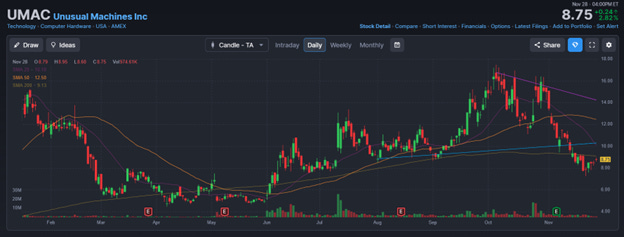
For an idea of how terrible things are, this chart is very helpful. It’s the stock price for Unusual Machines. Unusual Machines manufactures drones. Just after the election last November, President Trump’s son joined the company as an advisor and bought a lot of stock in the company. Donald Trump Jr. now owns over 300,000 shares, worth about $4 million.

This year, Unusual Machines won big contracts with the Pentagon to build drones for the Defense Department. So this is a stock that should have gone straight up, but instead is lower today than when Trump took over from Biden.

We shared before that the Defense Department has big plans for drones, and announced a big effort to “unleash US military drone dominance”. Soon after, Unusual Machines was awarded the contract to build drone motors for the Army, in drones used in recon and surveillance.

The Executive Order which Trump signed to build up the drone industry in the US repealed previous restrictions on where the technology needs to come from. And at the beginning, it was the removal of that restriction that goosed the shares of the companies that build the drones. Previously, strict regulations prevented the Pentagon from buying drones and parts made by Chinese companies. That restriction went away with Trump’s Executive Order, and that paved the way for Unusual Machines to bid on the new contracts to provide drones, because Unusual Machines sourced their motors from China.

The Blue UAS program maintains a list of companies that are allowed to be used by the Pentagon. Suddenly the list now includes drone parts built by companies in adversarial companies, and most of the drone systems that have been cleared for Pentagon use are sourced in China.

Naturally defense officials have mixed opinions about all that. One anonymous former official says that Chinese components are everywhere now in Pentagon drones, the motors, the batteries, and the speed controllers. He remembers fondly the days of a few years ago when nobody thought about raw materials, rare earth metals, or where parts come from. Now everyone knows all those things come from China. He goes on to worry that the Chinese may be building backdoors or geofences into their batteries, or something.

Most experts understand though that there is no real vulnerability to any of that—it’s just another example that China owns the supply chain for yet another thing the Pentagon wants to build. Simple components don’t create a high risk of exploitation; the real problem is that the economics don’t work for American companies to bother building them. A drone requires four motors. Chinese motors cost $12 to $25. American drone motors cost $100 to $200. So the cost of the motors for a simple, cheap drone will cost $48 bucks if using made-in-China motors, verses $400 if you want them built in the US.

Here’s another official’s take on the supply chain problem: if a hot war kicks off, sea lanes cut off, supply lines shut down, we’re not going to have access to those motors. ‘Sourcing drone parts from China is a bad strategy.” He’s worried here, that a shooting war with China will lead right away to an economic embargo, and naval blockades. If that happens, nobody is going to care—including him—about when the next shipment of cheap drone motors might get here from Shenzhen. It will be the last thing anyone cares about. During COVID Americans were fighting over toilet paper. Balloon goes up against the Chinese, and nothing is coming in, from anywhere.

So for now, there’s no getting around the China problem. And because the motors are so cheap, and simple, there’s not much the US government can do to change the situation. And the motors are just the first problem—the glass for the cameras that go into drones are made in China. Go through a bill of materials for any drone, and you’ll find a dozen parts that need a Chinese company to build them affordably, and on time. The Pentagon needs lots of new drones from wherever they can, and Unusual Machines and the other drone companies are happy to get the parts from wherever they can. President Trump signed the Executive Order that allowed Chinese drone parts makers to go on the UAS list, and that led right away to big contracts for the drone makers who get their parts from China.

For their part, Unusual Machines insists that the contract award had nothing whatsoever to do with the fact that the President’s son is now on their board, and it’s also just an amazing coincidence that he screened candidates for top jobs at the Defense Department, and pushed forward those who promised to invest in drones.

Besides Unusual Machines, Trump Jr. is an executive with a VC firm with investments in other companies—Firehawk Aerospace, Space X, and Anduril, and all of those have won big Pentagon contracts.

So on paper, everything should be great for these companies. They are very well politically connected; they were awarded big money-no-object contracts from the Pentagon, who spends more on weapons than the next ten countries combined. The Trump administration even changed the rules and now they are allowed to buy cheap parts from China, put them together, and slap their own company’s name on the side and pretend they’re “unleashing US drone dominance”. The companies are even going global: Unusual Machines is in partnership with a company in Puerto Rico to build a fleet of unmanned aircraft carriers, autonomous drones, anti-aircraft missiles and torpedoes.

And Anduril, another company in that portfolio, just contracted with Rheinmetall to build defense systems for Europe. Anduril’s Barracuda missiles and Fury drones will be developed, and new assembly lines in Europe for solid rocket motors, with a lot more projects on the way.

But instead of a vertical line that makes it look like the next Google, the stock is crashing and burning. And that’s because the drones themselves are. Shifting now to Anduril, recently conducting a big test with the US Navy: It was a launch and recovery test of 30 drone boats off California, and about half of them shut off automatically, and were dead in the water. That posed a navigation hazard to everything else floating nearby, so the Navy raced out to gather them up. In the report, the Navy ops guys said that the “company representatives misguided the military.”

That’s a bureaucratic way of saying they were lied to, we should think. Four sailors warned about chronic security and safety problems, and “performer misguidances”. Without urgent changes the Anduril drones pose an “extreme risk to force and potential for” guys getting killed.

The company’s software program, called Lattice, is sold to the Pentagon as a force integrator, allowing for multiple weapons to be deployed and handled by a single operator. But the system doesn’t work. In the case of the California drone test, the boats rejected commands and failed to navigate away from non-targets, so they had to shut the system down. Anduril says the fault was with the boats, which are builtby a different company, but that company said they integrate other software with no problem, and the Navy crews at the exercise says it’s on Anduril to make sure the software works before they give it to the Navy in the first place.

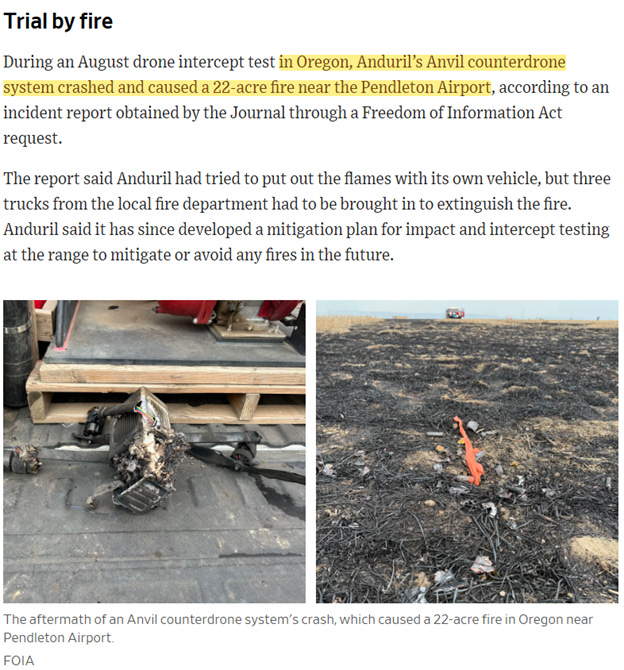
Another test in California, this time for the Fury jet. It had to be delayed by debris that caused engine damage. Up in Oregon, the company’s counterdrone system literally crashed and burned, causing a large fire there:

In another previous test, the drones performed so badly the testers themselves feared for their lives.

The company is privately held, and is worth $30 billion after racking up a bunch of contracts awards for the Fury jets and other systems. But their battlefield experience for their drones has been poor. They were used in Ukraine, briefly, but Anduril’s drones there were vulnerable to jamming. The Ukrainian operators gave up using them at all, because they kept missing their targets and blowing up stuff they weren’t supposed to.

Apparently, this industry is a lot more difficult, than simply buying some cheap parts from the Chinese and putting them into the air. We asked the question over a year ago. How bad must the American drones be, that the Ukrainians refuse to use them even though they’re free? What that can only mean, is that they have a negative utility on the battlefield. For soldiers in the field, it’s more risky for them to use the drones built by these companies, than just going without.

And another question that we like to ask, is just what exactly Anduril does, that’s worth a valuation of $30 billion, if they can’t even give their equipment away to guys in the fight right now, and if our own US Navy operators accuse the company of lying to them?

Be Good.

The Pentagon is desperate to catch up to China and Russia, and has announced ambitious plans to "unleash US drone dominance."

But the Trump Administration's Executive Orders to advance drone manufacturing in the United States ironically repealed previous restrictions on Chinese components in US military drones.

The removal of those restrictions were a boon to drone companies that source parts from China. That includes Unusual Machines, a company with Donald Trump, Jr. as a key investor and board member.

The President's son has other investments in drone companies, who have also been awarded large Pentagon contracts. Anduril now carries a private valuation of over $30 billion.

But the performance of the drones themselves is poor, in testing with the US military, and under battlefield conditions in Ukraine. The US Navy and Air Force accuse the companies of "misguiding" them, and operators in Ukraine refuse to deploy US drones at all, even though they're free.

Be good.

Resources and links:

Pentagon’s growing list of ‘made in America’ drones has a loophole for certain parts made in China
https://defensescoop.com/2025/11/20/dod-drones-blue-uas-list-chinese-parts-motors

The Pentagon wants to build millions of drones without Chinese parts. It's off to a bad start.

Hegseth To 'Unleash' U.S. Drone Dominance. These Stocks Surge.
https://www.investors.com/news/drones-hegseth-pentagon-department-of-defense-ktos-avav-defense-stocks/

‘We Do Fail … a Lot’: Defense Startup Anduril Hits Setbacks With Weapons Tech
https://www.wsj.com/wsjplus/dashboard/articles/anduril-industries-defense-tech-problems-52b90cae

Forbes, Donald Trump Jr.’s Expanding Business: After Joining 2nd New Board, U.S. Contracts Followed
https://www.forbes.com/sites/zacheverson/2025/10/29/donald-trump-jr-ultimate-machines-defense-contracts-drones/

IBD, Trump Jr.-Linked Firm Rallies On Pentagon Wins, Unmanned Carrier Efforts
https://www.investors.com/news/unusual-machines-drones-donald-trump-jr-red-cat-unmanned-carriers-umac-stock-kratos/

Rheinmetall, Anduril Team Up to Jointly Produce Defense Systems for Europe
https://www.wsj.com/world/europe/rheinmetall-anduril-team-up-to-jointly-produce-defense-systems-for-europe-07e08b90

Ukraine, Israel buying Chinese civilian drones for combat use; shun US military-grade drones

The Pentagon wants to build millions of drones without Chinese parts. It's off to a bad start.

Reuters Exclusive: US defense firm Anduril faces setbacks from drone crashes
https://www.reuters.com/business/aerospace-defense/us-defense-firm-anduril-faces-setbacks-drone-crashes-2025-11-27/

Ukraine, Israel buying Chinese civilian drones for combat use; shun US military-grade drones.

Inside China / Business is a reader-supported publication. To receive new posts and support my work, consider becoming a free or paid subscriber.


From Inside China / Business via This RSS Feed.


US forces stop another oil tanker off the coast of Venezuela, marking the second such operation in less than two weeks.


From Presstv via This RSS Feed.


Stand-alone flagship stores with distinctive architectural facades, long prevalent in global metropolises like Tokyo, Seoul and New York, are gradually gaining traction in China, as the country’s retail landscape undergoes a broader shift from enclosed malls towards open-air and street-facing formats. More luxury brands are setting up such flagships in places like Beijing’s Taikoo Li Sanlitun North, a trendy open-air commercial block developed and operated by Hong Kong’s Swire...


From China - South China Morning Post via This RSS Feed.


Chinese archaeologists unearthing the ruins of the earliest known settlement in the Yangtze River Delta say water management may have been the origin of ancient “cities” in the area. Researchers began large-scale excavations of the Doushan site in Wuxi in the eastern province of Jiangsu in July last year, dating the city to about 6,000 years ago. Previously, the oldest urban site in the delta area was the Liangzhu culture site near Hangzhou in Zhejiang province, dating back about 5,300...


From China - South China Morning Post via This RSS Feed.


China has boosted its armour steel production speed by 30 per cent with continuous investment in tech upgrades, while a major American steelmaker that provided military-grade steel for tanks, ships and mine-resistant vehicles ceased operation for financial reasons. Chinese military supplier Inner Mongolia First Machinery Group said it had solved key technical challenges to allow large-scale production of high-performance armour steel, which has been deployed for manufacturing tanks and armoured...


From China - South China Morning Post via This RSS Feed.


Reading by Tim Foley:

Subscribe now

You are allowed to subvert and undermine Israel’s interests, because Israel is trying to subvert and undermine your rights.

You are allowed to interfere in Israel’s affairs, because Israel is interfering in your country’s affairs.

As Israel tries to exert more and more influence over western society and pushes western governments to crush our freedom of speech and assembly, we should be doing everything we can to make sure that western society turns against Israel, and that western governments alienate this freakish apartheid state on the world stage.

And we should feel perfectly entitled in doing so, because Israel certainly feels comfortable coming after us and our rights.

If Israel is going after us, then we get to go after Israel. It’s just basic self-defense at this point.

The Israeli embassy in the UK has issued a press statement taking credit for British police arresting protesters who made public calls to “globalize the intifada,” saying the following:

“The Embassy of Israel in the United Kingdom welcomes the joint announcement by the Metropolitan Police and Greater Manchester Police forces that they will arrest people promoting the phrase ‘globalise the intifada’.

“As Israel and the Jewish community have been saying for years, calling to ‘globalise the intifada’ is clearly incitement to violence, and a direct line can be drawn between these antisemitic chants and the acts of terror that we have seen against Jewish people worldwide.

“It is disappointing it has taken such a long time for British authorities to recognise this and it should not have been on the Jewish community to plead with the authorities to take these threats seriously, only being done so after more Jews have been killed.

“However, we now hope that real action is now taken to stop this chant before it can lead to further radicalisation and violence against Jews.”

As we have discussed previously, there is nothing murderous or hateful about calling for worldwide resistance to a genocidal apartheid state and the empire that backs it, which is all people are advocating when they call for global intifada. Anyone who claims it’s a call to murder Jewish civilians like we saw last week in Sydney is lying, and is doing so in order to manufacture consent for authoritarian suppression of speech that is critical of Israel.

But we are seeing Israel and its propagandistic defenders in the western political/media class asserting in unison the ridiculous narrative that “globalize the intifada” means “kill all Jews throughout the world”. They are doing this to press governments to crush our civil rights. It is a direct attack on all of us. It’s personal.

Benjamin Netanyahu just appeared on the Murdoch-owned Sky News Australia to finger-wag at Prime Minister Anthony Albanese for failing to stomp out anti-genocide protests, which he called “antisemitic incitement”.

“You have to be prepared also to stop these hate marches,” Netanyahu told Murdoch muppet Sharri Markson. “Democracy and freedom is not the freedom to, what is it? The freedom to shout ‘fire’ in a crowded theater. It’s not the freedom to say ‘kill all the Jews’. It’s not. But that’s effectively what the government of Australia has allowed, and that was bound to reach these tragic outcomes just as I warned Prime Minister Albanese.”

This happens as the Australian Israel lobby gets increasingly explicit about wanting to ban criticism of Israel and stop pro-Palestinian protests throughout the country, and as New South Wales moves to bow to each of these demands with a ban on the phrase “globalise the intifada” and a three-month ban on pro-Palestine protests following the Bondi shooting.

If Israel is working to subvert and undermine the rights of Australians, then Australians are entitled to subvert and undermine the interests of Israel. We should be opposing Israel MORE aggressively as its officials ramp up efforts to push our government to crush our rights, not less. We should be openly and unapologetically working to collapse Canberra’s support for the Zionist entity.

And the same goes for Americans. On top of all the other egregious lobbying efforts and manipulations, the government of Israel is pouring millions of dollars into propaganda operations targeting US churches and Christian organizations in an effort to recapture their wavering conservative Christian base. You can literally be sitting in your own church in your own neighborhood, minding your own business without a screen in sight, and suddenly find yourself getting throat fucked by state propaganda paid for by the Israeli government.

Netanyahu has been taking aim at western governments as a whole, arrogantly issuing “demands” from western states that they do more to shut down anti-genocide protests and protect the information interests of Israel, framing it not as a plea but as a “warning”.

“I demand that Western governments do what is necessary to fight antisemitism and provide the required safety and security for Jewish communities worldwide. They would be well-advised to heed our warnings. I demand action from them — now,” Netanyahu said in a recent statement.

This is not something westerners need to take lying down. If Israel is trying to subvert and undermine our civil liberties in order to force our society to support genocide and apartheid, then we have every right to do everything we can to subvert and undermine the interests of Israel. They’re attacking our interests, so we get to attack theirs.

Our position should be one of outright hostility and aggression toward the Zionist state, and we should feel completely comfortable and entitled in this position. They’ll call us names and say our governments should silence us, but that’s just them proving that our position is correct. The west’s support for Israel needs to be brought crashing down.

Make it politically toxic to support Israel, or to have any connection to its lobbyists. Make alignment with Israel a career-ending mistake for celebrities. Do everything you can to weaken support for Israel among the western public, sharing as much information and thought on its criminality as you can. Do this completely unabashedly and unapologetically. Israel is coming after you, so you get to go after Israel.

Turn about is fair play. These freaks don’t get to stomp out our rights and poison our society for the advancement of the most evil agendas in the world and then expect zero resistance or opposition to this. That is not a thing.

________________

Caitlin’s Newsletter is a reader-supported publication. To receive new posts and support my work, consider becoming a free or paid subscriber.

My work is entirely reader-supported, so if you enjoyed this piece here are some options where you can toss some money into my tip jar if you want to. The best way to make sure you see everything I write is to get on my free mailing list. Click here for links for my social media, books, merch, and audio/video versions of each article. All my work is free to bootleg and use in any way, shape or form; republish it, translate it, use it on merchandise; whatever you want. All works co-authored with my husband Tim Foley.

Bitcoin donations: 1Ac7PCQXoQoLA9Sh8fhAgiU3PHA2EX5Zm2

Feature image via Israeli PM on Youtube (public domain).


From Caitlin’s Newsletter via This RSS Feed.


Ninety years ago, on December 18, 1935, a handful of young people came together to establish the Lanka Sama Samaja Party (LSSP) in Sri Lanka (then Ceylon). Leslie Goonewardena, general secretary of the LSSP from 1935 to 1977, later wrote that the party was founded because “there was a void to be filled”.

On the one hand, the conservative Ceylon National Congress (founded in 1919), composed of local elites with economic interests that overlapped with the colonial administration, was failing to push forward the agenda of national liberation—they preferred to settle for piecemeal reforms and dominion status over complete independence. On the other hand, the social democratic Ceylon Labour Party (founded in 1922), led by trade unionist A. E. Gunasinghe, was playing an increasingly collaborationist and communal role in the working-class movement, having come under the pacifying influence of the British Labour Party.

The young founders of the LSSP stepped into this political void during the height of the 1930s depression, which had caused great immiseration due to the reduction in prices of Ceylon’s export crops. The party’s first manifesto identified a series of goals that are as straightforward as they are ambitious:

First, achieve complete national independence. Second, nationalize the means of production, distribution, and exchange; and third, abolish inequality arising from differences of race, caste, creed, or sex. The LSSP’s founding aspirations were essentially for national sovereignty and the dignity of the working people of Sri Lanka.

Pre-history of the LSSP

Writing in 1945, LSSP co-founder S. A. Wickramasinghe recalled that “it all began on a misty cold day at the Indian Student Hostel in Bloomsbury, London”, where he met with fellow Ceylonese students Colvin R. De Silva, Philip Gunawardena, N. M. Perera, and Leslie Goonewardena. This group, which went on to form the core leadership of the LSSP, “were all appalled by the backwardness of Ceylon’s leaders, and at their smug complacency and self-satisfaction.” Their discussions were helped along by Shapurji Dorabji Saklatvala, an Indian Parsi who was Britain’s first communist member of Parliament. Wickramasinghe recalled that they were “tremendously impressed and inspired by the example of the Soviet Union” and “resolved that we must return to Ceylon to work for independence and socialism.”

At the time of the LSSP’s founding, the core membership was under 40 years old. Wickramasinghe was 35, then there was Philip Gunawardena (34), Colvin R. De Silva (32), N. M. Perea (30), and Goonewardene (26). But it would be a mistake to think that the LSSP was merely the product of a handful of young, idealistic, Western-educated radicals. These individuals were themselves shaped by the class struggles of the time.

In the late 19th century, the first manifestations of modern anti-colonialism took the form of the Buddhist revival movement. The activities of Buddhist monks like Migettuwatte Gunananda Thera and Hikkaduwe Sri Sumangala Thera attracted Western theosophists like Colonel Henry Steel Olcott. The Buddhist revivalist movement led to the foundation of Buddhist-oriented “Olcott schools” which challenged the monopoly of Christianized education. Wickramasinghe, De Silva, Gunawardena, and Perera were products of these schools.

In the 1920s and 1930s, Youth Leagues inspired by the Indian freedom movement’s call for Purna Swaraj (complete independence) sprang up in Ceylon, first in the northern city of Jaffna and then across the entire country. These organizations drew in young patriots and socialists dissatisfied with the conservatism of the Ceylonese elites who were deeply integrated into the colonial Planter Raj (a term used to describe the total political and economic domination of the plantation owners). During the 1930s, these youth leagues participated in a range of political activities that gradually took on a mass character.

In 1933, the members of the youth leagues stepped in to support striking workers at the Wellawatte Spinning and Weaving Mills when the existing union leadership sought to demobilize the workers. Youth league activists organized meetings and raised funds for the strikers, eventually creating a new union under their more radical leadership. These strikes were among the young socialists’ first experiences in organizing the working class. In the process, they also had their first confrontations against communalism, as the conservative union leaders attempted to disrupt the strikes by introducing backlegs along ethnic lines.

Also in 1933, youth league activists began to point out the hypocrisy of the colonial government using Ceylonese school children to sell poppy flowers to raise funds for British ex-servicemen. This led to the Suriya-Mal Movement, where activists sold local portia flowers (suriya-mal in Sinhala) to raise funds for Ceylonese ex-servicemen. These funds were also used to finance the education of children of oppressed castes, thereby combining the anti-imperialist struggle with the fight for democratizing society. The Suriya-Mal Movement spilled over into the malaria epidemic which ravaged the Ceylonese countryside in 1934-1935, revealing the colonial administration’s neglect of the rural masses. Many youth league members led relief works, using their own personal wealth and skills to set up rural dispensaries and making connections with the peasantry in this process.

The Buddhist revival, the Youth Leagues, the Wellawatte Spinning and Weaving Mills strikes, the Suriya-Mal Movement, and the malaria relief campaigns were part of the conjuncture that produced the LSSP. The experiences gained in these movements, and the connections made across the country’s geography and social classes, led to the necessity of a unifying political party to take the struggles for sovereignty and dignity forward.

Socialism and Sri Lankan Society

Despite numerous splits, the socialist movement embedded itself in Sri Lankan society and made a lasting impact on the polity. Had they been united, the socialists would have comprised the single largest bloc in Sri Lanka’s first post-independence parliament. The movement would go on to influence a range of progressive reforms, including the expulsion of British military bases, the nationalization of the plantations, and the formulation of the country’s first republican constitution in 1972.

Sri Lanka today is one of two countries to contain the word “socialist” in its full name—the Democratic Socialist Republic of Sri Lanka (the other country is the Socialist Republic of Vietnam). Ironically, the word “socialist” was entered into the constitution formulated under the right-wing President J. R. Jayawardena, who, while bringing in neoliberal reforms, still understood the broad appeal of socialist ideals.

According to a survey conducted between 2022 and 2023 (when Sri Lanka was in the throes of an economic crisis), 49% of Sri Lankans viewed socialism favorably, while only 22% felt the same about capitalism. Anothersurvey, conducted in 2022, found that privatization of healthcare and education was opposed by 52% and 54% of people, respectively. In fact, Sri Lanka is one of the few countries in Asia which provides free education and healthcare and is known to have social indicators above what is expected for its per capita GDP. Socialist ideals remain hardcoded in Sri Lanka’s social contract, even as the socialist movement itself is at an ebb tide.

The past decades of neoliberalism and austerity have made the original aspirations of Sri Lanka’s socialist movement more relevant and urgent than ever before. In the last decade, Sri Lanka’s people have been put through the grinder: the 2019 Easter bombings, the COVID-19 pandemic, the 2022 balance of payments crisis and sovereign default, and Cyclone Ditwah have peeled away layer after layer of Sri Lanka’s social fabric. Since 2019, the number of people in extreme poverty has doubled. Debt devours the national budget and the IMF circumscribes the possibilities of economic policy. Meanwhile, the country’s industrialization has stalled, pushing millions to migrate in search of employment.

The dilution of partisanship between the two mainstream political poles (the center-left UNP and its spinoff, the SJB, and the center-left SLFP and its spinoff, the SLPP) has once again created a political vacuum akin to the 1930s—a vacuum which the ruling NPP was able to exploit in 2019. Years of political horse-trading and opportunistic alliances have eroded confidence in the political establishment. But for the left, the challenge is not only to turn social discontent into political power but also to advance an actionable program towards economic development. Standing up to the creditors and the IMF, rebuilding state capacity and social protection, and repressing domestic merchant and financial capital in order to industrialize – these are some of the immediate tasks that the Sri Lankan socialist movement must provide a program for today.

Shiran Illanperuma is a Sri Lankan journalist and political economist. He is a researcher at Tricontinental: Institute for Social Research and a co-editor of Wenhua Zongheng: A Journal of Contemporary Chinese Thought.

This article was produced by Globetrotter.

The post The 90th anniversary of Sri Lanka’s socialist movement appeared first on Peoples Dispatch.


From Peoples Dispatch via This RSS Feed.

view more: ‹ prev next ›