rss

joined 2 months ago
MODERATOR OF
 

Stand-alone flagship stores with distinctive architectural facades, long prevalent in global metropolises like Tokyo, Seoul and New York, are gradually gaining traction in China, as the country’s retail landscape undergoes a broader shift from enclosed malls towards open-air and street-facing formats. More luxury brands are setting up such flagships in places like Beijing’s Taikoo Li Sanlitun North, a trendy open-air commercial block developed and operated by Hong Kong’s Swire...


From China - South China Morning Post via This RSS Feed.


Chinese archaeologists unearthing the ruins of the earliest known settlement in the Yangtze River Delta say water management may have been the origin of ancient “cities” in the area. Researchers began large-scale excavations of the Doushan site in Wuxi in the eastern province of Jiangsu in July last year, dating the city to about 6,000 years ago. Previously, the oldest urban site in the delta area was the Liangzhu culture site near Hangzhou in Zhejiang province, dating back about 5,300...


From China - South China Morning Post via This RSS Feed.


China has boosted its armour steel production speed by 30 per cent with continuous investment in tech upgrades, while a major American steelmaker that provided military-grade steel for tanks, ships and mine-resistant vehicles ceased operation for financial reasons. Chinese military supplier Inner Mongolia First Machinery Group said it had solved key technical challenges to allow large-scale production of high-performance armour steel, which has been deployed for manufacturing tanks and armoured...


From China - South China Morning Post via This RSS Feed.


Reading by Tim Foley:

Subscribe now

You are allowed to subvert and undermine Israel’s interests, because Israel is trying to subvert and undermine your rights.

You are allowed to interfere in Israel’s affairs, because Israel is interfering in your country’s affairs.

As Israel tries to exert more and more influence over western society and pushes western governments to crush our freedom of speech and assembly, we should be doing everything we can to make sure that western society turns against Israel, and that western governments alienate this freakish apartheid state on the world stage.

And we should feel perfectly entitled in doing so, because Israel certainly feels comfortable coming after us and our rights.

If Israel is going after us, then we get to go after Israel. It’s just basic self-defense at this point.

The Israeli embassy in the UK has issued a press statement taking credit for British police arresting protesters who made public calls to “globalize the intifada,” saying the following:

“The Embassy of Israel in the United Kingdom welcomes the joint announcement by the Metropolitan Police and Greater Manchester Police forces that they will arrest people promoting the phrase ‘globalise the intifada’.

“As Israel and the Jewish community have been saying for years, calling to ‘globalise the intifada’ is clearly incitement to violence, and a direct line can be drawn between these antisemitic chants and the acts of terror that we have seen against Jewish people worldwide.

“It is disappointing it has taken such a long time for British authorities to recognise this and it should not have been on the Jewish community to plead with the authorities to take these threats seriously, only being done so after more Jews have been killed.

“However, we now hope that real action is now taken to stop this chant before it can lead to further radicalisation and violence against Jews.”

As we have discussed previously, there is nothing murderous or hateful about calling for worldwide resistance to a genocidal apartheid state and the empire that backs it, which is all people are advocating when they call for global intifada. Anyone who claims it’s a call to murder Jewish civilians like we saw last week in Sydney is lying, and is doing so in order to manufacture consent for authoritarian suppression of speech that is critical of Israel.

But we are seeing Israel and its propagandistic defenders in the western political/media class asserting in unison the ridiculous narrative that “globalize the intifada” means “kill all Jews throughout the world”. They are doing this to press governments to crush our civil rights. It is a direct attack on all of us. It’s personal.

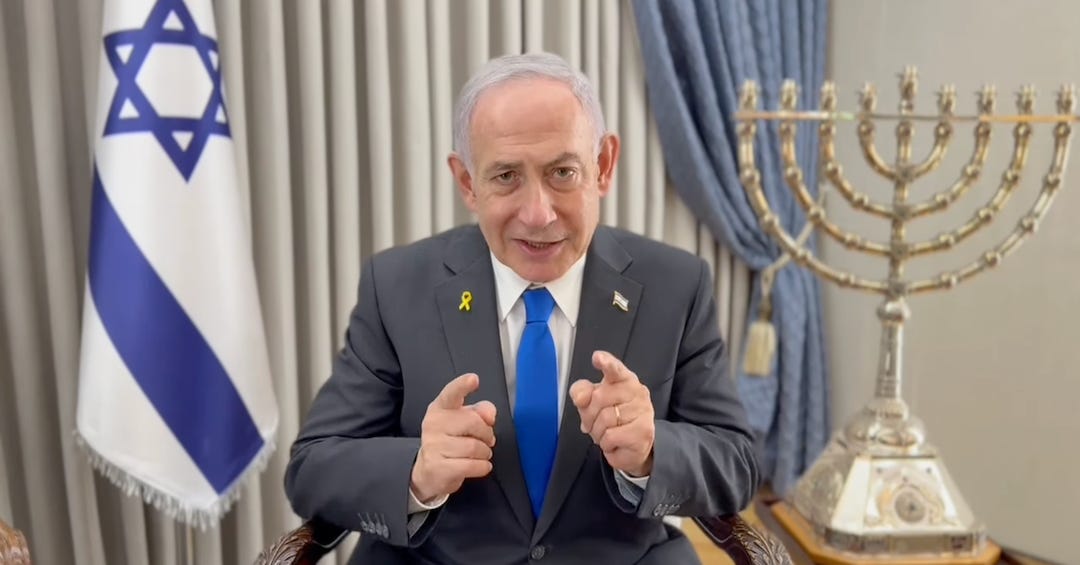
Benjamin Netanyahu just appeared on the Murdoch-owned Sky News Australia to finger-wag at Prime Minister Anthony Albanese for failing to stomp out anti-genocide protests, which he called “antisemitic incitement”.

“You have to be prepared also to stop these hate marches,” Netanyahu told Murdoch muppet Sharri Markson. “Democracy and freedom is not the freedom to, what is it? The freedom to shout ‘fire’ in a crowded theater. It’s not the freedom to say ‘kill all the Jews’. It’s not. But that’s effectively what the government of Australia has allowed, and that was bound to reach these tragic outcomes just as I warned Prime Minister Albanese.”

This happens as the Australian Israel lobby gets increasingly explicit about wanting to ban criticism of Israel and stop pro-Palestinian protests throughout the country, and as New South Wales moves to bow to each of these demands with a ban on the phrase “globalise the intifada” and a three-month ban on pro-Palestine protests following the Bondi shooting.

If Israel is working to subvert and undermine the rights of Australians, then Australians are entitled to subvert and undermine the interests of Israel. We should be opposing Israel MORE aggressively as its officials ramp up efforts to push our government to crush our rights, not less. We should be openly and unapologetically working to collapse Canberra’s support for the Zionist entity.

And the same goes for Americans. On top of all the other egregious lobbying efforts and manipulations, the government of Israel is pouring millions of dollars into propaganda operations targeting US churches and Christian organizations in an effort to recapture their wavering conservative Christian base. You can literally be sitting in your own church in your own neighborhood, minding your own business without a screen in sight, and suddenly find yourself getting throat fucked by state propaganda paid for by the Israeli government.

Netanyahu has been taking aim at western governments as a whole, arrogantly issuing “demands” from western states that they do more to shut down anti-genocide protests and protect the information interests of Israel, framing it not as a plea but as a “warning”.

“I demand that Western governments do what is necessary to fight antisemitism and provide the required safety and security for Jewish communities worldwide. They would be well-advised to heed our warnings. I demand action from them — now,” Netanyahu said in a recent statement.

This is not something westerners need to take lying down. If Israel is trying to subvert and undermine our civil liberties in order to force our society to support genocide and apartheid, then we have every right to do everything we can to subvert and undermine the interests of Israel. They’re attacking our interests, so we get to attack theirs.

Our position should be one of outright hostility and aggression toward the Zionist state, and we should feel completely comfortable and entitled in this position. They’ll call us names and say our governments should silence us, but that’s just them proving that our position is correct. The west’s support for Israel needs to be brought crashing down.

Make it politically toxic to support Israel, or to have any connection to its lobbyists. Make alignment with Israel a career-ending mistake for celebrities. Do everything you can to weaken support for Israel among the western public, sharing as much information and thought on its criminality as you can. Do this completely unabashedly and unapologetically. Israel is coming after you, so you get to go after Israel.

Turn about is fair play. These freaks don’t get to stomp out our rights and poison our society for the advancement of the most evil agendas in the world and then expect zero resistance or opposition to this. That is not a thing.

________________

Caitlin’s Newsletter is a reader-supported publication. To receive new posts and support my work, consider becoming a free or paid subscriber.

My work is entirely reader-supported, so if you enjoyed this piece here are some options where you can toss some money into my tip jar if you want to. The best way to make sure you see everything I write is to get on my free mailing list. Click here for links for my social media, books, merch, and audio/video versions of each article. All my work is free to bootleg and use in any way, shape or form; republish it, translate it, use it on merchandise; whatever you want. All works co-authored with my husband Tim Foley.

Bitcoin donations: 1Ac7PCQXoQoLA9Sh8fhAgiU3PHA2EX5Zm2

Feature image via Israeli PM on Youtube (public domain).


From Caitlin’s Newsletter via This RSS Feed.


Ninety years ago, on December 18, 1935, a handful of young people came together to establish the Lanka Sama Samaja Party (LSSP) in Sri Lanka (then Ceylon). Leslie Goonewardena, general secretary of the LSSP from 1935 to 1977, later wrote that the party was founded because “there was a void to be filled”.

On the one hand, the conservative Ceylon National Congress (founded in 1919), composed of local elites with economic interests that overlapped with the colonial administration, was failing to push forward the agenda of national liberation—they preferred to settle for piecemeal reforms and dominion status over complete independence. On the other hand, the social democratic Ceylon Labour Party (founded in 1922), led by trade unionist A. E. Gunasinghe, was playing an increasingly collaborationist and communal role in the working-class movement, having come under the pacifying influence of the British Labour Party.

The young founders of the LSSP stepped into this political void during the height of the 1930s depression, which had caused great immiseration due to the reduction in prices of Ceylon’s export crops. The party’s first manifesto identified a series of goals that are as straightforward as they are ambitious:

First, achieve complete national independence. Second, nationalize the means of production, distribution, and exchange; and third, abolish inequality arising from differences of race, caste, creed, or sex. The LSSP’s founding aspirations were essentially for national sovereignty and the dignity of the working people of Sri Lanka.

Pre-history of the LSSP

Writing in 1945, LSSP co-founder S. A. Wickramasinghe recalled that “it all began on a misty cold day at the Indian Student Hostel in Bloomsbury, London”, where he met with fellow Ceylonese students Colvin R. De Silva, Philip Gunawardena, N. M. Perera, and Leslie Goonewardena. This group, which went on to form the core leadership of the LSSP, “were all appalled by the backwardness of Ceylon’s leaders, and at their smug complacency and self-satisfaction.” Their discussions were helped along by Shapurji Dorabji Saklatvala, an Indian Parsi who was Britain’s first communist member of Parliament. Wickramasinghe recalled that they were “tremendously impressed and inspired by the example of the Soviet Union” and “resolved that we must return to Ceylon to work for independence and socialism.”

At the time of the LSSP’s founding, the core membership was under 40 years old. Wickramasinghe was 35, then there was Philip Gunawardena (34), Colvin R. De Silva (32), N. M. Perea (30), and Goonewardene (26). But it would be a mistake to think that the LSSP was merely the product of a handful of young, idealistic, Western-educated radicals. These individuals were themselves shaped by the class struggles of the time.

In the late 19th century, the first manifestations of modern anti-colonialism took the form of the Buddhist revival movement. The activities of Buddhist monks like Migettuwatte Gunananda Thera and Hikkaduwe Sri Sumangala Thera attracted Western theosophists like Colonel Henry Steel Olcott. The Buddhist revivalist movement led to the foundation of Buddhist-oriented “Olcott schools” which challenged the monopoly of Christianized education. Wickramasinghe, De Silva, Gunawardena, and Perera were products of these schools.

In the 1920s and 1930s, Youth Leagues inspired by the Indian freedom movement’s call for Purna Swaraj (complete independence) sprang up in Ceylon, first in the northern city of Jaffna and then across the entire country. These organizations drew in young patriots and socialists dissatisfied with the conservatism of the Ceylonese elites who were deeply integrated into the colonial Planter Raj (a term used to describe the total political and economic domination of the plantation owners). During the 1930s, these youth leagues participated in a range of political activities that gradually took on a mass character.

In 1933, the members of the youth leagues stepped in to support striking workers at the Wellawatte Spinning and Weaving Mills when the existing union leadership sought to demobilize the workers. Youth league activists organized meetings and raised funds for the strikers, eventually creating a new union under their more radical leadership. These strikes were among the young socialists’ first experiences in organizing the working class. In the process, they also had their first confrontations against communalism, as the conservative union leaders attempted to disrupt the strikes by introducing backlegs along ethnic lines.

Also in 1933, youth league activists began to point out the hypocrisy of the colonial government using Ceylonese school children to sell poppy flowers to raise funds for British ex-servicemen. This led to the Suriya-Mal Movement, where activists sold local portia flowers (suriya-mal in Sinhala) to raise funds for Ceylonese ex-servicemen. These funds were also used to finance the education of children of oppressed castes, thereby combining the anti-imperialist struggle with the fight for democratizing society. The Suriya-Mal Movement spilled over into the malaria epidemic which ravaged the Ceylonese countryside in 1934-1935, revealing the colonial administration’s neglect of the rural masses. Many youth league members led relief works, using their own personal wealth and skills to set up rural dispensaries and making connections with the peasantry in this process.

The Buddhist revival, the Youth Leagues, the Wellawatte Spinning and Weaving Mills strikes, the Suriya-Mal Movement, and the malaria relief campaigns were part of the conjuncture that produced the LSSP. The experiences gained in these movements, and the connections made across the country’s geography and social classes, led to the necessity of a unifying political party to take the struggles for sovereignty and dignity forward.

Socialism and Sri Lankan Society

Despite numerous splits, the socialist movement embedded itself in Sri Lankan society and made a lasting impact on the polity. Had they been united, the socialists would have comprised the single largest bloc in Sri Lanka’s first post-independence parliament. The movement would go on to influence a range of progressive reforms, including the expulsion of British military bases, the nationalization of the plantations, and the formulation of the country’s first republican constitution in 1972.

Sri Lanka today is one of two countries to contain the word “socialist” in its full name—the Democratic Socialist Republic of Sri Lanka (the other country is the Socialist Republic of Vietnam). Ironically, the word “socialist” was entered into the constitution formulated under the right-wing President J. R. Jayawardena, who, while bringing in neoliberal reforms, still understood the broad appeal of socialist ideals.

According to a survey conducted between 2022 and 2023 (when Sri Lanka was in the throes of an economic crisis), 49% of Sri Lankans viewed socialism favorably, while only 22% felt the same about capitalism. Anothersurvey, conducted in 2022, found that privatization of healthcare and education was opposed by 52% and 54% of people, respectively. In fact, Sri Lanka is one of the few countries in Asia which provides free education and healthcare and is known to have social indicators above what is expected for its per capita GDP. Socialist ideals remain hardcoded in Sri Lanka’s social contract, even as the socialist movement itself is at an ebb tide.

The past decades of neoliberalism and austerity have made the original aspirations of Sri Lanka’s socialist movement more relevant and urgent than ever before. In the last decade, Sri Lanka’s people have been put through the grinder: the 2019 Easter bombings, the COVID-19 pandemic, the 2022 balance of payments crisis and sovereign default, and Cyclone Ditwah have peeled away layer after layer of Sri Lanka’s social fabric. Since 2019, the number of people in extreme poverty has doubled. Debt devours the national budget and the IMF circumscribes the possibilities of economic policy. Meanwhile, the country’s industrialization has stalled, pushing millions to migrate in search of employment.

The dilution of partisanship between the two mainstream political poles (the center-left UNP and its spinoff, the SJB, and the center-left SLFP and its spinoff, the SLPP) has once again created a political vacuum akin to the 1930s—a vacuum which the ruling NPP was able to exploit in 2019. Years of political horse-trading and opportunistic alliances have eroded confidence in the political establishment. But for the left, the challenge is not only to turn social discontent into political power but also to advance an actionable program towards economic development. Standing up to the creditors and the IMF, rebuilding state capacity and social protection, and repressing domestic merchant and financial capital in order to industrialize – these are some of the immediate tasks that the Sri Lankan socialist movement must provide a program for today.

Shiran Illanperuma is a Sri Lankan journalist and political economist. He is a researcher at Tricontinental: Institute for Social Research and a co-editor of Wenhua Zongheng: A Journal of Contemporary Chinese Thought.

This article was produced by Globetrotter.

The post The 90th anniversary of Sri Lanka’s socialist movement appeared first on Peoples Dispatch.


From Peoples Dispatch via This RSS Feed.


Left and communist parties across Asia issued a statement expressing solidarity with the people of Venezuela, who are facing unprecedented attacks from the United States with an aggressive military build up in the Caribbean, as well as open threats of invasion.

The statement, dated December 16, notes the concerns over ongoing “military escalation in the Caribbean and the aggression against Venezuela by the imperialist US” and demands the immediate cessation of all such hostile activities.

The statement was signed by the Communist Party of India (Marxist-Leninist) Liberation, the Socialist Party of Malaysia (PSM), the Party of the Laboring Masses of Philippines (PLM), and Indonesia’s Partai Pembebasan Rakyat.

The US deployed a large contingent of war ships in the Caribbean starting in August this year and has amassed over 15,000 military personnel. President Donald Trump claims it to be the largest naval mobilization in the region ever. This was purportedly to fight alleged drug trafficking from the region.

The US has threatened war with Venezuela, accusing its government, led by President Nicolás Maduro, of supporting the drug cartels.

US forces have killed several Venezuelan citizens by attacking and blowing up several boats, claiming them to be drug traffickers. The US has failed to provide any evidence for all its accusations against the Maduro government or the targeted boats.

Last week, the US illegally seized a large tanker carrying oil from Venezuela to Cuba, which several people have called an act of piracy.

Trump also announced a naval blockade of Venezuela earlier this week, saying no sanctioned ships would be allowed to sail from its coast.

“We strongly condemn the US military deployment in the Caribbean and its military build up and operations in the Caribbean Sea, blowing up boats and resulting in extrajudicial killings,” the statement says.

“The military build-up in the Caribbean under the pretext of combating drug trafficking and ‘narcoterrorists,’” the left parties claim, “is the latest attempt of the imperialist US to conduct a regime change operation in Venezuela.”

Venezuelan people’s right to sovereignty

The Maduro-led government in Venezuela has been targeted by the US with unilateral punitive measures (or sanctions) for years, although under different “justifications”. In the past decade, the US has justified such aggressive measures against Venezuela by accusing Maduro of being authoritarian, allegedly suppressing political opposition in the country and manipulating elections to stay in power, and most recently declaring that Maduro is the head of an international drug trafficking organization.

Such attacks and media campaigns have been consistently condemned by Caracas that has deemed them part of an attempt by the US to subvert Venezuela’s democratic process and install a government that is more subservient to US interests.

“The intention of the imperialist US is clear, which is to remove the current Venezuelan government led by Nicolás Maduro, to reverse the gains of the Bolivarian Revolution, and to restore the pro-US oligarchical rule in the country,” the joint statement underlines.

All this effort is made “in order to serve the geopolitical interests” of the imperialist power both in the region and beyond.

Read More: In Venezuela, we have not been invaded

Citing how the US illegally seized the Venezuelan super tanker last week, the statement accuses that “[the US] seizing Venezuela’s oil deposits, one of the largest in the world, is a critical consideration” of this.

Trump, on several occasions, referred to Venezuelan oil as significant for US interests, even while announcing the naval blockade. Trump claimed Venezuela’s oil belongs to the US and vowed to “take back” control over it through the present military maneuvers.

The Maduro government has defied American claims and threats and has resolved to resist what it calls the US attempts to recolonize Venezuela in every way possible.

The left parties in Asia also asserted that “the people of Venezuela have every right to defend their sovereignty and to determine their own path of development, without any intervention from foreign imperialist powers.”

The post Left parties in Asia denounce US military threats against Venezuela appeared first on Peoples Dispatch.


From Peoples Dispatch via This RSS Feed.


The Israeli regime appears to be laying the groundwork for a permanent military presence in large parts of the Gaza Strip, according to a new satellite imagery analysis.


From Presstv via This RSS Feed.


Alas-5 ng madaling araw noong Disyembre 13, 2025, kinubkob ng tropa ng 2nd Infantry Battalion Philippine Army sa pamumuno ni 2nd Lt. Reynaldo G. Taladua, ang bahay na pansamantalang pinagpahingahan ng yunit ng pulang Hukbo sa barangay Pitogo, Cataingan. Unang nakapamutok ang mga pulang Hukbo na nagresulta sa pagkamatay ng dalawang tropa ng militar, isa na rito si 2nd Lt. Taladua habang may inako ring isang sugatan ang hanay ng mga militar.

Sa gitna ng palitan ng putok, tinamaan sa kanyang paa si kasamang Mil. Buhay siya nang mahuli ng mga berdugong tropa ng 2nd IB subalit dahil sa galit na napatay ang kanilang upisyal ay tinortyur ang kasama. Tinusok ang kanyang leeg, binalian ng mga binti at braso, tinanggalan ng laman ang kanyang likod bago siya tuluyang pinaslang sa pamamagitan ng pagbaril sa kanyang ulo na sanhi ng pagkabiyak nito. Ang brutal na pagtortyur at pagpatay sa isang wala na sa katayuang lumaban ay labag sa internasyunal na makataong batas sa digma alinsunod sa Protocol II ng Geneva Convention.

Magkaiba man ang pananaw, paniniwala, prinsipyo at pinaglilingkuran ay batid ng magkabilang panig, na sa labanan natural ang magbuwis ng buhay. Kaya, gaano man kasakit ang kanilang nararamdaman sa pagkasawi ng kanilang upisyal o kasamahan, hindi ito lehitimong dahilan upang brutal na paslangin ang isang wala nang kakayahang lumaban.

Sa tuwing napapaslang sa labanan ang namumunong upisyal ng tropa ng militar, nakagawian na ng mga berdugo na ibaling ang kanilang galit sa mga nahuhuling kasama sa labanan at brutal na tinotortyur at pinapaslang ang mga ito.

Ngayong taon, ikatlo si kasamang Mil na nahuling sugatan ngunit brutal na tinortyur bago pinaslang ng mga berdugong tropa ng 2nd IB. Ang dalawang iba pa, ay si Ka Popoy/Roco, na nasukol sa labanan at nahuling sugatan ng mga pasistang militar noong Setyembre 30 sa barangay San Jose, Uson, makikita sa kanyang katawan ang mga tusok mula sa matalim na bagay. At si Ka Boboy na binalian rin ng mga binti at braso, maraming saksak at tama ng bala sa katawan, na nahuling buhay matapos mahiwalay sa pagmaniobra ng yunit at masugatan sa nangyaring labanan sa barangay Candelaria, Uson noong Hulyo 19.

Nagbuwis naman ng kanyang buhay si kasamang Kin noong Disyembre 2, matapos makubkob ng tropa ng 96th IB ang base ng mga pulang Hukbo sa hangganan ng barangay Cancahorao at Igang sa bayan ng Baleno.

Ipinaaabot ng Jose Rapsing Command-NPA Masbate ang taos-pusong pakikiramay at pakikidalamhati sa mga pamilya, kamag-anak at kakilala nina kasamang Mil, Kin at sa mga nauna nang namartir na mga kasama sa kanilang pagkawala. Kasabay nito, tinitiyak ng pamprubinsyang kumand na hindi ito titigil hanggang sa mapanagot at masingil ang mga berdugong tropa ng militar at mabigyan ng karampatang hustisya ang mga kasama at masang kanilang brutal na tinortyur at pinaslang ng walang kalaban-laban.

The post Brutal na pagtortyur at pamamaslang sa mga kasamang nahuhuling sugatan at wala nang laban, labag sa internasyunal na batas sa digmaan appeared first on PRWC | Philippine Revolution Web Central.


From PRWC | Philippine Revolution Web Central via This RSS Feed.


This interview was conducted in collaboration with Malik Muhammad’s representative team. Vox Ummah has not edited any of the content. We hope you take the time to read this interview, and after digesting its content, renew your struggle for the Palestinian cause and stand in solidarity with those facing state repression because of their principled stand against Imperialism.

If you want to get involved, here are 8 different ways to stand in solidarity with the hunger strikers.

IntroductionThe publication of this interview on December 19th marks day 48 of the historic Prisoners for Palestine hunger strike—the largest prisoner hunger strike in the u.k since 1981, when prisoners from the Irish Republican Army undertook a prolonged and militant refusal of food in protest of the british government’s withdrawal of their special status as prisoners of war.

The eight Prisoners for Palestine hunger strikers—Qesser Zuhrah, Amu Gib, Heba Muraisi, Jon Cink, Kamran Ahmed, Teuta “T” Hoxha, Lewie Chiaramello, and Umer Khalid—have taken up their predecessors’ same weapon of the body, declaring their refusal to eat until all five of their audacious demands have been met. Many of them have been held on “remand” (pre-trial detention) for over a year for alleged direct actions taken against Elbit Systems, the weapons manufacturer in britain which makes 80-85% of the zionist entity’s land weaponry and drones. These weapons are currently being used in the holocaust of Gaza, to lay waste to Palestinian lives.

The hunger strikers’ demands are as follows: end all communications censorship; release them on immediate bail while awaiting trial; a fair and transparent trial with all records related to Elbit released in full; the deproscription of Palestine Action; and lastly, the permanent closure of every Elbit facility on british soil.

The strike has been met with a wave of international support: Italian prisoner Stecco has chosen to expand the strike across Europe; federal defendant Jakhi in the so-called u.s. declared his solidarity with the hunger strikers and undertook a 10-day solidarity fast; recently liberated Lebanese political prisoner Georges Abdallah released a statement of admiration and solidarity, along with Abdel-Nasser and Ammar, Palestinian prisoners who were liberated by the resistance earlier this year in the Al-Ahrar Flood exchange.

Earlier this year, in August of 2025, T. Hoxha —who is currently on hunger strike again—was the first of the Palestine Action prisoners to initiate a solo hunger strike when the prison officials at HMP Peterborough revoked her job in the prison library, withheld her mail, and represented her as a danger to the other prisoners because of her political beliefs. Hoxha’s strike gained international attention when Casey Goonan—at that time the only federal defendant from the 2024 Student Intifada—announced they were joining the strike in solidarity with her, refusing to eat until her demands had been won. A week later, Malik Muhammad—the subject of this interview—also joined the strike in support of Hoxha’s demands.

This historic act of internationalist solidarity undertaken by political prisoners across multiple geographies directly paved the way for Palestine Action’s current larger hunger strike, serving as a model of militant anti-imperialist solidarity in the service of Palestine from those facing the brunt of the state’s repression.

It is necessary for us to maintain internationalist solidarity because ‘that’ isn’t happening ‘over there’ to ‘them’ but oppression is ‘HERE’ and happening to ‘US’ all. Our movements are stronger together. The people are stronger together. Don’t let them separate us. And remember as Palestinians starve in Gaza, so do the unjustly held 12,000 Palestinian prisoners, and the ones in US prisons and ‘detention’ (death) centers, prisons in t**he UK, Australia — they are all the same. The prisoners are living under forced displacement, oppression, occupation.

Malik’s responseto Hoxha’s August 2025 hunger strike

Malik introduces themself as an “anti-fascist, anarchist, a revolutionary, a writer of everything creative.” They are a Black and Palestinian direct actionist serving an absurd ten-year sentence in Oregon for their legitimate actions during the George Floyd Uprising of 2020. In retaliation for their organizing behind bars, they’ve spent the majority of the past two years in solitary confinement, in a battle against mail censorship — the same mail censorship that is being waged against our Palestine Action comrades in britain.

Reading their many writings and interviews is an exercise in frustration. Here is a serious militant and revolutionary who is burning to engage with the larger struggle, but has been trammelled at every turn. James Yaki Sayles defines political prisoners as “conscious and active servants of the people”, but how can our prisoners remain conscious and active elements when the people allow them to languish and die alone behind bars? Georges Abdallah, liberated after 41 years in a French prison, attributes his ability to remain a part of the wider movement to his comrades on the outside. By constantly supplying him with news of the resistance in the outside world they gave him the necessaries of political development; by publicizing his voice they made it into a weapon of theory in the service of resistance.

Iwas surrounded by men and women dedicated to the cause who allowed me to keep resisting, by making my resistance part of the struggle against the genocide in Gaza. They gave me a permanent voice on the outside, allowing me to speak about the struggles of**various peoples and other political prisoners. So, I wasn’t just a prisoner. I was a fighter who was in prison.

Georges Abdallah

For those of us who consider ourselves supporters, sisters, and defenders of political prisoners, our primary responsibility is to serve as intermediaries between them and the international war against imperialism. Hundreds and thousands of revolutionaries and potential comrades are crying out to be seriously engaged with in this struggle on every level. This interview aims to be a bridge into this war for our sibling Malik, who calls on those of us on the outside to transmit their call to action to our political prisoners in the u.s.—the only way that international hunger strikes are possible.

Interview with Malik Muhammad

How do you see the Prisoners for Palestine hunger strike as part of a broader, international struggle against imperialism?

Imperialism is upheld through state-sanctioned violence, and part of that violence involves the systemic kidnapping of people they call prisoners. To recognize freedom as a collective struggle is to know that none of us are free until all of us are—including and especially those who have been stolen from us under the guise of “public safety.” They want to silence and lock away the fighters and their voices. What I see in the case of my Pal Action siblings is a settler colonial state trying to distract from the sins of its past — namely, Britain’s complicity in zionism and the Nakba. A state that at once “decries” a genocide it won’t even acknowledge is happening, all the while violently repressing those who object to it. The state’s only tool is a hammer, the only language it speaks is violence. But the perpetual struggle for freedom transcends generations.

When you were organizing in 2020, did you see yourself and the Black liberation movement as part of that war against imperialism? How have your politics developed since then, especially in the two years since the Toufan Al-Aqsa?

Afrikan liberation is the struggle against imperialism and settler colonialism. First Nation liberation and sovereignty and Palestinian liberation are one struggle, and cannot be separated from each other. They exist in an interconnected and interwoven web of oppression and resistance. What affects one directly affects the other. As my dear sibling Lisa says, “that” isn’t happening “over there.” No. We are told to believe so but that’s not the case.

I feel that resistance against this unique fascist state is important because of its central role in the exploitation of land, lives, and cultures at such rapid rates, all while destroying the planet. So while my direct actions [in 2020] were taken against this [u.s. settler] state, they didn’t happen in a vacuum–just like the actions of the Palestinian resistance. The oppressed are never the ones who initiate violence. How could we be, when the state is the one who constantly perpetuates violence against us?

My politics haven’t changed much. I’ve been an anarchist ever since I was a kid and discovered radical blogs on Tumblr. [In regard to Palestine], I would say that in spite of my anti-state beliefs, for a time I held onto hope for a two-state solution. It’s hard to tell a people to “fuck the state” when they don’t even have one to call their own to begin with, when they’re still fighting and struggling for their right to exist at all. It was the same with Afrikans here [in the so-called u.s.], which is why the Black Power movement often had statist ideals.

But [the events of] October 7th reinforced for me that “resistance is essence”, and under occupation, it is a right. It reminded me that perhaps the freest we can ever be is in the moments when we are resisting, when the people take fate and destiny into their own hands and take action. As Jonathan and George, Assata and Mutulu, Oso, Hanson, Peltier, Xinachtli, Tyler and Luigi, the IRA and my Pal Action siblings, all faithful resisters within the death kamps, the ones we don’t hear about, and the slave rebellions lost to history.

Like John Brown meeting the hangman’s noose, we do only what we feel called to do by our creator. The genocidal campaign the zionist entity has waged against the Palestinians after they were forced to hear the cries of the unheard on October 7, that barbaric, internationally-sponsored terror, that all reaffirmed to me that my hope will always be in the people, not the state. The mutual aid, the resistance in the face of genocide, people pulling bodies from rubble, the fighters and the martyrs–all that carnage mixed with all that resilience. Beautiful resistance and faith. That reminded me of my core belief that resistance is essence.

One of the demands of the prisoners in the UK hunger strike is to be able to “send and receive communications without restriction, surveillance, or interference.” Shine White, Xinachtli, and almost every political prisoner reports censored and withheld mai****l. Why is freedom of mail such an indispensable thing for a prisoner?

Letters and communications are a lifeline for us. The state wants to break us by locking us away. They want us disappeared and forgotten about. And even if we aren’t forgotten about, they want us to feel like we are anyway. I’ve had mail withheld for so long. I know guys who have gotten garbage bags full of mail after a whole year.

They try to break your spirit, make you feel like there’s nothing to fight for, and that you should just give up. That’s why it’s imperative to always correspond, even more so when the mail is withheld. They can hide a few parcels from their higher-ups and deny there ever was any, but if you flood their inboxes it helps pressure the [prison officials.] And when the prisoner does eventually get that huge stack of mail, it’s a beautiful reminder that they’re loved, and their strength can be renewed.

The oppressor’s only tactic is to intensify their repression, to wait us out. So our memory must be longer than the state’s. That’s why we should never forget [the prisoners.]

How should the outside movement be working to bring political prisoners into the anti-imperialist struggle?

Any way you can. I don’t think there’s a one size fits all solution. Like anarchy, it’s fluid, and there’s room for a diversity of tactics. Never be afraid to dream or think bigger than the established box. Do what has been working and leave behind what hasn’t, and try things you never have. Our imagination must also be bigger than the state’s. They only know one use for a hammer, while an anarchist recognizes the versatility of that tool.

Writing to and communicating with a political prisoner is the bare minimum. Building and platforming their voice, strategizing in ways that would directly aid those inside, making sure they know that they’re part of a movement that transcends the bars and gates and walls, that they’re only on a different front but still fighting the same fight. More than that though, making sure they know that they’ll be free by any means. See, Assata was [freed]. So they should know that they’ll be freed by any means. And that they’ll be supported in any actions they take.

What makes a hunger strike effective or ineffective? How much of its power comes from public pressure vs the will of the strikers themselves?

Hunger strikes are most effective when you know your ‘why.’ The will must be there, but it’s all in the ‘why.’ The power is always within the people. Under repression, to refuse to eat, to starve yourself purposefully, is powerful in itself. The power is with you the second you refuse. The state threatens violence to coerce and control. So we say, “You can beat me, deprive me, but my intent is to still not eat. I’m the one with the power. And you just pretend.”

Public pressure is imperative too: You [on the outside] have power too. It’s imperative to keep the striker alive with that public pressure. Because when you go down that path, you know why. And you’re prepared to die for it. You know your red lines, the demands that you will accept instead—but you are still prepared to die for it. The public’s job is to not let you go that way.

That’s where pressure is imperative. You support in all the ways you can, apply pressure in all the ways you can, and you also accept that the power is with that person, too. That they must be trusted to make the best decisions for themselves, even if that means it meets an disagreeable end. They eat only at their own will. You hope to expedite that, spread their message, even if they go.

A hunger strike is never ineffective. As revolutionaries, we never die. We just spread, and multiply. Like our ideas, they’re always here. Because [as Fred Hampton said], you can jail a revolutionary, but you can’t jail the revolution. You can kill a revolutionary son, but you’ll only martyr another one. You can steal a revolutionary daughter, but you’ll only add water for the revolution to drink from. So–we have the power, you have the power. The state has none.

Are there any verses from the Quran you reflect on most in regards to the struggle you are waging?

“Beat back the oppressors wherever you find them.”

Are there any Islamic figures you think about most during this period of struggle?

The prophet Mohammed (peace be upon him) and his refusal of riches to renounce Allah. He said, “You can give me the moon in my left hand, and all the stars in my right hand. And still I would never renounce the teachings of Allah.” It’s that resistance, that steadfast dedication that inspires me.

How does the struggle for Palestine in the global north become re-ignited in a meaningful way? How does the global****north escalate?

International solidarity. Radical direct action, autonomous groups acting together, sabotaging systems to directly hinder the genocidal IOF. *The global north needs to hear us now, or be us later.*Militancy and direct action is imperative. Resistance is essence, and under occupation, it’s a right.

The world is occupied, and whether you live in a prison, or an open-air minimum like the so-called u.s. or u.k, or a harsher maximum open-air prison like gaza, the state occupies land, lives and people. Do we play at revolution, or do we make it? October 7th should be a rallying cry for radical direct action everywhere. Palestinians have managed to resist one of the world’s most powerful and best-equipped militaries. As George Jackson said, “Their reliance on their technology will be their downfall.” The system is fragile, and can be brought down. A stone thrown can crumble a nation. The system must be raged against because none are free until we all are free.

Is there anything you’d like to say directly to the hunger strikers or any of the prisoners associated with Palestine Action?

Resistance is essence, siblings. You’re never forgotten. Know your “why” and the “how” will come. We are not separated by these man-made monstrous constructs. We are connected in spite of them—and in some ways, because of them. The state creates its own monster, so be Frankenstein’s monster and destroy him. Refine yourself inside—plot, plan, rally, foment, organize and resist. Prison is only another front of the struggle. Until we all are free, none are. So remember: resistance is essence; under occupation it’s a right. I love you siblings. Love, rage, and solidarity.

Conclusion

During the hunger strike led by T. Hoxha in the summer of 2025, people called for international protests at british embassies, press and media, and direct pressure on the prisons and the government through continuous phone calls and emails.

Prisoners for Palestine is calling on us to take these actions once again. But the hunger strikers’ demands have a right to be enforced through greater measures. Again and again, the u.s. left has shouted down calls to direct action & basic property damage in the name of “a diversity of tactics”. The effect of this, ironically, is a impotent political movement almost entirely reduced to legal parades and useless finger-wagging at politicians. A hunger strike is a last-ditch tactic taken up by prisoners who have no weapons left but their own bodies. It throws the movement at large into sharp relief: while our imprisoned comrades scrape away at the concrete with broken spoons, we put our jackhammers and our pipes into some backyard shed and close the door.

Aren’t our comrades’ lives worth the same as Bobby Sands’, or Assata Shakur’s, or Abdel-Nassar and Ammar’s? When will it seriously be time for a diversity of tactics? Who will bring out the tools? Two years after the Toufan Al Aqsa, Palestine Action remains one of the few examples of genuinely effective solidarity. And now its prisoners, who took up the crowbar and the hammer, are left to starve by their imperialist government, their bodies degrading alone in concrete cells.

The strikers’ demand for bail can be answered by the british public. Self-liberated Sean “Shibby” Middlebrough, of the Filton 24, answered it on his own behalf. But the call to shut Elbit down mustbe answered by the general public, and it must be answered in defense of not only the lives of these hunger strikers, but the lives of every Palestinian left to be killed in winter floods — in lines to buy rotten food — in bombed out hospitals — in the tunnels of Rafah, the most honorable men of our time — in “israeli” torture chambers — and, for Malik Muhammad and his comrades, in the heart of the empire, the british-amerikan prison cell.

TAKE ACTION NOW

Toolkit (u.s. version)

Contact script for political prisoners

british embassy locations (worldwide)

Elbit locations (u.s.)

STAY UPDATEDPrisoners for Palestine website and Instagram

Free Malik Now website and Instagram

(Vox Ummah)


From Orinoco Tribune – News and opinion pieces about Venezuela and beyond via This RSS Feed.


Brazil passed the semiannual presidency of Mercosur to Paraguay this Saturday, at the conclusion of the South American bloc’s summit in the border city of Foz do Iguaçu.

RELATED:

Mercosur Initiates Negotiations for a Tariff Preferences Agreement With Vietnam

The summit concluded with the publication of a joint declaration with 41 points, in which the bloc’s “disappointment” was expressed due to the postponement of the signing of the agreement with the European Union, which was due to internal divergences within the bloc.

The declaration also reaffirmed the member countries’ interest in revising the common external tariff, as well as the commitment of the Mercosur countries to regional integration, regulatory modernization, and the bloc’s commercial opening.

#CupulaMERCOSUL
A Delegação do #PARLASUL @senadorhumberto @DCaggiani @depchinaglia acompanha a Cúpula de Chefes de Estado do #MERCOSUL, momento em que o Brasil @LulaOficial realiza a transferência da Presidência Pro Tempore ao Paraguai @SantiPenap pic.twitter.com/fYsnD3lMWg

— Parlamento MERCOSUR (@PARLASUR) December 20, 2025

The document also reaffirms the support of Argentina, Brazil, Paraguay, and Uruguay for the full accession of Bolivia, which is in the final phase.

Regarding the upcoming semiannual presidency, the head of state of Paraguay, Santiago Peña, stated that he intends to promote the trade agreements being negotiated by the South American bloc.

One of those agreements, with the European Union, should be signed next January in Paraguay, after the Europeans postponed the signing, which was scheduled for this Saturday, due to internal divergences.

Peña also wishes to promote concrete projects of regional integration, especially a waterway and the road integration corridor that will connect Brazil with the Pacific Ocean.

The presidents of Brazil, Luiz Inácio Lula da Silva; Argentina, Javier Milei; Paraguay, Santiago Peña; Uruguay, Yamandú Orsi; and Panama, José Raúl Mulino, in his capacity as an associated country, participated in the Foz do Iguaçu summit.


From teleSUR English via This RSS Feed.


Venezuela denounces the theft and kidnapping of a second Venezuelan private ship loaded with oil and the disappearance of its crew, acts perpetrated by US military in international waters this Saturday.

RELATED:

Venezuelan Pdvsa Exceeds Oil Production Target With 1,200,000 Barrels per Day

“The Bolivarian Republic of Venezuela denounces and categorically rejects the theft and hijacking of a new private vessel carrying Venezuelan oil, as well as the enforced disappearance of its crew, committed by United States military personnel in waters international,” said a statement from the Venezuelan government.

Venezuela warned that these actions will not go unpunished and will exercise all the corresponding actions, including denunciation before the UN Security Council, other multilateral agencies and governments of the world.

#COMUNICADO | La República Bolivariana de #Venezuela 🇻🇪 denuncia y rechaza categóricamente el robo y secuestro de un nuevo buque privado cargado con petróleo venezolano, así como la desaparición forzada de su tripulación. Estos actos fueron perpetrados por efectivos militares de… pic.twitter.com/EzMNBFsVeo

— teleSUR TV (@teleSURtv) December 20, 2025

In addition, the Bolivarian government recalls that international law will prevail and those responsible for these serious acts will be held accountable by justice and history for their criminal conduct.

The US government intercepted a Panamanian-flagged oil tanker in international Caribbean waters off Venezuela. The detained ship, named Centuries, is not on the list of tankers sanctioned by the USA.

The government of constitutional president of Venezuela Nicolas Maduro warns that this serious act of piracy “involves the flagrant commission of an offence under article 3 of the Convention for the Suppression of Unlawful Acts against the Safety of Maritime Navigation, 1988 and a gross violation of article 2 of the Charter of the United Nations, Article 2 of the Geneva Convention on the High Seas and the Declaration on the principles of international law relating to friendly relations and cooperation between States.”

Venezuela stresses that the colonialist model which the United States Government intends to impose through this type of practice will fail and be defeated by the Venezuelan people, and will continue with its economic growth, tion of its 14 engines and the development of its hydrocarbon industry in an independent and sovereign manner.

The US government intercepted a Panamanian-flagged oil tanker in international Caribbean waters off Venezuela. According to the Secretary of National Security, the operation seeks to stop the illicit movement of sanctioned oil.

This is the second vessel intercepted by the U.S. in the Caribbean, after the seizure of the ship Skipper last week. The detained ship, named Centuries, is not on the list of tankers sanctioned by the USA.


From teleSUR English via This RSS Feed.


China has pulled far ahead in the race to build humanoid robots, issuing five times as many related patents as the United States over the past five years, Morgan Stanley said in its latest Robot Almanac. In “Robot Almanac, Volume 3: Humanoids & Industrial Robots”, released on Tuesday as part of a six-volume series, Morgan Stanley said China recorded 7,705 humanoid patents over the past five years, compared with 1,561 in the US. Japan ranked next with 1,102, followed by the World Intellectual...


From China - South China Morning Post via This RSS Feed.

view more: ‹ prev next ›