I've updated the URL. Try it now.
By Craig Murray – Mar 31, 2026
As I was leaving the University of the Communes in Tocuyito, after a joyful and uplifting visit, an earnest young professor came up to me and pulled me aside. Very quietly, he asked me what was going to happen. A number of the students were terrified there would be regime change and they, picked as young socialist leaders in the commune movement, would be imprisoned, tortured and executed.
It was a sharp reality check after a great day at this fledgling university. But it is very real. I had met sober and professional diplomats at the Ministry of Foreign Affairs who knew exactly which part of the mountains they would flee to with assault rifles in the event of the right coming to power, and were resigned to a life of guerilla warfare, including partners and children. I have met nobody who doubts that a change of regime in Caracas would lead to immediate mass killings of leftists, and a lengthy civil war.

Craig Murray with students at an agricultural project of the Vittoria commune. Photo: Craig Murray.
Almost everything you are told in the West about Venezuela is untrue, and the biggest lie is that Machado, Guaidó and the groupings around them are in any sense democrats or liberal. They are not, and have direct family and political links to the murderous CIA-sponsored regimes of the pre-Chávez years. They also have many scores to settle – Machado’s family, to give just one example, dominated the electricity supply before it was nationalised.
A very large number of the “political prisoners” the West is so concerned about, were involved in efforts at military coup or violent insurrection, of which Guaidó’s comic opera attempt in 2019 was only the most publicised. After the disputed 2024 elections many of those imprisoned were actually brandishing weapons – I met the families of three young men who told me their sons were misled into taking to the streets with guns, and hoped they would get out in the current amnesty.
Sanctions caused great economic hardship which affected government popularity. But it is a huge error to conflate discontent at the Maduro government with support for Machado – there is almost no evidence of the latter, no matter how hard you look. That Machado does not have the internal support to run the country is one of the few things Trump has stated truthfully. The alternative to the socialist government is chaos.
So Delcy Rodríguez has to maintain the Socialist Party in government, or see supporters butchered and the start of a civil war. At the same time she has to contend with the blatant colonialist assertion of control over Venezuela’s assets and finances by the USA, while placating the irascible and irrational Trump.
Let us get one thing straight. I have spoken personally to those closest to President Nicolás Maduro. I have spoken with Francisco Torrealba, who followed Maduro as President of the Transport Workers Union and also took over Maduro’s seat in the National Assembly. I have spoken to Maduro’s son, also Nicolás. None of these people believe for one second that Delcy Rodríguez was in any way implicated in the kidnap of Nicolás and Cilia Maduro.
Why does almost everybody in the West believe a narrative that nobody in Venezuela believes, and which I am quite certain is untrue?
That narrative has been force-fed to you. Trump undermined Delcy Rodríguez by open praise of her and assertion that she is his choice. The truth of course is different: as Maduro’s Vice-President, she naturally assumes the duties of President, as confirmed by the Venezuelan Supreme Court. A co-ordinated effort of briefings to journalists by the Trump administration, by the security services, and by Machado-aligned Venezuelans in Miami, gave to the media in a coordinated fashion a detailed story of negotiations between Delcy and her brother Jorge and the Americans, for a strategy of economic reform that included Maduro’s removal.
I have looked again through many articles that forward this narrative, and all of them very obviously come primarily from Washington sources, and it is a narrative that the United States has been very, very assiduous in feeding you.
It begs the question, if Delcy really is a Western puppet, why is the Western Establishment so keen to tell you that? In every other circumstance, like the Gulf monarchies or al-Jolani, they are always anxious to promote the myth that their puppets are not puppets.
My maxim, that if the government really wants you to know something, it probably means it isn’t true, holds in this case. Trump wants it known that Delcy Rodríguez is his puppet because it is part of his victory narrative, the fake story of Trump greatness. It is also intended to divide and weaken the socialist movement in Venezuela.
We have to look at the night of 3 January when Maduro was kidnapped. There is one key fact which again is simply not part of the Western narrative. It was Nicolás Maduro who instructed the military to stand down and not to fight, in the event of an attempt to take him. In fact he was aware that such an event was imminent, though he did not know the exact date.
Maduro’s primary concern was to avoid war between Venezuela and the United States, war which would devastate this peaceful country.
It is important to note that Maduro was consciously following the template of his mentor President Hugo Chávez in his kidnapping in a CIA-orchestrated coup in 2002. (That link is a wrenching reminder that there was once a Guardian and Observer not captured by the security services). Following armed opposition insurrection on 11 April 2002, in which 19 Chávez supporters were massacred and 150 injured, a military coup captured President Chávez and he was flown to the island of La Orchila in a CIA-chartered plane.
Opposition leader Pedro Carmona was sworn in as President by the military leaders and instantly recognised by the Bush regime in Washington. He announced the immediate repeal of all of Chávez’s reform measures. However the people and bulk of the armed forces rose against the plotters and after only 48 hours took back control. Chávez returned to power. This is the basis of the brilliant Irish documentary The Revolution Will Not Be Televised (which, naturally, was never televised).
The key thing to understand is that – remarkably – Chávez did not execute any of the coup participants, not even those in the military. There were in fact few prosecutions, jail sentences were remarkably light and many – including “President” Carmona – were allowed to “escape” into exile. The longest jailings were for those who actually took part in the massacre of April 11. Chávez gave a December 2007 general amnesty.
The same astonishing tolerance was shown to Juan Guaidó, the Western puppet who attempted a farcical military coup on 30 April 2019. While his coup was a pathetic failure and his total number of military defectors was 50, he nevertheless caused the deaths of four people and wounding of 230.
Again the response of the socialist government was astonishingly lenient. Nobody was executed. Proper trials were held of those accused and jail sentences were remarkably light even for those convicted of treason. It is worth saying that the numbers tried and the sentences were notably lighter than those handed down for the Washington Capitol Hill “insurrection” of 2021.
A group of thirty who took refuge in Bolsonaro’s Brazilian Embassy were allowed peacefully to leave the country. Guaidó was never arrested and was tolerated to wander around the country for years claiming to be President, and travel freely in and out, until he was indicted by the Government of Colombia for entering that country illegally in 2023.
The socialists’ refusal to spill blood has never been mirrored on the right. The large majority of those “political prisoners” you constantly hear about were involved in these or a whole series of lesser-known armed attempts, or in the opposition’s very real links to narcotics trafficking and organised crime.
What is surprising to me is not the claimed authoritarianism of the socialist government but, on the contrary, its quite astonishing leniency with the opposition in the face of repeated CIA-sponsored, frequently armed attempts at overthrow.
One has only to envisage how a right-wing Latin American government would deal with repeated left-wing armed coup attempts, to appreciate just how extraordinary this restraint has been. Lack of violence or vengeance has always characterised the Bolivarian Revolution’s reaction to right-wing coup attempts. Though it is admirably principled, I am not even sure I think this extreme degree of tolerance is wise.
It is in the context of this longstanding socialist reluctance to use violence that you have to view Maduro’s decision to stand down the defence forces in the event of an American kidnap mission. This is a government which does not just use revolutionary slogans, it lives by them, and “peace” is a key one. Maduro almost certainly hoped that domestic solidarity would oblige his return quickly, as had happened with Chávez. It is unlikely it occurred to him that Trump would simply – and pointlessly – remove Maduro and leave his government in power.
Multiple sources have confirmed to me that the Venezuelan forces were ordered to stand down. I visited the hillside location at Fuerte Tiuna where young female Lieutenant Alejandra del Valle Oliveros Velásquez, age 23, refused the order to stand down and continued to stand guard with her gun at a vital hilltop communications facility. She died as it was struck by American missiles.

FANB Lieutenant Alejandra del Valle Oliveros Velásquez, killed in Tiuna Fort by US troops on January 3, 2026. Photo: social media.
This is also a point missing from the Western narrative of military events. Venezuela’s defensive posture is hopelessly outdated in the age of precision missile warfare. Its radar installations and anti-aircraft batteries are highly visible on open hilltop locations, not in hardened bunkers. Its troops are in open barracks, like the unnecessarily murdered Cuban guards.
Outrage at the entirely unprovoked American assault has restored a much-needed sense of national unity to Venezuela. In the bitter aftermath of the disputed July 2024 presidential election, many government supporters, including some in office, concede that the wave of arrests went too far. That overreach damaged the government’s moral authority at home and handed valuable propaganda ammunition to its critics abroad.
There was not sufficient discrimination between armed and unarmed protestors, and while many would argue that emergency measures were essential to prevent immediate anarchic violence, it is generally admitted that many incarcerations have gone on far too long.
Acknowledging this does not mean accepting the inflated figures and politicised methodology pushed by Western-funded NGOs such as Foro Penal and their international partners. Those counts routinely lump together genuine dissidents with armed plotters, participants in violent insurrection attempts, and outright criminals — many of whom were brandishing weapons or linked to coup networks.
The NGOs’ inflated numbers are not neutral human rights monitoring; they are part of a longstanding information warfare operation, generously funded by the very governments and foundations that have spent years supporting regime change efforts in Venezuela. Their selective outrage and consistent inflation of “political prisoner” tallies serve a clear political purpose: to delegitimise the Bolivarian process and justify external interference.
Broader perspective is essential. The arrests did not emerge from a vacuum. They followed years of sanctions-induced economic pain, repeated opposition attempts to subvert constitutional order through street violence, election disruption both physical and electronic, and what were forged or selectively manipulated election returns from the opposition. The response was heavy-handed, but it occurred against a backdrop of genuine security threats.
The narrative that the opposition won 70% of the votes in the 2024 election is simply absurd to anyone who knows Venezuela. In their final election rallies, Maduro had 1 million people on the streets of Caracas and the opposition had 50,000. Many of the alleged voting machine printouts bandied about by the Biden regime were very evident forgeries – with the same handwriting in different locations, and multiple examples of returning officers or party officials signing with an X in a country with almost 100% literacy.
The Opposition refused to present these printouts to the Supreme Court for verification. The truth is that the electronic electoral process (I am not a fan) was badly affected by external hacking, almost certainly by the USA. There was indeed popular discontent with the effects of economic sanctions, and many seasoned observers think the elections were close. It will never be possible to discover the real result. But Western claims of 70% opposition support are absolute nonsense.
In fact, I do not believe that either the government or the Supreme Court really knew the true result. I certainly do not. But it was US-orchestrated disruption that made it impossible.
Venezuela is a substantively free country. People have criticised the government to me openly and without fear, including on camera. There was an opposition demonstration in Caracas a few weeks ago. It was very lightly policed. Speakers could say what they wished – support for Donald Trump was a key theme – and nobody has been subsequently questioned. About 500 people turned out. I have seen three or four opposition posters around town. Nobody takes them down.
I have been filming all around Venezuela in total for six weeks, and have never been asked who I am by officials or police, or required to produce identity papers. I received a permit from the Ministry of Communications but nobody has ever looked at it. Nobody has ever suggested what I should say, or instructed me not to film something.
I have been to many different areas and provinces. Everywhere the shops are fully stocked and the bars and restaurants fully operational. People look well fed. I have not seen one drug addict, beggar or homeless person. I have seen five police or military checkpoints in six weeks – three at the Presidential residence, Police HQ, and National Assembly; one checking car tyres and lights; and one at the exit to a national park doing wildlife conservation enforcement.
I have been rather obsessively keeping check because Western journalists always put in police and military checkpoints in their imaginary descriptions of Venezuela, penned from thousands of miles away. The Machado opposition have made it a meme, putting out advice saying you are not obliged to show identity documents at police checkpoints. It would be very hard to find a checkpoint to show your documents to.
This is not a repressive government. The atmosphere of repression is entirely absent and that is because the mechanisms of repression are entirely absent. There is no heavy police presence. People are not scared of informers. I have seen very few guns carried by police, and zero guns carried by anybody else.
The narrative now dominating Western media — that any economic liberalisation or pragmatic opening under Delcy Rodríguez is a sudden capitulation forced by Trump’s pressure — is simply false. Nicolás Maduro himself initiated processes of economic liberalisation years earlier, as a direct survival response to the crushing weight of sanctions. These are Maduro’s policies. The recent legislation liberalising the hydrocarbons sector was entirely developed under, and approved by, Nicolás Maduro.
Dollarisation spread from below as ordinary people sought stability; the government gradually relaxed price controls, permitted greater private-sector involvement in imports and distribution, and developed workarounds for oil sales. These were pragmatic adaptations forced on the revolution long before Trump returned to the White House.
As I told the students at the University of the Communes, if late-stage capitalism were (as it claims) the natural order of society, rather than a series of entirely artificial institutions and arrangements designed to produce an extreme concentration of resources in the hands of an elite, enforced ultimately through the violence of the state, then the capitalist states would not need to crush states practising other systems, through crippling sanctions and isolation from exchange of resources and capital, and ultimately through military force.
Its own founding ideology states that capitalism will naturally prevail eventually in any society through its greater beneficence and more efficient distribution of resources. Yet the rulers of the capitalist states constantly seek to crush any state practising any alternative system. They do this for fear that their own population will see the possibility of a better path than working as effective slaves while the value produced by their labour concentrates entirely into the hands of the Epstein class.
We will never know how the Bolivarian Revolution would have developed were it not for the financial and trade sanctions that crippled it.
But this is the key fact. Venezuela was targeted because of the extraordinary successes of Chavismo, not because it was a failed state. Poverty was more than halved. Literacy increased to better rates than the United States. Free education and healthcare were instituted. Pension recipients were tripled. Utilities were nationalised. Massive amounts of social housing were provided. These were the achievements that precipitated sanctions.
The economic collapse of 2017 was not caused by failures of a socialist system. The collapse – and the subsequent mass wave of emigration – was caused entirely by the sanctions regime, and particularly the blocking of all payment systems and financial transactions.
There is an obvious point seldom discussed: sanctions — particularly the financial sanctions that block normal international payment transactions and banking channels — do not merely cause hardship.
Sanctions actively breed corruption.
When a sovereign government is prevented from conducting legitimate trade and finance through standard global systems, it is driven into the arms of those who specialise in sanctions-busting, informal transfer networks, and money laundering. These forced partnerships with elements outside the formal economy then infect the state apparatus itself, creating new avenues for graft and abuse.
It is a vicious, predictable cycle engineered by Washington policy.
Sanctions force states for very survival to do things classified as illegal, and draw their operatives into the ambit of actual criminals. Some of the criticisms of the Maduro government should be viewed through this prism; and of course there is not, and has never been, any state entirely free of corruption.
Maduro’s rule is not the failure that is routinely portrayed in the West. The economy has rebounded remarkably. Under Maduro, the government scored measurable successes in public security. Murder rates have dropped by over two thirds and the narco gangs are almost entirely off the streets.
Large-scale operations significantly curtailed narcotics production and trafficking routes through Venezuelan territory. Venezuela reported record drug seizures to the UN Commission on Narcotic Drugs — nearly 66 tonnes in 2025 alone, the highest level in two decades. UN data states that Venezuela plays only a very marginal role in global cocaine flows, and almost none in production. On fentanyl it doesn’t feature at all.
Maduro has succeeded to an extraordinary degree in suppressing drugs on the streets of Venezuela and in stopping trafficking. That he is now in a US jail charged with “narco-terrorism” is truly a sign of how depraved the United States has become.
At the same time, the overall crime rate fell sharply. Cities that once ranked among the most dangerous in the world became noticeably safer for ordinary citizens. Even Venezuelans critical of the government on other grounds acknowledge this improvement in daily life and personal safety. Just two nights ago I was talking to a Venezuelan visiting home from Germany, who told me she used to be terrified to walk the streets of Caracas at night, but now felt perfectly safe.
It is important to understand what kind of socialism Venezuela actually practised under Chávez and Maduro.
The Bolivarian project was never the full state ownership of the means of production and distribution envisaged in classical Marxist texts. Venezuela has always been a mixed economy. Its distinctive feature — and its greatest strength — was the heavy reliance of the state on ownership of the full range of oil sector activity, upstream and downstream, to channel large public revenues into socialist-oriented goals: universal free education from cradle to university, a national health service that brought clinics and hospitals into every barrio, expanded social security, housing programmes such as the Gran Misión Vivienda, and subsidies that kept basic foodstuffs affordable for the poor.
The nationalisation of utilities — electricity, telecommunications, water — followed the same logic. In many respects it resembled the Western social-democratic model of the 1970s, when European governments used progressive taxation to fund the welfare state while leaving large parts of the economy in private hands. The massive scale of affordable decent quality public housing in Venezuela is truly a marvel to behold for a developing economy.
What made Bolivarianism different, and ultimately more radical, was the commune movement. Its philosophy is genuinely grassroots. The communes did not spring from decrees in Miraflores Palace; they grew from below, from the communal councils that ordinary people in poor neighbourhoods formed to solve their own problems — fixing roads, organising rubbish collection, building clinics.
Chávez gave these organic commune structures constitutional recognition and legal power, but the energy came from the communities themselves.
Decision-making in the communes is direct democracy in action: assemblies debate and vote on how to spend the funds allocated to them. The people decide their own priorities. I have always been a sceptic of people’s assemblies and direct democracy. Visiting Venezuela’s communes has converted me. The key factor is the quite astonishing prevalence of political education and social awareness among the ordinary members of the Venezuelan working class.
For a long time the communes remained largely a mechanism for redistributing oil revenue in a more democratic and transparent way. But it was still, in essence, social democracy with revolutionary rhetoric — spending the rents from oil on social goods.
The Commune and Popular Sovereignty in Times of Imperialist Siege
But the commune movement has not stood still. It has begun to push outward, asserting communal ownership over the means of production and distribution. Increasing numbers of communes now run their own small factories, agricultural cooperatives, bakeries, abattoirs, transport collectives and distribution networks. I have discussed with senior government figures how to use commune-owned enterprises as a spearhead in liberalised sectors of the economy, to socialise profit.
Communes are moving beyond simply receiving and spending state money and towards controlling the actual creation and allocation of wealth. This is the qualitative leap that marks Bolivarian socialism as something more than 1970s-style welfare statism.
Maduro instituted the University of the Communes in 2025. It is predicated on providing practical university-level teaching in the areas of particular value to the communes, ranging from public administration to electrical engineering and agriculture. Agricultural production is an area where many of Venezuela’s over 7,000 communes are engaged.
Agriculture collapsed in Venezuela long before Chávez. This is in common with many oil states.
My first overseas diplomatic post was an appointment to Nigeria in 1986, as Second Secretary (Agriculture and Water Resources), where my favourite statistic was that Nigeria went, in just 8 years, from being the world’s largest exporter of palm oil to being the world’s largest importer of palm oil. Oil-backed currencies frequently make agricultural exports uncompetitive and imported agricultural products cheaper than domestic.
This collapsed Venezuela’s cocoa, coffee, maize and other agricultural sectors decades before Chávez came to power.
The communes are reintroducing agricultural production from ground level up. I visited local commune Vittoria not far from the University. It has over 20 agricultural production units, and students were assisting in developing, for example, bamboo cattle pens to replace iron hurdles no longer imported due to Western sanctions.

Cattle pen at Vittoria commune. Photo: Craig Murray.
At the other end of the production process I visited the Metro HQ in Caracas on the day when all the Metro workers and pensioners are given monthly packages including cooking oil, pasta, flour, eggs and tinned meat and fruit, all of it now produced in Venezuela, and almost all are new products since the 2018 crisis.

Products of the monthly packages provided to Caracas Metro workers. Photo: Craig Murray.
What strikes every visitor is the extraordinary level of public awareness of socialist philosophy. In the communes, in the Bolivarian universities, in political education circles, ordinary people discuss with real knowledge the difference between social democracy and socialism, the role of the commune as the “cellular tissue” of the new society, and the necessity of moving from distribution to production.
Ideology is lived daily practice. I have heard teenagers and market sellers quote Chávez and Marx with ease, and with confidence their interlocutors will follow.
These are the fundamental elements of Bolivarian socialism that Delcy Rodríguez is now fighting to preserve and safeguard in the face of the Trump onslaught: the oil-funded social democratic state, the nationalised utilities, the direct-democracy structures of the communes, and the moves to spread the assertion of popular ownership over production.
Consider this: Venezuela has the most beautiful Caribbean beaches I have ever seen. They are as good as Mauritius or the Maldives. These are my own photos and the colours are not retouched.


Venezuelan beaches. Photo: Craig Murray.
What is remarkable about this is that all the people you see are ordinary Venezuelans. There is not a foreign tourist in sight: no beachside bar, restaurant or hotel chaining off stretches and covering them in sunbeds. Instead you have happy Venezuelan families with coolboxes enjoying the day for free. That is because, Isla Margarita aside, the Bolivarian Revolution protects Venezuela’s hundreds of miles of white sand beach by National Parks.
Where Chavismo sees a great amenity for the people and an astonishing habitat to be preserved, the Kushner and Machado worldview sees billions of dollars of prime beachside real estate, ripe for condominiums and huge hotels. Do not for one moment believe that they do not have their eye on it as part of the Imperialist grab. They do not want Venezuelans frolicking with their families on those beaches. They want them reserved to American and Israeli tourists, with the only Venezuelans in white shirt and bow tie carrying trays of drinks.
It may seem a small digression, but it is I believe a potent, and poignant, symbol of the clash of worldview that is at the heart of the struggle in Venezuela.
What the opposition wish to do is dismantle this entire architecture. Machado is pledged to abolish communes, to privatise utilities, to return Venezuela to the pre-Chávez model in which oil wealth flowed upward to a tiny elite and foreign corporations, while the majority existed only to serve. Delcy’s task is to hold the line so that the communes, and the consciousness they have created, can continue to develop while the universal education, healthcare and social provision are retained.
But this is the reality Delcy Rodríguez now confronts: Trump imposed a physical naval blockade on Venezuelan oil exports. Tankers carrying Venezuelan oil to buyers not approved by the US were physically seized by the US Navy. The US thus, by military force, imposed control over Venezuelan crude sales.
Revenues were initially routed to a US-controlled account in Qatar, later shifted to US Treasury accounts. Disbursements to the Rodríguez government are discretionary and ad hoc — for example, only $300 million of the first $500 million was released, with US approval required for its spending. The mechanism operates under executive emergency powers in the USA but under no Venezuelan authority. This is not with Delcy Rodríguez’s agreement.
It is totally illegal in every possible way. The naval blockade, the seizure of tankers, the stealing of oil revenue. All of this is absolutely against international law. Precisely what “Emergency” is justifying Trump’s powers, even in US domestic law, I have no idea.
The United States has no treaty agreement with Venezuela or international mandate permitting it to seize Venezuela’s oil and sell it. It is simple theft.
By controlling the tankers, Washington seized control of Venezuela’s only significant source of foreign revenue and crippled the government of Delcy Rodríguez. Oil accounts for over 70% of Venezuelan government revenue.
Oil cargoes approved by the United States are now sold on the international market, but the proceeds are not paid to Caracas. They are, incredibly, paid to the United States Treasury. The Trump regime dispenses ad hoc payments back to the Venezuelan government — whatever portion it chooses, whenever it chooses — to allow basic state functions to continue. It is a system entirely governed by the whims of Donald Trump, controlling another sovereign state.
This is less structured than the formal occupation authority the United States imposed on Iraq after 2003, but the principle is identical. Iraq’s oil revenues have been treated this way for 25 years. A great many people are unaware that all of Iraq’s oil revenue is stolen into United States Treasury accounts: the legacy media never tell you.
It is the classical colonial model. It is exactly how the British East India Company ran the princely states of India in the eighteenth and nineteenth centuries: the local ruler was allowed to remain in nominal office, but the taxes were collected by the British and the local ruler given back whatever they chose. Senior East India Company officials in post were actually titled “Collector”.
Western coverage calls it “safeguarding,” “protection,” or “leverage”; the reality is pure, physical piracy.
Yet Delcy Rodríguez is stuck. She has no military force capable of countering it. The Venezuelan navy cannot challenge the US fleet, while the USA’s giant bombers can reach Caracas with 2,000lb bombs direct from US airbases in Florida. Any open attempt at defiance would spark the US military regime change which would lead to massacre.
Rodríguez is therefore reduced to negotiating with the occupiers over how much of Venezuela’s own money she is allowed to spend on her own people. She is obliged to host a series of sickening visits from smirking Trump henchmen, openly humiliating and raping Venezuela. The claims that Rodríguez wants this, still more that she engineered this, are nuts.
I have seen criticism from the political left in the West, that Venezuela should have fought, should still fight, should join the anti-Imperial resistance. I have seen Venezuelans criticised as “sell-outs”.
Rather few of those making these criticisms have personally taken to the mountains with an AK47 to fight a superpower which has openly abandoned all pretence to follow the laws of war on protection of civilian life and infrastructure. It is certainly an option; but the death toll would be appalling and Venezuela would be condemned to many years of civil war and US military occupation.
It is a suicidal option, as Maduro himself recognised.
Delcy Rodríguez is struggling under an almost unbearable burden. A lifelong socialist whose own father was tortured to death by a CIA-run Venezuelan security service, she now finds herself effectively a prisoner of the United States. Venezuela is not Iran. It does not possess the military capacity, the strategic depth or the alliances to fight the United States. If Trump wakes up one morning and decides on full regime change — and he could — the result would be an immediate bloodbath and the total erasure of all the social gains of twenty-five years of Chavismo.
To prevent that catastrophe Rodríguez must placate Trump. She must speak the language of economic liberalisation that Washington wants to hear, even though the actual policy shifts amount to only the smallest rightward adjustment in an economy that remains overwhelmingly mixed. The fundamental social-democratic achievements — the education, the health missions, the housing programmes, the pensions and welfare, the privatised utilities — are being preserved.
Rodríguez’s strategy is therefore one of grim endurance: hunker down, preserve what can be preserved, and wait for a change of political wind in Washington. Sources very close to her repeatedly mention the November midterms in the USA as the next possible turning point.
The tragedy is that this woman must endure the portrayal abroad, spread from Washington, as a traitor to her class and her country. She cannot publicly kick too hard against Trump without risking the provocation of the psychopath to the very violence she is trying to avert. A friend who has known her for decades told me: “She is doing what she can to keep the peace in this time of war.”
There is very concrete evidence of Rodríguez’s loyalty to Maduro. Far from erasing Maduro or positioning herself as the new face of the revolution, Delcy Rodríguez has covered Venezuela in highly visible “Free Nicolás and Cilia” billboards and street art, while introducing no material that praises herself or attempts to construct her own cult of personality. This public symbolism is a powerful, real-life counter to narratives of disloyalty or betrayal.

Graffiti demanding freedom of President Nicolás Maduro and First Lady Cilia Flores from US imprisonment. Photo: Craig Murray.
One of my personal critiques of Chavismo is that it is too centred on cult of personality. It is a key fact that Rodríguez is doing the very opposite of trying to move that spotlight onto herself.
Most of Rodríguez’s critics, especially those in the Western media and commentariat, know almost nothing of Venezuela. Most of what the Western public think they know is the very opposite of the truth; the ability of Western media to maintain a false narrative is astonishingly evident on a visit here.
I have now spent a total of six weeks in the country over two trips, talking to students, diplomats, union leaders, commune activists and people inside the government – and a great many barmen. What I have seen and heard convinces me of one thing above all: Delcy Rodríguez is not a traitor. She is a socialist doing the only thing possible to her in this impossible situation — buying time for the Bolivarian Revolution to survive.
From Orinoco Tribune via This RSS Feed.

The Department of Work and Pensions (DWP) is bragging about how “successful” the Managed Migration to Universal Credit has been. This is despite over 360,000 vulnerable people being stripped of vital benefits in the process.
The DWP announced the closure of Employment Support Allowance and Housing Benefit following the campaign to force claimants to move to Universal Credit.
They bragged:
Over 1.9 million people now better supported to find good, secure jobs as the Government moves customers off outdated benefits and on to Universal Credit
Considering ESA was a benefit for disabled people who couldn’t work as much or at all, it’s absolutely gross that the focus here is on work. But it doesn’t come as a surprise from the department that wants to force disabled people into work by any means necessary.
What about those who haven’t migrated?
However, this ignores how many haven’t been able to claim or have been stripped of their benefits. The DWP sent out over 2,352,886 managed migration notices, and 1,985,703 have moved over. That means 367,183 people haven’t successfully moved over yet and could have them stripped away.
That means a huge number of disabled people who already live in poverty will be forced into even harsher living conditions. As the Canary has previously reported, making the move is especially difficult for chronically ill and disabled people, who struggle with stress and lack the energy to fill in excessive forms.
An internal report showed that some disabled claimants often have very little of what they were being asked to do. As a result, many failed to make a new claim for Universal Credit and lost their legacy benefit.
It’s been such a cause for concern that mental health professionals have warned the DWP that migration will put claimants at risk.
The National Association of Welfare Rights Workers told Work and Pensions committee chair Debbie Abrahams that:
These claimants will all have long-term health conditions and/or disabilities, and their legacy benefits are likely to be their only source of income. A failure to migrate to universal credit therefore carries a high risk of destitution, rapid deterioration in their health, and even death.
The latest DWP statistics, published on 11 November 2025, provide a detailed analysis of the migration of the ESA cohort to universal credit. The Department highlights that, for those sent a migration notice between July 2024 and May 2025, 3% failed to make a claim to universal credit and had their legacy benefits stopped. However, for claimants who were in receipt of ESA only, the figure alarmingly doubles to 6%.
Many lose out while DWP pushes workshy narrative
What’s also missing is that many forced onto UC have their benefits reduced and somehow have to survive on less as prices rapidly increase. Policy in Practice found that around 200,000 households lost around £59.54 a week. That’s over £230 a month that people are just expected to do without.
The DWP release also only mentions two of the benefits that are being amalgamated into Universal Credit. Others have an even worse success rate. As the Canary has previously reported, nearly a quarter of Tax Credits claimants who’ve been forced onto Universal Credit ended up without any benefits.
And once again, despite ESA claimants having already been found too sick to work, the DWP is obsessed with pushing the workshy narrative.
This Government is committed to updating the welfare system so that it promotes opportunity, rather than stifling it – as part of our Plan for Change.
The campaign means the number of people on Universal Credit has increased, particularly the number of people who receive the benefit with no requirement to look for work, as, since June last year, the focus has been on moving vulnerable people from Employment and Support Allowance.
There’s absolutely no need for them to constantly mention people with ‘no work requirements’ other than to remind people of this fact. By using this wording, they make it sound like people are choosing to work, as opposed to not being well enough to.
While the DWP are celebrating ‘supporting’ so many to switch to UC, it’s clear what their motives are. It’s easier to push people into work from Universal Credit, and even easier to turn the public against people with ‘no work requirements’.
Featured image via the Canary
From Canary via This RSS Feed.
1
US, UK lose "safe haven" status: Persian Gulf capital flight heads to China
(kdwalmsley.substack.com)
Bullets:
In a major economic shift, Hong Kong is supplanting the United States and Europe as the preferred "safe haven" for capital flight outbound the Middle East.
Even though government bonds from the US and UK yield nearly three times lending rates in Hong Kong and China, risk-averse investors are shifting funds to HK.
Hong Kong is the financial center for emerging Global Majority system, and Southeast Asia enjoys far stronger economic growth.
China also has tight relationships with Iran, who has granted Chinese ships passage through the Strait of Hormuz.
Inside China / Business is a reader-supported publication. To receive new posts and support my work, consider becoming a free or paid subscriber.
Report:
Good morning.
This is not what is supposed to happen during a time of global unrest. When supply chains across the world seize up, when global economies are on the verge of recession, or even depression—investors across the world move capital to “safe havens”. They buy bonds in safe havens, like the United States, or move money to American banks.
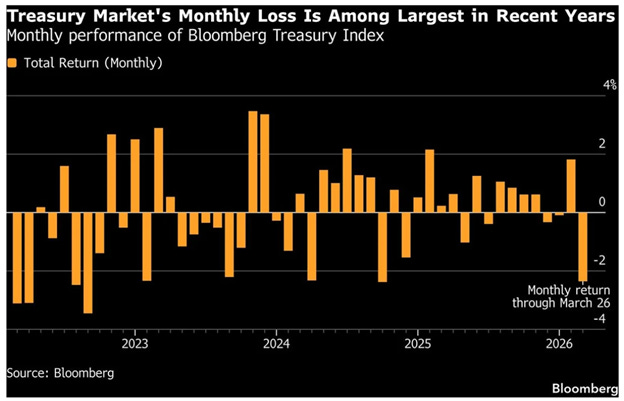
What is happening, this time, is the opposite. US government bonds are in liquidation by global investors. March 2026 was the worst month for Treasury investors since 2022.
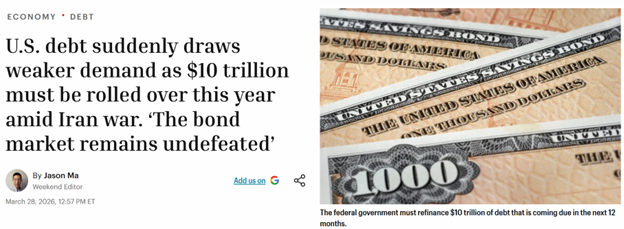
The American debt market already faces major headwinds, with $10 trillion that needs to be rolled over this year, at far higher borrowing costs than when originally issued. Now there is a war on, the Department of War is asking for another $200 billion and is burning through billions of dollars of weapons stockpiles every week, and so investors are looking somewhere else.
Typically that “somewhere else” might be the United Kingdom. They are not at war in Iran, and one might think London would be an alternative safe haven for those who don’t want to send money to New York. But that isn’t happening either.
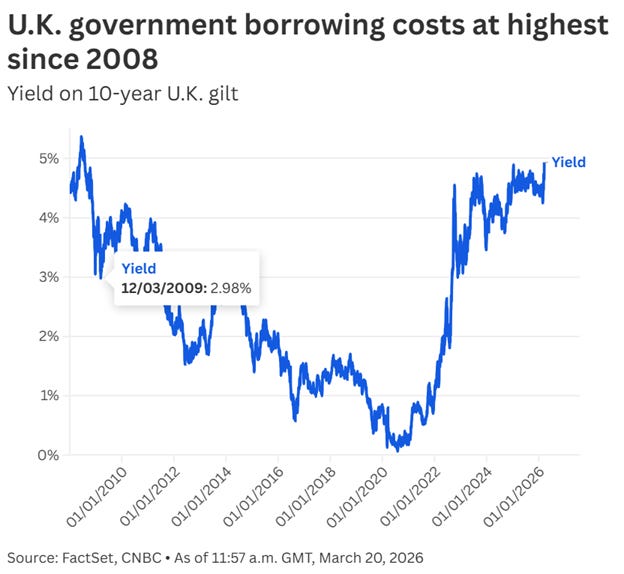
Bond yields there are blowing out, too: 10-year government yields in the UK are higher today than any time since the Great Financial Crisis.
These are the 10-year government bond yields from leading world economies. Yields on the so-called “safe-haven” investments of US and UK government debt are rising. If demand were high, and foreign capital were moving in, those yields would be coming down, not heading the other way:
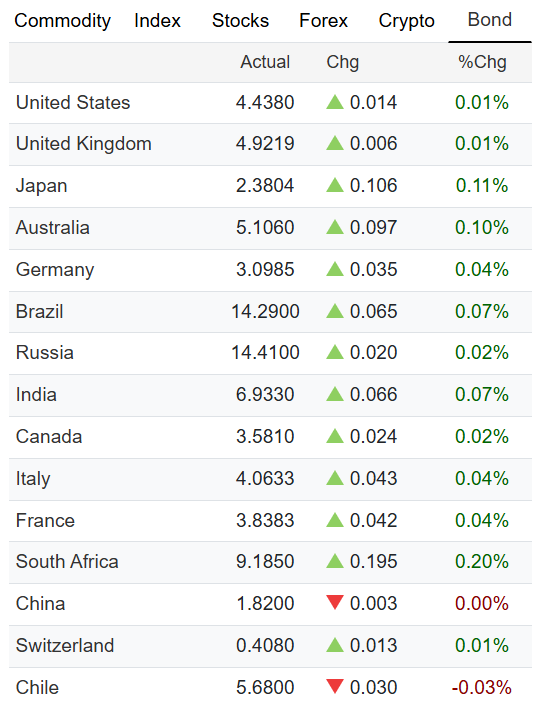
China, in comparison, is at 1.82%, and falling. Put another way, the Chinese government can borrow money for 10 years, and their interest payments on that debt is around one-third what it costs the American government. Investors are preferring the safety of Chinese bonds, at lower yields, than debt from North America and Europe.
In that context, the capital outflows from the Persian Gulf are accelerating, yet are not going to higher-yielding investments on offer by the United States or Europe. It’s going to Hong Kong. Wall Street and European asset management firms are expanding in Hong Kong, to take on new clients selling off assets in the Middle East, and bringing it here, to China. For investors in Dubai in particular, Hong Kong is a way to diversify their risk. China and other regional economies have stronger economic growth, and even sovereign funds—those are government investment pools—were making the shift to Hong Kong.
Banks in the Persian Gulf region are badly exposed to capital flight, with over $300 billion that may move out, depending on how long the war goes on. The S&P’s analysis of the problem assumes that the “intense phase” of the war “lasts two to four weeks”. We’re already past four weeks, and Dubai itself is being targeted by Iranian rockets and drones.
The objective of shifting assets away from banks in Dubai and other Gulf States, is to diversify risk during wartime. Capital flight is a wager, by investors, about perceived safety. But the so-called “Iron Dome” cannot protect Tel Aviv from ballistic missile strikes from Iran. American Air Force bases and even embassies are being hit. Iran has closed the Strait of Hormuz, and only ships from friendly countries, like China are allowed to pass through.
Maybe Middle East investors are thinking about all of that too.
Be Good.
Resources and links:
S&P: Potential outflow from Gulf banks of around US$307 billion
https://www.idnfinancials.com/news/62301/sp-potential-outflow-from-gulf-banks-of-around-us307-billion
U.S. debt suddenly draws weaker demand as $10 trillion must be rolled over this year amid Iran war. ‘The bond market remains undefeated’
https://fortune.com/2026/03/28/us-debt-auctions-weak-demand-treasury-yields-10-trillion-refinance-iran-war-bond-market/
U.K. government borrowing costs at highest since 2008
https://www.cnbc.com/2026/03/20/uk-gilt-market-interest-rates-boe-inflation-reeves.html
Hong Kong should use ‘safe haven’ status to draw capital from Gulf: agency chief
https://www.scmp.com/news/hong-kong/hong-kong-economy/article/3347376/hong-kong-should-use-safe-haven-status-draw-capital-gulf-agency-chief
Super Rich Regain Zest for Hong Kong as War Stokes Gulf Unease
https://www.bloomberg.com/news/articles/2026-03-27/super-rich-regain-zest-for-hong-kong-as-war-stokes-gulf-unease
Super Rich Regain Zest for Hong Kong as War Stokes Gulf Unease
https://financialpost.com/pmn/business-pmn/super-rich-regain-zest-for-hong-kong-as-war-stokes-gulf-unease
Global investors pivot to ‘stability’ of China amid turmoil: Milken forum speakers
https://www.scmp.com/business/markets/article/3347593/global-investors-pivot-stability-china-amid-turmoil-milken-forum-speakers
U.S. Embassy in Baghdad Hit by Missile
https://www.wsj.com/livecoverage/us-israel-iran-war-news-2026/card/u-s-embassy-in-baghdad-hit-by-missile-DukK29ECyDjwtX7fIAGt
Israel’s Missile Defense Under Scrutiny After Iranian Attack
https://www.nytimes.com/2026/03/22/world/middleeast/israel-missile-defense-iran.html
Inside China / Business is a reader-supported publication. To receive new posts and support my work, consider becoming a free or paid subscriber.
From Inside China / Business via This RSS Feed.
6
Warren Says Trump Knows Iran War and Price Hikes Are Unpopular, So He's 'Trying to Rig' Midterms
(www.commondreams.org)

US Sen. Elizabeth Warren on Tuesday accused President Donald Trump of trying to sabotage the 2026 midterm elections as his illegal war on Iran jacks up gas prices and threatens higher inflation throughout the economy, angering voters across the political spectrum.
The Massachusetts Democrat's warning came shortly after Trump signed an executive order aimed at restricting mail-in voting, a move that was widely seen as unconstitutional. Warren wrote on social media: "Trump knows his war with Iran is unpopular. Trump knows Americans are angry that he's made everything more expensive. Instead of reversing course, Trump is trying to rig the next election. It's illegal—and we will fight back."
Ben Raderstorf, a policy advocate at the nonprofit group Protect Democracy, said that "just like the war in Iran, the war against the midterms is extremely dangerous and will do so much damage to our elections and our democracy."
A Reuters/Ipsos poll released Tuesday evening found that 66% of US voters—including 40% of Republicans—want a quick end to Trump's war on Iran, even if his administration doesn't achieve its vague and constantly shifting objectives, which have ranged from thwarting an imminent threat that analysts say was not present, to full-scale regime change, to destroying a nuclear weapons program that US intelligence has repeatedly found does not exist.
Reuters reported that two in three respondents to the new survey "said they expected gas prices to worsen over the next year, including 40% of Republicans."
While oil prices fell sharply on Tuesday after Trump declared that US forces would end their assault on Iran in "two weeks or maybe a few days longer," the Institute on Taxation and Economic Policy (ITEP) estimated last week that the gas price surge stemming from the war was on pace to cost American drivers an additional $9.4 billion per month.
"Alabama is the most affected state in the nation, with residents spending an extra $52 per person, per month," ITEP found. "Other heavily impacted states include Mississippi ($51), Wyoming ($49), Kentucky ($47), and New Mexico ($44)."
Trump is expected to address the nation on the Iran war at 9 pm ET on Wednesday, more than a month into a military campaign that was not authorized by lawmakers and that has sparked a regional conflict, killing thousands and displacing millions.
The president told reporters on Tuesday that Iran "doesn't have to make a deal" to end the war, and Trump has privately told aides that he's willing to end the assault without securing the reopening of the Strait of Hormuz.
“We leave because there’s no reason for us to do this,” Trump said.
From Common Dreams via This RSS Feed.

By David Swanson, World BEYOND War, April 1, 2026
This seems like an April Fool’s Day story, and I did always used to write those. But it isn’t. And it’s going to be a growing list. I’m going to add to it here on future days, I hope. You can help add to it in the comments below.
The story is that some governments are finally, finally, finally, doing one or two things right. They are also doing hundreds of things wrong — the very same governments. This is not a monument to deified hero governments. Allowing the United States military to have a base in your country and then not allowing it to use that base for a particular war is at best a glass-half-full move, and — painfully obviously — you still need to close that and all other military bases permanently. It’s war or survival, not both. Blocking “offensive” weapons while sending “defensive” weapons to gulf dictatorships, er, excuse me, key allies, is insulting to everyone you’re selling it to. But baby steps in the right direction are still in the right direction.
These acts of doing things right amount to standing up to the horrific crimes and atrocities of the U.S. and Israeli governments. If the U.S. and Israeli publics don’t like the fact that this is now what it takes to do the right thing, they do have the option of preventing the single individuals running their nations into the ground from continuing, or even of changing their governments so that they are not run by a single individual — a state of affairs that sounds fantastical and yet already exists in those nations’ laws.
According to social media, this list should be a lot bigger, but a lot of the “news” is phony. There seems to be desire out there for more such actions to happen in the real world.
Without further ado, the envelopes please . . .
SPAIN
Spain has denied the U.S. the use of bases in Spain for the war on Iran, and denied the U.S. the use of its airspace for the war on Iran, and publicly denounced the war on Iran as the crime that all wars are. It has also denounced the war on Gaza (having already taken numerous steps to avoid supporting that war, and having cut off diplomatic relations with Israel) and denounced the war on Lebanon, and refused to spend the amount of money demanded by Trump on its military. Spain’s government is receiving gratitude from around the world for these simple acts of refraining from complete hypocrisy when talking about the rule of law or democracy.
SWITZERLAND
Switzerland has stopped weapons shipments to the United States over the war on Iran. Switzerland has denied use of its airspace for the war on Iran.
ITALY
Italy has finally denied the U.S. the use of a base for the war on Iran.
POLAND
Poland has refused to send some of its weapons to the Middle East (though they may contribute more to starting WWIII right where they are).
GERMANY
Germany has said a few good things while doing the opposite. That’s progress for Germany, which is ahead of the UK.
CANADA
Canada’s prime minister finally found a war he opposes in the war on Lebanon.
BRAZIL
The president of Brazil has demanded that the United Nations reform itself, i.e. get rid of the veto.
FRANCE
While Trump said France denied use of its airspace for the slaughter in Iran, France has denied that it had done so. Shame on France!
UNITED NATION
Yeah, this is the April Fool’s bit.
Here is where this could and should be heading:
The post Amazingly, Some Governments Are Doing Some Things Right appeared first on World BEYOND War.
From World BEYOND War via This RSS Feed.

Salungguhit by Cartoonist Zach
The post April Fools Daily appeared first on Bulatlat.
From Bulatlat via This RSS Feed.
‘Eulogy for globalist hypocrisy’: Netizens react to Canada PM’s speech on end of ‘rules-based order’
view more: next ›
Extra context added because this headline is wildly misleading.