Architeuthis

joined 2 years ago
[–] Architeuthis@awful.systems 9 points 2 weeks ago (3 children)

The one-shotting phenomenon (or how a positive initial experience with the technology seems to lead to a heavily biased view of its merits) should probably be considered a distinct cognitive bias at this point.

Turns out a lot of bright people can't deal with a technology being utterly subjective in its efficiency, and also how that's specifically the part that reduces it to being so narrowly useful as to force the existential question, given the insane resource burn and the socioeconomic disruption that's part and parcel, even if like Doctorow you think that their rape and pillage of artist's rights and intellectual property in general isn't an especially big deal.

Also, local LLMs are hardly extricable from the whole mess, they are basically a byproduct, and updated versions only will keep coming as long as their imperial size online counterparts remain a viable concern.

[–] Architeuthis@awful.systems 7 points 2 weeks ago* (last edited 2 weeks ago) (1 children)

In the original post he kept referring to Ollama like it was an LLM instead of a server app that hosts LLMs so I'd say the jury's out on that.

edit: Also, throughout this piece he keeps equivocating between local LLMs and their behemoth online counterparts with their heavily proprietary tooling that occasionally wraps them into a somewhat useful product.

I think he assumes that because he can load up a modest speech-to-text model locally and casually transcribe several hours of video resources in somewhat short order (this was apparently his major formative experience with modern AI) it works the same with e.g. coding.

Like, hey gpt-oss please make sense of these ten thousand lines of context without access to a hundred bespoke MCP intermediaries and one or three functioning RAG systems as I watch the token generation rate slow to a trickle while the context window gradually fills up.

[–] Architeuthis@awful.systems 10 points 4 weeks ago (1 children)

Usually, you wake up on a lifeless beach that’s adorned with some sort of abandoned marble temple. It’s supposed to be beautiful, but instead it’s really sad. Almost unbearably sad. So much so that you want to get away from it. So you crawl downward into these vents going below the horrible temple, and suddenly it’s like you’re moving through the innards of an incomprehensible machine that’s thudding away, thud, thud, thud. And as you get deeper, the metal sidings are carved with scrawled ominous curses and slurs directed toward you, and you hear the voices, louder than before, and you somehow know these people are in pain because of you. It keeps getting colder. Color drains from the world. And you see the crowd through the slats of the vents: pale and emaciated men, women, and children from centuries to come, all of them pressed together for warmth in some sort of unending cavern. What clothes they have are torn and ragged. Before you know it, their dirty hands and dirty fingernails lurch through the grates, and they’re reaching for you, tearing at your shirt, moaning terrible things about their suffering and how you made it happen, you made it, and you need to stop this now, now, now. And next they’re ripping you apart, limb from limb, and you are joining them in the gray dimness forever.

[–] Architeuthis@awful.systems 8 points 1 month ago* (last edited 1 month ago)

A potential massive uptick of consumer tier subscribers that they don't break even on at the same time the DoD fallout drives more lucrative prospects away could be fun to watch at least, a considerable chunk of the llm code helper ecosystem appears to hinge on anthropic not doing anything crazy like suddenly hiking prices.

edit: Aaaand they had a worldwide outage

[–] Architeuthis@awful.systems 22 points 1 month ago* (last edited 1 month ago) (4 children)

The bitcoin whitepaper certainly goes hard if you are dumb, it's goldbug conspiratonomics meets technosolutionism except the proposed solution is the least efficient and most easily trackable and hijackable system possible.

Also I loved how ethereum pioneered all the worst and most felonious aspects of crypto by introducing the ability to create shitcoins, and smart contracts, a feature that just cranked the attack surface to infinity with no mitigations.

[–] Architeuthis@awful.systems 4 points 1 month ago (1 children)

It unthickened, it was just Altman grandstanding while at the same time taking over Antrhopic's ~~DoD~~ DoW: The Everything App contracts.

[–] Architeuthis@awful.systems 6 points 1 month ago* (last edited 1 month ago) (2 children)

Pentagon labels Anthropic a supply-chain risk, strikes deal with OpenAI whose president Greg Brockman is a Trump mega-donor.

🍌🍌🍌

Trump added there would be a six-month phase-out for the Defense Department and other agencies that use the company's products. If Anthropic does not help with the transition, Trump said, he would use "the Full Power of the Presidency to make them comply, with major civil and criminal consequences to follow."

The designation could bar tens of thousands of contractors from using Anthropic's AI when working for the Pentagon. That represents an existential threat to its business with the government and could harm its private-sector relationships, said Franklin Turner, an attorney who specializes in government contracts.

"Blacklisting Anthropic is the contractual equivalent of nuclear war," he said.

[–] Architeuthis@awful.systems 12 points 1 month ago (5 children)

As far as I can tell it's only on anthropic's word that that's the main issue, DoD just talks about unfettered access for all lawful purposes, which is basically a bend-the-knee-or-else framing, and pivoting away from that to bargaining on particulars will make them look weak, so I guess that's that for now.

Αnthropic being against mass surveillance and autonomous weaponry while in bed with Palantir is kind of if IBM took a stand against antisemitism while spearheading the computerization of the third reich prison system.

Kudos to Dario for stepping off the hype train for one millisecond to admit that using an LLM to control an automated weapons platform is currently kind of out of scope for this technology, I bet that took a toll on his psyche.

And also for pointing out that something can be legal only because the law hasn't yet caught up with the technology.

[–] Architeuthis@awful.systems 4 points 1 month ago

It's entirely possible he does get that it's a nothing burger but is just being his usual disingenuous self to pull people in.

[–] Architeuthis@awful.systems 8 points 1 month ago

I mean the whole entire premise (not unique to this post, scoot's gotten a lot of mileage out of this) is shoehorning LLMs into the predictive coding framework mostly on the grounds that they both use prediction terminology and deal with work units that they call neurons, with the added bonus that PC posits Bayesian inference is involved so it's obviously extra valid.

Queue a few thousand words of scoot wearing his science popularizer hat and just declaring the most vacuous shit imaginable with a straight face and a friendly teacher's casual authority.

[–] Architeuthis@awful.systems 11 points 1 month ago* (last edited 1 month ago) (7 children)

He isn’t even trying with the yellow and orange boxes. What the fuck do “high-D toroidal attractor manifolds” and “6D helical manifolds” have to do with anything? Why are they there? And he really thinks he can get away with nobody closely reading his charts, with the “(???, nothing)” business. Maybe I should throw in that box in my publications and see how that goes.

It's from another horseshit analogy that roughly boils down to both neural net inference (specifically when generating end-of-line tokens) and aspects of specific biological components of human perception being somewhat geometrically modellable. I didn't include the entire context or a link to the substack in the OP because I didn't care to, but here is the analogy in full:

spoiler

The answer was: the AI represents various features of the line breaking process as one-dimensional helical manifolds in a six-dimensional space, then rotates the manifolds in some way that corresponds to multiplying or comparing the numbers that they’re representing. You don’t need to understand what this means, so I’ve relegated my half-hearted attempt to explain it to a footnote1. From our point of view, what’s important is that this doesn’t look like “LOL, it just sees that the last token was ree and there’s a 12.27% of a line break token following ree.” Next-token prediction created this system, but the system itself can involve arbitrary choices about how to represent and manipulate data.

Human neuron interpretability is even harder than AI neuron interpretability, but probably your thoughts involve something at least as weird as helical manifolds in 6D spaces.I searched the literature for the closest human equivalent to Claude’s weird helical manifolds, and was able to find one team talking about how the entorhinal cells in the hippocampus, which help you track locations in 2D space, use “high-dimensional toroidal attractor manifolds”. You never think about these, and if Claude is conscious, it doesn’t think about its helices either2. These are just the sorts of strange hacks that next-token/next-sense-datum prediction algorithms discover to encode complicated concepts onto physical computational substrate.

re: the bolded part, I like how explicitly cherry-picking neuroscience passes for peak rationalism.


rootclaim appears to be yet another group of people who, having stumbled upon the idea of the Bayes rule as a good enough alternative to critical thinking, decided to try their luck in becoming a Serious and Important Arbiter of Truth in a Post-Mainstream-Journalism World.

This includes a randiesque challenge that they'll take a $100K bet that you can't prove them wrong on a select group of topics they've done deep dives on, like if the 2020 election was stolen (91% nay) or if covid was man-made and leaked from a lab (89% yay).

Also their methodology yields results like 95% certainty on Usain Bolt never having used PEDs, so it's not entirely surprising that the first person to take their challenge appears to have wiped the floor with them.

Don't worry though, they have taken the results of the debate to heart and according to their postmortem blogpost they learned many important lessons, like how they need to (checks notes) gameplan against the rules of the debate better? What a way to spend 100K... Maybe once you've reached a conclusion using the Sacred Method changing your mind becomes difficult.

I've included the novel-length judges opinions in the links below, where a cursory look indicates they are notably less charitable towards rootclaim's views than their postmortem indicates, pointing at stuff like logical inconsistencies and the inclusion of data that on closer look appear basically irrelevant to the thing they are trying to model probabilities for.

There's also like 18 hours of video of the debate if anyone wants to really get into it, but I'll tap out here.

ssc reddit thread

quantian's short writeup on the birdsite, will post screens in comments

pdf of judge's opinion that isn't quite book length, 27 pages, judge is a microbiologist and immunologist PhD

pdf of other judge's opinion that's 87 pages, judge is an applied mathematician PhD with a background in mathematical virology -- despite the length this is better organized and generally way more readable, if you can spare the time.

rootclaim's post mortem blogpost, includes more links to debate material and judge's opinions.

edit: added additional details to the pdf descriptions.


edited to add tl;dr: Siskind seems ticked off because recent papers on the genetics of schizophrenia are increasingly pointing out that at current miniscule levels of prevalence, even with the commonly accepted 80% heritability, actually developing the disorder is all but impossible unless at least some of the environmental factors are also in play. This is understandably very worrisome, since it indicates that even high heritability issues might be solvable without immediately employing eugenics.

Also notable because I don't think it's very often that eugenics grievances breach the surface in such an obvious way in a public siskind post, including the claim that the whole thing is just HBD denialists spreading FUD:

People really hate the finding that most diseases are substantially (often primarily) genetic. There’s a whole toolbox that people in denial about this use to sow doubt. Usually it involves misunderstanding polygenicity/omnigenicity, or confusing GWAS’ current inability to detect a gene with the gene not existing. I hope most people are already wise to these tactics.


... while at the same time not really worth worrying about so we should be concentrating on unnamed alleged mid term risks.

EY tweets are probably the lowest effort sneerclub content possible but the birdsite threw this to my face this morning so it's only fair you suffer too. Transcript follows:

Andrew Ng wrote:

In AI, the ratio of attention on hypothetical, future, forms of harm to actual, current, realized forms of harm seems out of whack.

Many of the hypothetical forms of harm, like AI "taking over", are based on highly questionable hypotheses about what technology that does not currently exist might do.

Every field should examine both future and current problems. But is there any other engineering discipline where this much attention is on hypothetical problems rather than actual problems?

EY replied:

I think when the near-term harm is massive numbers of young men and women dropping out of the human dating market, and the mid-term harm is the utter extermination of humanity, it makes sense to focus on policies motivated by preventing mid-term harm, if there's even a trade-off.


Sam Altman, the recently fired (and rehired) chief executive of Open AI, was asked earlier this year by his fellow tech billionaire Patrick Collison what he thought of the risks of synthetic biology. ‘I would like to not have another synthetic pathogen cause a global pandemic. I think we can all agree that wasn’t a great experience,’ he replied. ‘Wasn’t that bad compared to what it could have been, but I’m surprised there has not been more global coordination and I think we should have more of that.’


original is here, but you aren't missing any context, that's the twit.

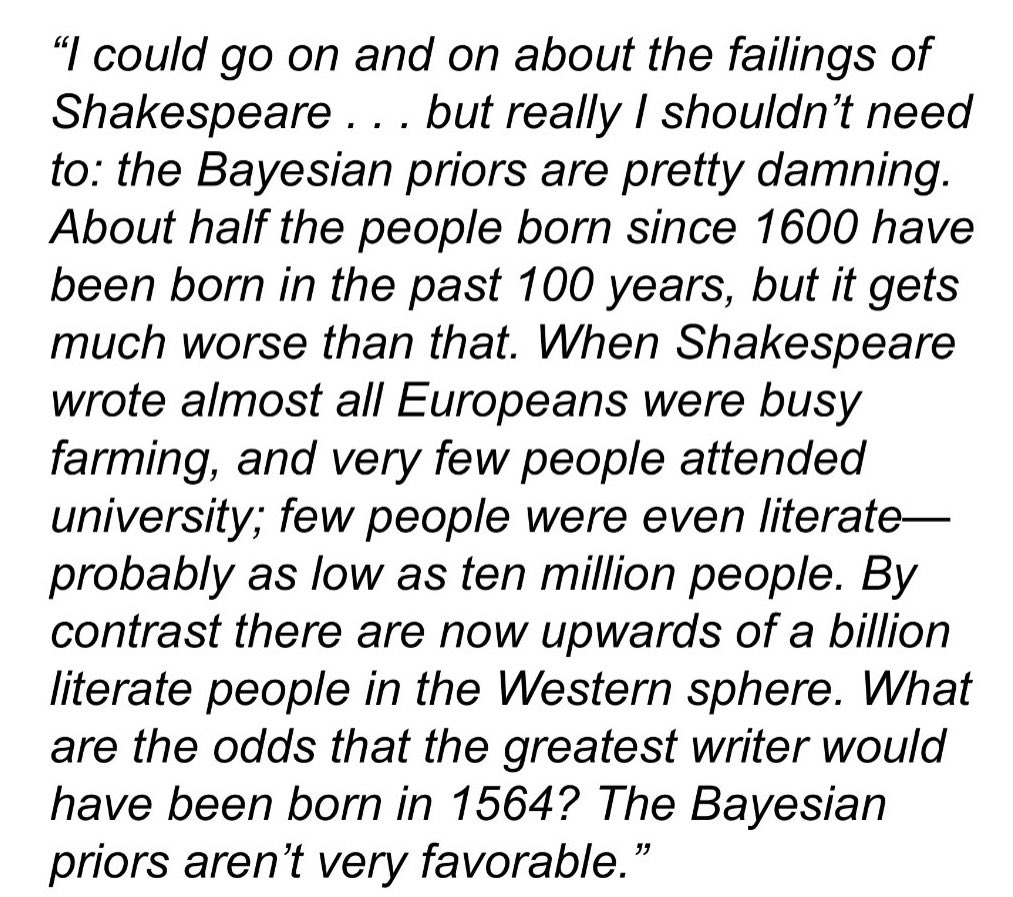
I could go on and on about the failings of Shakespear... but really I shouldn't need to: the Bayesian priors are pretty damning. About half the people born since 1600 have been born in the past 100 years, but it gets much worse that that. When Shakespear wrote almost all Europeans were busy farming, and very few people attended university; few people were even literate -- probably as low as ten million people. By contrast there are now upwards of a billion literate people in the Western sphere. What are the odds that the greatest writer would have been born in 1564? The Bayesian priors aren't very favorable.

edited to add this seems to be an excerpt from the fawning book the big short/moneyball guy wrote about him that was recently released.

view more: ‹ prev next ›