


Bullets:
In a major economic shift, Hong Kong is supplanting the United States and Europe as the preferred "safe haven" for capital flight outbound the Middle East.
Even though government bonds from the US and UK yield nearly three times lending rates in Hong Kong and China, risk-averse investors are shifting funds to HK.
Hong Kong is the financial center for emerging Global Majority system, and Southeast Asia enjoys far stronger economic growth.
China also has tight relationships with Iran, who has granted Chinese ships passage through the Strait of Hormuz.
Inside China / Business is a reader-supported publication. To receive new posts and support my work, consider becoming a free or paid subscriber.
Report:
Good morning.
This is not what is supposed to happen during a time of global unrest. When supply chains across the world seize up, when global economies are on the verge of recession, or even depression—investors across the world move capital to “safe havens”. They buy bonds in safe havens, like the United States, or move money to American banks.
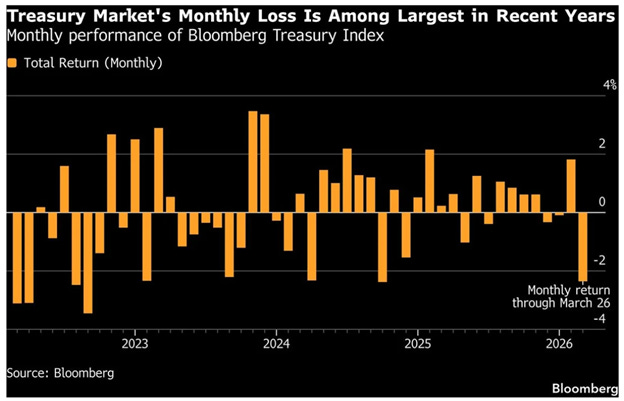
What is happening, this time, is the opposite. US government bonds are in liquidation by global investors. March 2026 was the worst month for Treasury investors since 2022.
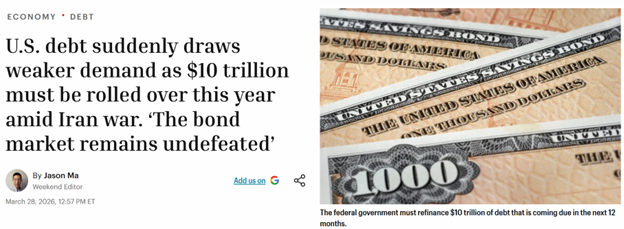
The American debt market already faces major headwinds, with $10 trillion that needs to be rolled over this year, at far higher borrowing costs than when originally issued. Now there is a war on, the Department of War is asking for another $200 billion and is burning through billions of dollars of weapons stockpiles every week, and so investors are looking somewhere else.
Typically that “somewhere else” might be the United Kingdom. They are not at war in Iran, and one might think London would be an alternative safe haven for those who don’t want to send money to New York. But that isn’t happening either.
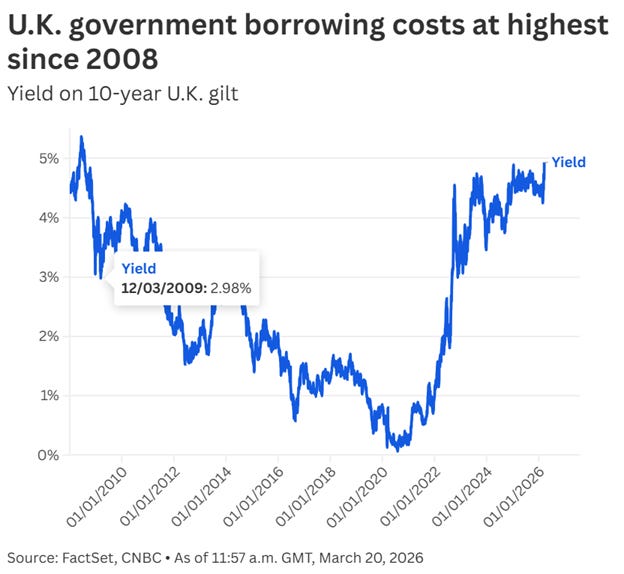
Bond yields there are blowing out, too: 10-year government yields in the UK are higher today than any time since the Great Financial Crisis.
These are the 10-year government bond yields from leading world economies. Yields on the so-called “safe-haven” investments of US and UK government debt are rising. If demand were high, and foreign capital were moving in, those yields would be coming down, not heading the other way:
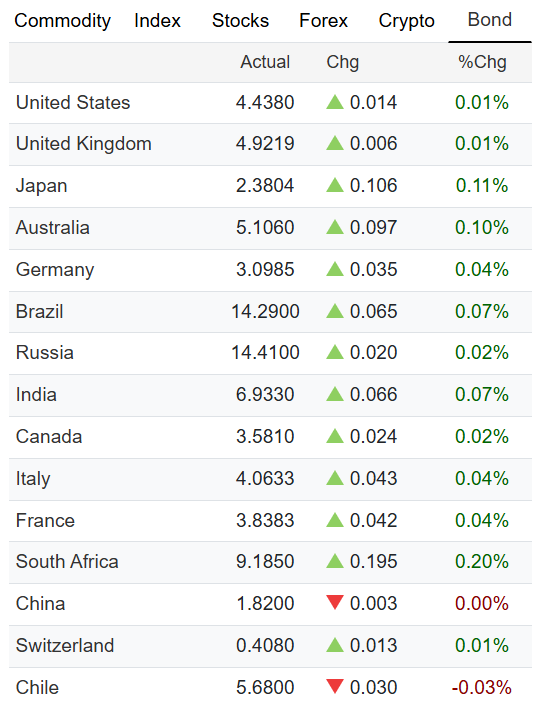
China, in comparison, is at 1.82%, and falling. Put another way, the Chinese government can borrow money for 10 years, and their interest payments on that debt is around one-third what it costs the American government. Investors are preferring the safety of Chinese bonds, at lower yields, than debt from North America and Europe.
In that context, the capital outflows from the Persian Gulf are accelerating, yet are not going to higher-yielding investments on offer by the United States or Europe. It’s going to Hong Kong. Wall Street and European asset management firms are expanding in Hong Kong, to take on new clients selling off assets in the Middle East, and bringing it here, to China. For investors in Dubai in particular, Hong Kong is a way to diversify their risk. China and other regional economies have stronger economic growth, and even sovereign funds—those are government investment pools—were making the shift to Hong Kong.
Banks in the Persian Gulf region are badly exposed to capital flight, with over $300 billion that may move out, depending on how long the war goes on. The S&P’s analysis of the problem assumes that the “intense phase” of the war “lasts two to four weeks”. We’re already past four weeks, and Dubai itself is being targeted by Iranian rockets and drones.
The objective of shifting assets away from banks in Dubai and other Gulf States, is to diversify risk during wartime. Capital flight is a wager, by investors, about perceived safety. But the so-called “Iron Dome” cannot protect Tel Aviv from ballistic missile strikes from Iran. American Air Force bases and even embassies are being hit. Iran has closed the Strait of Hormuz, and only ships from friendly countries, like China are allowed to pass through.
Maybe Middle East investors are thinking about all of that too.
Be Good.
Resources and links:
S&P: Potential outflow from Gulf banks of around US$307 billion
https://www.idnfinancials.com/news/62301/sp-potential-outflow-from-gulf-banks-of-around-us307-billion
U.S. debt suddenly draws weaker demand as $10 trillion must be rolled over this year amid Iran war. ‘The bond market remains undefeated’
https://fortune.com/2026/03/28/us-debt-auctions-weak-demand-treasury-yields-10-trillion-refinance-iran-war-bond-market/
U.K. government borrowing costs at highest since 2008
https://www.cnbc.com/2026/03/20/uk-gilt-market-interest-rates-boe-inflation-reeves.html
Hong Kong should use ‘safe haven’ status to draw capital from Gulf: agency chief
https://www.scmp.com/news/hong-kong/hong-kong-economy/article/3347376/hong-kong-should-use-safe-haven-status-draw-capital-gulf-agency-chief
Super Rich Regain Zest for Hong Kong as War Stokes Gulf Unease
https://www.bloomberg.com/news/articles/2026-03-27/super-rich-regain-zest-for-hong-kong-as-war-stokes-gulf-unease
Super Rich Regain Zest for Hong Kong as War Stokes Gulf Unease
https://financialpost.com/pmn/business-pmn/super-rich-regain-zest-for-hong-kong-as-war-stokes-gulf-unease
Global investors pivot to ‘stability’ of China amid turmoil: Milken forum speakers
https://www.scmp.com/business/markets/article/3347593/global-investors-pivot-stability-china-amid-turmoil-milken-forum-speakers
U.S. Embassy in Baghdad Hit by Missile
https://www.wsj.com/livecoverage/us-israel-iran-war-news-2026/card/u-s-embassy-in-baghdad-hit-by-missile-DukK29ECyDjwtX7fIAGt
Israel’s Missile Defense Under Scrutiny After Iranian Attack
https://www.nytimes.com/2026/03/22/world/middleeast/israel-missile-defense-iran.html
Inside China / Business is a reader-supported publication. To receive new posts and support my work, consider becoming a free or paid subscriber.
From Inside China / Business via This RSS Feed.