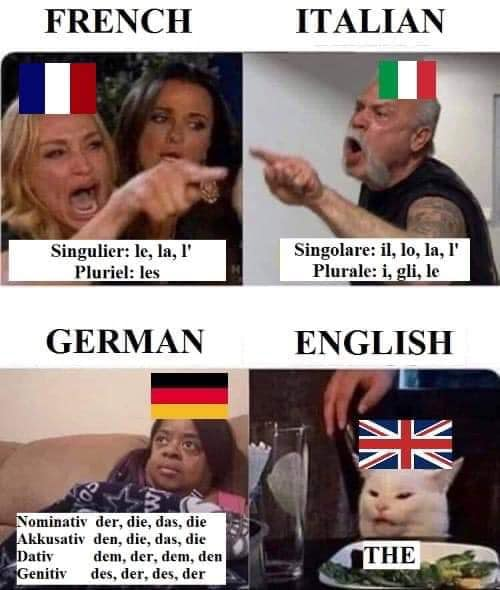
Slavic languages: You guys have articles?
Behavior rules:
Posting rules:
NSFW: NSFW content is permitted but it must be tagged and have content warnings. Anything that doesn't adhere to this will be removed. Content warnings should be added like: [penis], [explicit description of sex]. Non-sexualized breasts of any gender are not considered inappropriate and therefore do not need to be blurred/tagged.
Also, when sharing art (comics etc.) please credit the creators.
If you have any questions, feel free to contact us on our matrix channel or email.
Other 196's:

Japanese: you guys have plurals?
Japanese: just say the word twice.
Any slavic language afaik.
Damn, beat me to it!
What really fucks with me is akkusativ suffixes
If dein grampa isn't the first and foremost noun in a sentence then it has to be deinen grampa but if it's a feminine word the the rule doesn't matter
Meine Oma Liebt deine Oma.
Mein Opa Liebt deine Oma.
Mein Opa Liebt deinen Opa.
Meine Oma Liebt deinen Opa.
I want to be good at this but that shit makes no sense, Hans. And why the fuck does a Library have a gender?!
EDIT: Liebt not Liebst in this context
Just a minor correction: instead of "Liebst" it must be "liebt" since it's 3rd person singular:
Thank you for catching that, I appreciate the input.
It's not gender like in humans or in animals. Nobody thinks of the library as a woman, that would be absurd. It's a purely grammatical concept.
Grammatical gender will never make sense to me, and I suspect that's because it actually just doesn't make sense.
Don't worry, Dativ will come and double fuck you too
Because the subject is in Nominativ and the object is in Akusativ here.
I fucking love German grammar!!!! It's awesome. The Futur 2 and Plusquamperfekt are my favourite. We have some funky letters like ß (<- look at this guy :) ) and weird sounds like the CH and SCH. There is this one grammar "rule" that I don't like. Because there is no real rule. You just have to know. It's about the "connecting s". So in some compound words you sometimes put an s between the two words to connect them. But there is not really a way to know when to do it. It's Rind + Fleisch = Rindlfeisch but Rind + Leder = Rindsleder with an S.
Thank you all for coming to my tedtalk.
I love how we can stick two words together and bam it's a new word. Rucksackriemenquerverbindunsgträger
Compound words are great because there's no ambiguity about where noun groups start and end. English has compound words too, but german are the undisputed champions of compound words.
In Persian we don't even have "the". If it's indefinite we use the equivalent of "a". If it's definite we don't use anything.
That sounds... efficient
In Russian there aren't any articles, and no concept of definite/indefinite. Hence the cliché accent in English leaving out all of the "the" and "a/an"
I have guessed the lack of articles in Russian from the cliché! By the way, how many cases does Russian have?
Six real cases, plus some remnants of two more that are no longer used.
The same ones as in German, plus prepositive (typical use is "in" something) and instrumental (typical use is "with" something). They also distinguish between living and non-living, for example, accusative male is the same as nominative male if the subject is non-living (things), but if living (humans and animals) then it is the same as genitive male.
They also love to use genitive for everything. Let's say you're counting. One is nominative, two through four is genitive singular, five through twenty and zero is genitive plural. Above twenty the last digit determines the case.
Wanna say a date? Ordinal number in genitive according to the rules above for the day, genitive for the month.
Wanna say x amount of something? The something is genitive. If it is countable, it's genitive plural, if it's uncountable, it's genitive singular. You might think, that's not so bad, until you discover that Russians consider onions, potatoes, carrots etc as uncountable. Of course you can't say 5 carrots! Impossible to count them. You must say "5 pieces of carrot" in genitive plural. Duh.
Please hit like and subscribe to be notified when a new Russian grammar rant is published.
You might think, that's not so bad, until you discover that Russians consider onions, potatoes, carrots etc as uncountable. Of course you can't say 5 carrots! Impossible to count them.
:))) I love these random craziness of languages. And I don't want to know the reason behind them. Like when I learned the word for "girl" is neuter in German, I was happy but when I learned the reason, it was boring.
I swear Persian might be the easiest language there is.
Is it prepositive or locative? I know slovenian has the same cases and they are used pretty similarly.
Prepositive. They don't have locative anymore. I believe prep. replaced loc. They also had ablative but I think it was combined with accusative. But I'm not sure about that.
The last time I counted them, it was six.
I finally realize why the people coming from the east to speak Portuguese have some special quirks in their efforts. It's really hard coming from that perspective.
Also English: Random pronunciation without working rules.
That's why "the" is such a common word in English. If you have a toddler, teach them to read (recognize) the word "the." Then sit down together with a book, reading aloud with your finger running under the words, and pausing to let them read all the "the"s. It'll help them get the connection between print and speech, even if they're still working on the alphabet. And they'll feel powerful.
As a lesson in English, you can explain that even though there's no t, h, or e sound in it, it's pronounced "the" because whenever t and h are together we say (long exaggerated th sound), and it's such an old and common word that we got lazy about saying "ee" and now we just say "uh."
I taught my daughter to read during covid when the schools were closed. ‘The’ was the first word she learned to read, and I did exactly what you suggest, pausing for her to read it. It really helped. When my workshop reopened I made her a silver badge of the word ‘the’ to celebrate.
This really fucked me up in German class
Ha, try the modal verbs! Or Konjunktiv 1. Partizip is also a favourite
Plusquamperfekt! Futur II!
Meanwhile Danish turns the indefinite article into a definite suffix. Like:
A house: "et hus"
The house: "huset"
Houses: "huse"
The houses: "husene"
Don't most (if not all) Nordic languages do that?
Also, I can't help but share: https://youtu.be/s-mOy8VUEBk
Scandinavian, yes, nordic, well, I don't think they do it in Finnish? Not sure about Icelandic.
Fair. I meant Scandinavian and not Finno-Scandic in my comment. Finnish isn't even in the same language family, so I don't claim to know anything about it
Which psychopath decided to put the cases in German in the wrong order?
It's:
Singular male, female, neuter, Plural male, female, neuter
Nominative: ο, η, το, οι, οι, τα
Genitive: του, της, του, των, των, των
Accusative: τον, την, το, τους, τις, τα
Callitive: (no article)
German:
Singular: der, die, das
Plural: die
It’s a weird contrast between Germanic language German and Germanic language English
I wonder if it comes from Gaelic languages
Germanic language Dutch only has "de" and "het"
We should absolutely steal it. All the different articles serve no linguistic purpose at all. You could literally just use "de" and "en" in German today, and it'd be perfectly understandable.
Good Neder
that’s awesome