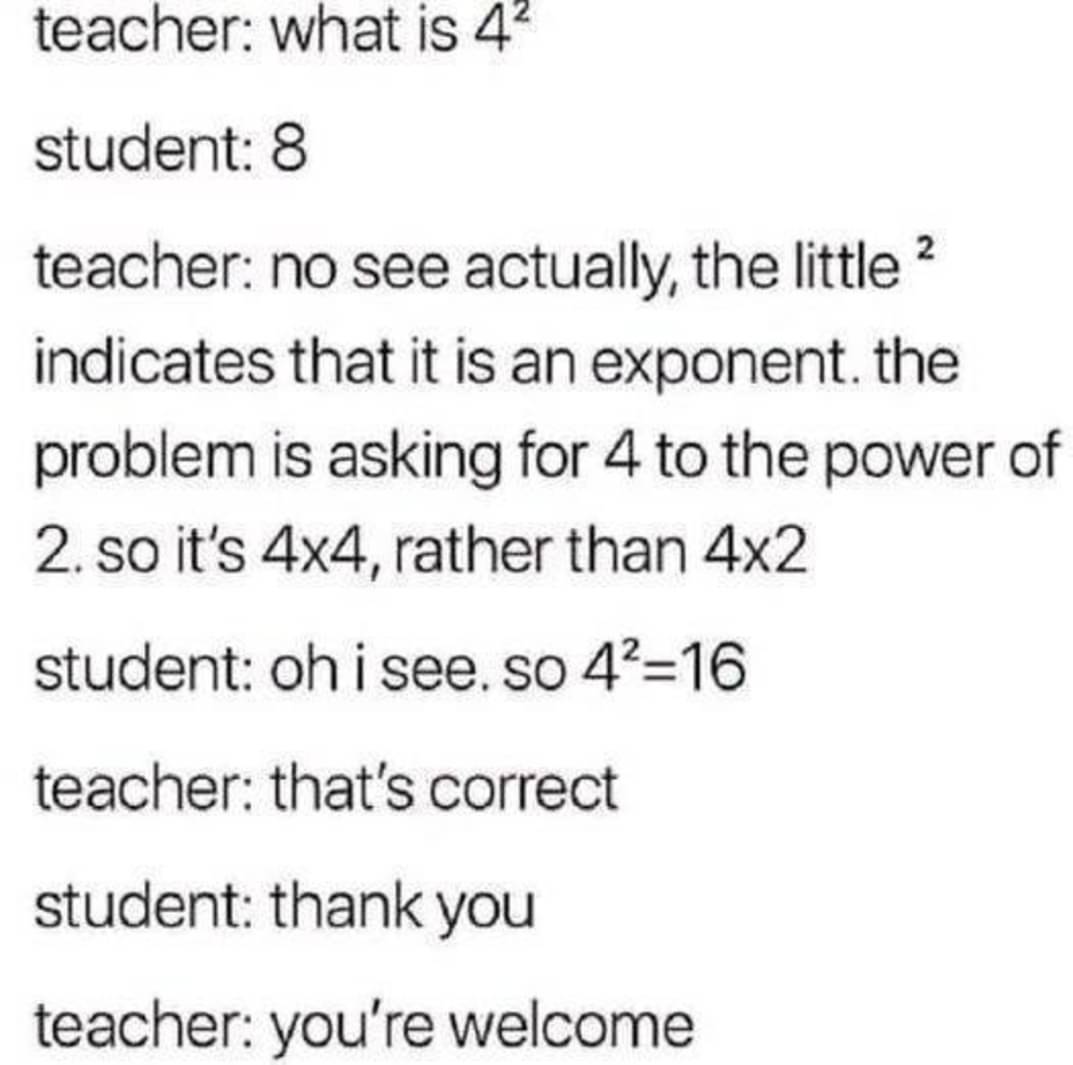
Hrm, it sounds like the teacher already knew the answer.
Maybe stop wasting the time of the student then!?
You're welcome.
A place for majestic STEMLORD peacocking, as well as memes about the realities of working in a lab.

Rules
This is a science community. We use the Dawkins definition of meme.
Hrm, it sounds like the teacher already knew the answer.
Maybe stop wasting the time of the student then!?
You're welcome.
Can someone explain this to me? Not the maths, the joke.
Old man voice: "Aunt eye memes? In my day, we only had regular memes, and I turned out fine!"
I prefer large memes
The test:
Solve e^{int_0 1 x2+x+1 dx}^
No, copilot solve this test
Answer:
To solve the expression ( e^{\int_0^1 x^2+x+1 , dx} ), we first need to calculate the integral of ( x^2+x+1 ) from 0 to 1.
The integral of ( x^2+x+1 ) is: [ \int x^2+x+1 , dx = \frac{x^3}{3} + \frac{x^2}{2} + x + C ]
Evaluating this from 0 to 1 gives us: [ \left[ \frac{x^3}{3} + \frac{x^2}{2} + x \right]_0^1 = \left( \frac{1}{3} + \frac{1}{2} + 1 \right) - \left( 0 + 0 + 0 \right) = \frac{11}{6} ]
Now, we raise ( e ) to the power of this result: [ e^{\frac{11}{6}} ]
This is the solution to the given expression. If you need a numerical approximation, ( e^{\frac{11}{6}} ) is approximately 4.953.
...and this student was Albert Einstein