this post was submitted on 11 Apr 2026
523 points (96.8% liked)
Flippanarchy
2333 readers
993 users here now
Flippant Anarchism. A lighter take on social criticism with the aim of agitation.
Post humorous takes on capitalism and the states which prop it up. Memes, shitposting, screenshots of humorous good takes, discussions making fun of some reactionary online, it all works.
This community is anarchist-flavored. Reactionary takes won't be tolerated.
Don't take yourselves too seriously. Serious posts go to !anarchism@lemmy.dbzer0.com
Rules
-
If you post images with text, endeavour to provide the alt-text
-
If the image is a crosspost from an OP, Provide the source.
-
Absolutely no right-wing jokes. This includes "Anarcho"-Capitalist concepts.
-
Absolutely no redfash jokes. This includes anything that props up the capitalist ruling classes pretending to be communists.
-
No bigotry whatsoever. See instance rules.
-
This is an anarchist comm. You don't have to be an anarchist to post, but you should at least understand what anarchism actually is. We're not here to educate you.
-
No shaming people for being anti-electoralism. This should be obvious from the above point but apparently we need to make it obvious to the turbolibs who can't control themselves. You have the rest of lemmy to moralize.
Join the matrix room for some real-time discussion.
founded 2 years ago
MODERATORS
you are viewing a single comment's thread
view the rest of the comments
view the rest of the comments
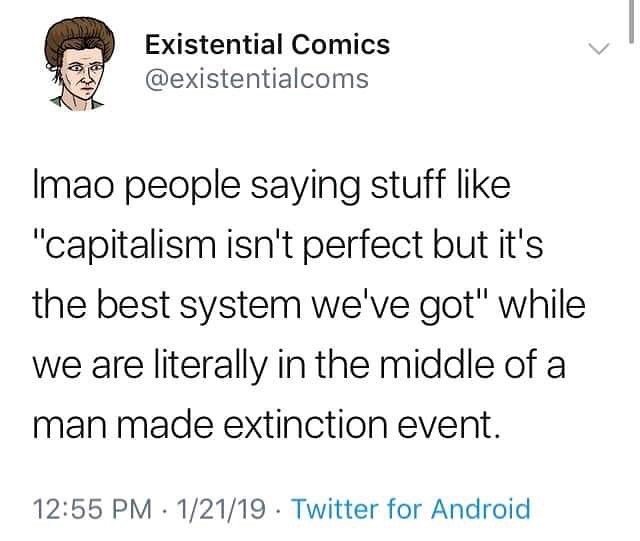
I think it important to distinguish between a free trade market, which should be largely unregulated. People should be able to buy and sell goods on an open market.
Capital markets, or ownership and control of wealth should be heavily regulated.
Derivatives should be outlawed and stock trading should have minimum asset holding periods of 24 months or more. Return it to a platform for making investments and raising capital, rather than a gambling and market manipulation platform.
I would also change the law that the duties of publicly traded company's board and executives is not profit, but the long term sustainability of the organization.
Huh, what's interesting about this is that you've basically arrived at a communist/anarchist idea on your own, but are describing it using Libertarian / Neoliberal Capitalist terminology. You're describing different types of property and saying that one type should be regulated and the other type shouldn't. Anti-capitalists distinguish between private property (the means of production privately owned and involved in an economic enterprise employing wage labor (i.e. factories, offices, farms)) and personal property (consumer goods or goods produced by an individual (i.e. books, art, jewelry)), and believe that the former should be abolished (or one could say regulated to require collective ownership of such property by the workers) while the latter should be unregulated or lightly regulated.
In short, you've independently come to the same conclusion that anarchists and communists came to, but are describing it in a strange way.
I am not well versed in the terminology of Marx, but I do think given the age, it can do with some updating for modern times.
I am not sure you need to distinguish between private and personal property.
I think how I would describe it, is that you get physical goods and services that should be largely unregulated. First order trade.
But when it comes to derived or abstracted goods, like shares, investments, currencies, they should be regulated to ensure they stay closely tied to the physical assets they represent.
In terms of property, I do see some issues when as automation and knowledge becomes more prominent as a means of production, we will need to switch to a different way of thinking.
Something along the lines where knowledge becomes public domain knowledge much sooner than under current laws.
Then approaching taxation of private property and corporations differently, where they are taxed based on the value of assets. You would also stop taxing on revenue and profit. This way they will always have and incentive to make sure they are using assets effectively, or selling it and not just squat on it, to prevent others from having it. Those taxes would then be used to fund universal basic income.