this post was submitted on 02 Oct 2024
1699 points (95.5% liked)
Microblog Memes
11246 readers
1955 users here now
A place to share screenshots of Microblog posts, whether from Mastodon, tumblr, ~~Twitter~~ X, KBin, Threads or elsewhere.
Created as an evolution of White People Twitter and other tweet-capture subreddits.
RULES:
- Your post must be a screen capture of a microblog-type post that includes the UI of the site it came from, preferably also including the avatar and username of the original poster. Including relevant comments made to the original post is encouraged.
- Your post, included comments, or your title/comment should include some kind of commentary or remark on the subject of the screen capture. Your title must include at least one word relevant to your post.
- You are encouraged to provide a link back to the source of your screen capture in the body of your post.
- Current politics and news are allowed, but discouraged. There MUST be some kind of human commentary/reaction included (either by the original poster or you). Just news articles or headlines will be deleted.
- Doctored posts/images and AI are allowed, but discouraged. You MUST indicate this in your post (even if you didn't originally know). If an image is found to be fabricated or edited in any way and it is not properly labeled, it will be deleted.
- Absolutely no NSFL content.
- Be nice. Don't take anything personally. Take political debates to the appropriate communities. Take personal disagreements & arguments to private messages.
- No advertising, brand promotion, or guerrilla marketing.
RELATED COMMUNITIES:
founded 2 years ago
MODERATORS
you are viewing a single comment's thread
view the rest of the comments
view the rest of the comments
It is all quite complicated.
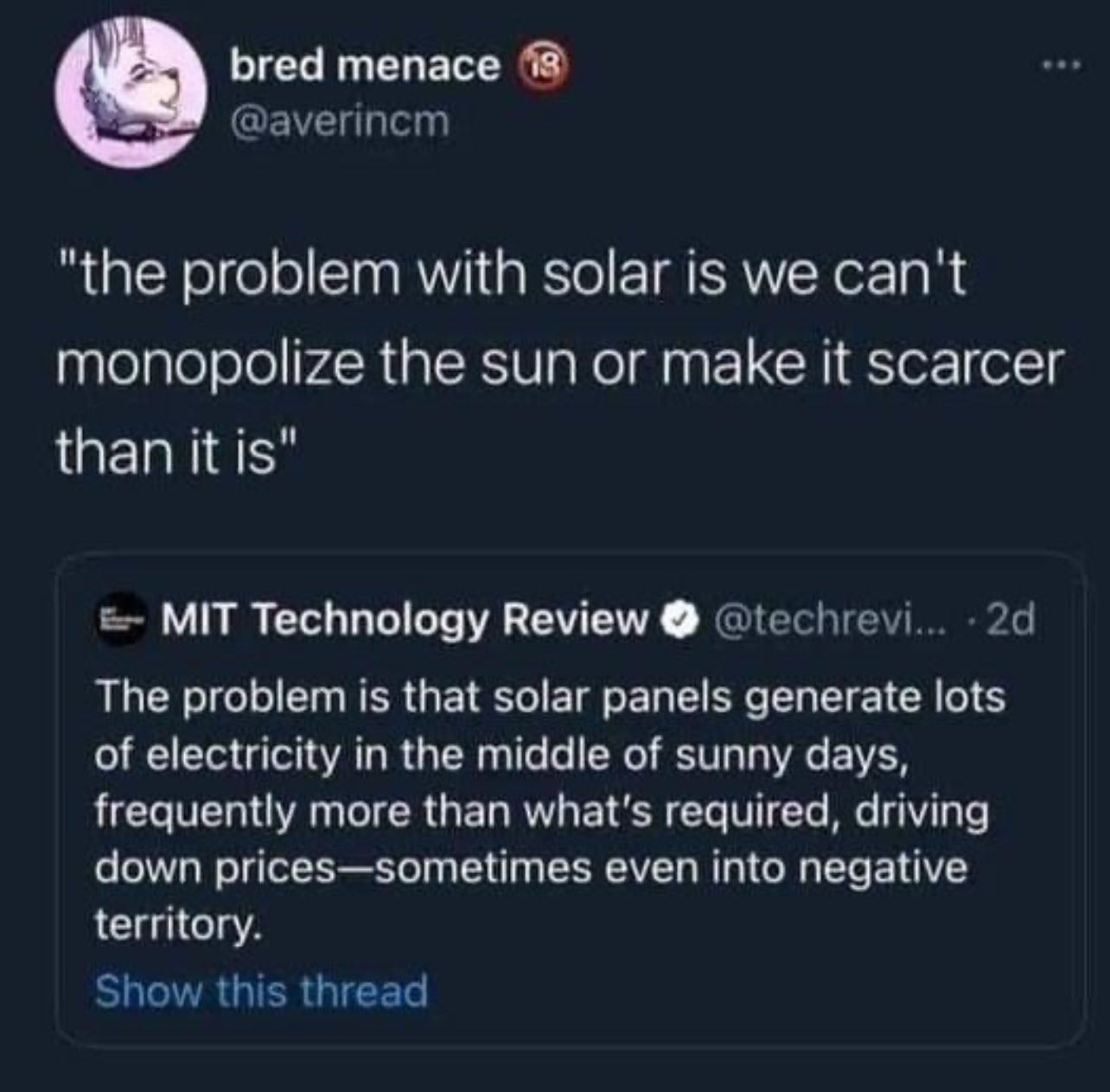
A renewable producer (e.g. solar panels) cannot produce energy 24/7. And when it produces energy, you are not guaranteed the production is stable.
A consumer cannot consume energy 24/7. And when they consume energy, you are not guaranteed the consumption is stable.
To make the issue worse, a producer may not be producing energy when the consumer wants it, and vice versa.
Currently, energy storage is not widely installed. Hence any produced energy must be consumed at the same time.
The factors above combined means that there will be a mismatch. If the production is too great, your electricity appliances will probably explode and whatnot. If the consumption is too great, you experience blackouts. Neither are desirable.
Now consider there is a middleman. The grid. Producers sell energy to the grid. Consumers buy energy from the grid.
At some point in time, due to the factors above, the grid will need (A) zero to negative prices to encourage consumers to buy & use more energy from it, and to encourage producers to produce & sell less energy to it. Or (B) increased prices to encourage consumers to buy & use less energy and producers to produce & sell more energy. A flat price is not realistic. (Residential users only have a flat rate because our demand patterns are more stable.)
But due to the production patterns of renewable energy and consumption patterns of our society, there is a not-insignificant risk that renewable producers will consistently face scenario (A) above making it difficult to cover back the costs.
Number 2 is not inherently true. We can incentivize time-of-use, and push it to time-of-generation. Not with all loads, of course, but with a lot of them, and a lot of very heavy loads.
Our old nuclear/coal model pushes a lot of these loads overnight to reduce daytime demand and "level the curve". Steel mills and aluminum smelters often operate overnight and shutdown during the day, because that is what nuclear and coal needed.
With solar and wind becoming predominant, we need to reverse those overnight, "off peak" incentives, and push consumption to daytime hours.
The concept is known as "demand shaping". It is an underutilized method of matching production and consumption, but it is essential if solar and wind are to become our primary source of power.