Latin American Publications!

94 readers
54 users here now

A community for Latin American publications.

NOTE: All the publications in this feed are Latin American in origin; that does not mean they only report on Latin American news.

founded 2 months ago
MODERATORS
301


The US president orders a “total and complete blockade” of all sanctioned oil tankers entering or leaving Venezuela.


From Presstv via This RSS Feed.

302


(FILE) Photo: EFE.

The Cuban Central Bank (BCC, in Spanish) announced Wednesday the implementation of a new exchange market structure, introducing a daily floating exchange rate segment for currencies, alongside two existing fixed rates.


The Central Bank’s President, Juana Lilia Delgado Portal stated that the current coexistence of different foreign exchange rates “generates distortions, incentivizes informality, and complicates the banking and fiscal traceability of economic activity”, so authorities have the objective of create the conditions to initiate transformations in the foreign exchange market, under principles of graduality and temporality.

RELATED: Cuba Rejects EU Extension of Sanctions Against Venezuela

A new three-segment structure was designed as a transitional scheme to avoid a sharp, disruptive devaluation:

  • Segment I: Maintains a fixed rate of 24 Cuban pesos (CUP) to 1 unit.
  • Segment II: Maintains a fixed rate of 120 CUP to 1.
  • Segment III: A newly created segment featuring a daily floating exchange rate, to be published by the BCC. This rate is intended to reflect “the objective existence of differences between the official exchange rates and the real value that reflects the scarcity of foreign currency”, explained the official. The BCC will daily update  this rate on its official website.

The first two segments will be maintained to prevent sharp devaluations of the exchange rate and, consequently, the value of the national currency, trying to protect the population in basic and sensitive transactions, preserving stability and predictability in the prices of essential goods and services.

The third segment, based on a daily floating rate, will allow exporters and other foreign currency suppliers to sell at a competitive price determined by supply and demand, in a way to incentivize the inflow of foreign currency into the exchange market, which will serve as a source for its operations and reduce the pressures and irregularities of the informal market.

The reform aims to gradually recover the convertibility of the Cuban peso and move toward monetary convergence in an economy plagued by multiple, disjointed exchange rates.

🗣️💵|| Anuncian transformación del mercado cambiario de divisas

🗣️ @BancoCentralCub, en la persona de su ministra presidenta @JlDelgadoPortal anunció, una transformación de su mercado cambiario de divisas, que entrará en vigor a partir de este 18 de diciembre.#ACNreporta pic.twitter.com/1ZedHIA030

— Agencia Cubana de Noticias (@ACN_Cuba) December 18, 2025

Text reads: “Currency exchange market transformation announced @BancoCentralCub, in the person of its Minister-President @JlDelgadoPortal announced a change in its foreign exchange market, which will take effect on 18 December.”

Addressing the MLC

On the other hand, Delgado explicitly denied rumors about the elimination of accounts in the so-called “freely convertible currency” (MLC, in Spanish), asserting the goal is to “strengthen the purchasing power of the MLC and its use value.”

“An immediate unification of the exchange rate, without a transition stage, could cause a sharp devaluation, with greater inflationary effects than current ones and a deepening of the loss of purchasing power of the national currency,” Delgado warned, citing international experience with economies facing accumulated imbalances.

The strategy, aimed at recovering the purchasing power of the national currency, is to concentrate and orient the foreign exchange market by connecting the various economic actors -state and non-state- in the production, export and marketing of goods and services at competitive prices.

The legal provisions enacting these changes will be published in Cuba’s Official Gazette and will enter on force on December 18, 2025.


From teleSUR English via This RSS Feed.

303


Such a talk would imply a serious and flagrant violation of the State policy that has historically guided Chile’s international actions, regardless of the government in power, a statement noted in this capital.

This policy is based on strict compliance with International Law, the promotion and defense of Human Rights, and the unrestricted respect for International Humanitarian Law (IHL).

The text warns that Netanyahu is currently wanted by the International Criminal Court for war crimes, and holding a political conversation with him would represent a break with the diplomatic and legal tradition of the State of Chile.

The Palestinian community called on all political leaders to act responsibly, consistently, and with respect for the principles that have guided the country’s foreign relations, avoiding gestures that could be interpreted as endorsing serious human rights violations.

In a post, Netanyahu congratulated Kast on his election, and several media outlets here reported that the Israeli Foreign Ministry was preparing for a telephone conversation between the two.

jdt/iff/oda/car

The post Palestinian community in Chile rejects Kast-Netanyahu talk first appeared on Prensa Latina.


From Prensa Latina via This RSS Feed.

304


The European Commission opened two antitrust investigations into Google and Meta.

On Thursday, the Office of the United States Trade Representative (USTR) threatened to take countermeasures against the European Union (EU) over what it described as the bloc’s controversial regulations on service providers.

RELATED:

Every Voting Tech Hack Washington Blamed On Venezuela Was Invented In Ohio

“If the EU and EU Member States insist on continuing to restrict, limit, and deter the competitiveness of U.S. service providers through discriminatory means, the United States will have no choice but to begin using every tool at its disposal to counter these unreasonable measures,” the USTR posted on X.

Potential countermeasures could include assessing fees or imposing restrictions on foreign services. The agency also warned that it could adopt a similar approach toward other countries pursuing what it called an EU-style regulatory strategy in this area.

The USTR alleged that the EU and certain member states have pursued a sustained pattern of discriminatory and harassing lawsuits, taxes, fines, and directives targeting U.S. service providers.

US threatens retaliation on EU firms including Accenture, Siemens, Spotify, DHL, and SAP over digital taxes hitting Google, Meta, and Amazon. USTR calls EU measures “discriminatory” and warns of escalation if enforcement continues. pic.twitter.com/WTwzzXLpBc

— MKTNews (@MKTNews_Global) December 16, 2025

“The United States has raised concerns with the EU for years on these matters without meaningful engagement or basic acknowledgement of U.S. concerns,” the USTR added.

The USTR also said EU service providers have operated freely in the United States for decades, benefiting from access to the U.S. market and consumers, while naming several European technology giants with expansive presence in the country.

The latest remarks reflect growing frustration among U.S. officials over the EU’s tightening technology regulations and lawsuits targeting U.S. tech giants.

The European Commission has recently opened two antitrust investigations into U.S. tech giants Google and Meta, and fined Elon Musk’s platform X 120 million euros (US$140 million) in its first non-compliance decision under the Digital Services Act.

#US President Donald Trump confirms at a press conference his interference in the general elections held in #Chile on December 14 and in #Honduras on November 30. pic.twitter.com/Y2yydXRAma

— teleSUR English (@telesurenglish) December 16, 2025

teleSUR/ JF

Source: Xinhua


From teleSUR English via This RSS Feed.

305


On Monday, Venezuela’s public oil company, Petróleos de Venezuela (PDVSA), reported that it was the target of a cyberattack aimed at disrupting its operations. The attempted act of aggression is said to be part of the US government’s strategy to seize Venezuela’s oil through force and piracy, according to a PDVSA statement.

The document stated, “Thanks to the expertise of PDVSA’s human talent, the operational areas were not affected, with the attack limited to its administrative system.”

It added that “the operational capacity of the oil industry is maintained through the implementation of security protocols, which allow the continuation of its regular activities in supplying products to the domestic market and the faithful fulfillment of all its export commitments.”

Cyberattack hits Venezuela's PDVSA. Caracas calls it a US plot to steal its oil. Escalation or desperation?

Where does hybrid warfare go from here? pic.twitter.com/WakMDIDvqi

— Orinoco Tribune (@OrinocoTribune) December 15, 2025

The full unofficial translation of the statement follows:

Petróleos de Venezuela, SA (PDVSA) informs the Venezuelan people and the international community that the company was the target of a cyberattack aimed at halting its operations.

Thanks to the expertise of PDVSA’s human talent, the operational areas were not affected, with the attack limited to its administrative system. Therefore, the operational capacity of the oil industry is maintained through the implementation of security protocols, which allow the continuation of its regular activities in supplying products to the domestic market and the faithful fulfillment of all its export commitments.

This attempted attack is part of the US government’s public strategy to seize Venezuelan oil through force and piracy. The working class in the hydrocarbon industry has faced similar attacks in the past. It was precisely their commitment, expertise, and loyalty that enabled them to detect and neutralize this latest attack.

Petróleos de Venezuela, SA categorically condemns this despicable act, orchestrated by foreign interests in collusion with unpatriotic actors seeking to undermine the country’s right to sovereign energy development. It is worth noting that this is not the first time the United States government, allied with extremist sectors, has attempted to destabilize the nation and steal Christmas from the Venezuelan people.

Nothing and no one will stop the victorious march of PDVSA and its working class in service to all Venezuelans.

Caracas, Dec. 15, 2025.

Renewed European sanctionsAlso on Monday, Venezuela categorically repudiated the policy of illegal sanctions and unilateral coercive measures renewed by the European Union (EU). Venezuela labeled these policies as illegitimate, illegal, and against international law, as well as contrary to the principles and purposes enshrined in the Charter of the United Nations.

International Condemnation Against US Theft of Venezuelan Oil Tanker Grows

In a statement published by Foreign Minister Yván Gil, Venezuela emphasized that the leaders of the EU bloc regrettably “have chosen to accelerate their own political decline, insisting on a line of sterile hostility against Venezuela, which demonstrates an erratic foreign policy, lacking autonomy and subject to interests foreign to the peoples they claim to represent.”

Finally, the statement highlighted that “after years of implementation, this sanctions policy has proven to be a resounding failure. It has significantly damaged political and diplomatic relations, and confirmed the growing irrelevance of the European Union as an international actor capable of acting independently, rationally, and with respect for sovereign states.”

(Últimas Noticias) by Olys Guárate with Orinoco Tribune content

Translation: Orinoco Tribune

OT/JRE/SF


From Orinoco Tribune – News and opinion pieces about Venezuela and beyond via This RSS Feed.

306


Photos by Jay Watts.

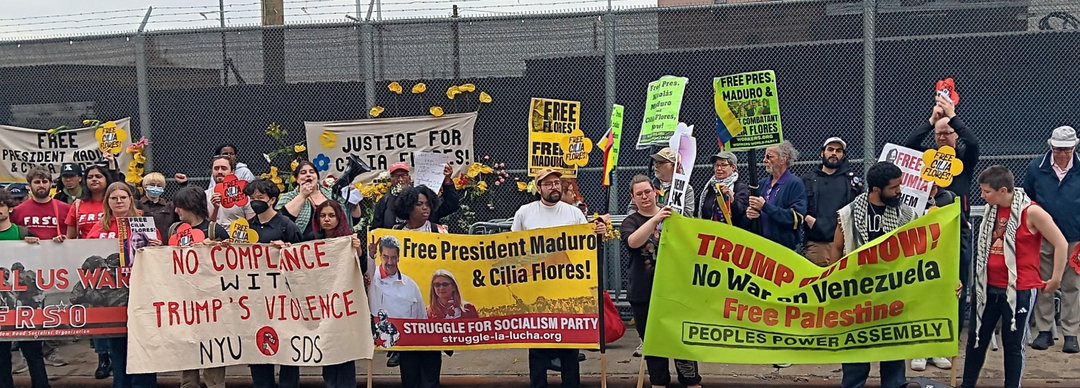
Coordinadora Mexicana de Solidaridad con Venezuela organized a quick rally, held outside the new US embassy in Mexico City, protesting US President Donald Trump’s growing aggression against the Bolivarian Republic of Venezuela and its people. Speakers expressed solidarity from the Mexican people and demanded respect for Venezuela’s sovereignty, an end to US imperialism’s militarization of the Caribbean and regional peace.


The post Trump, Hands Off Venezuela Rally appeared first on Mexico Solidarity Media.


From Mexico Solidarity Media via This RSS Feed.

307


This editorial by Alejandro Castellano López originally appeared in the December 15, 2025 edition of Los Reporteros. The views expressed in this article are the authors’ and do not necessarily reflect those of Mexico Solidarity Media*, or the* Mexico Solidarity Project*.*

I have carefully read the proposed law to “reduce the workweek to 40 hours.” At the same time, I clearly notice that the opposition to the current government hasn’t uttered a peep about it. I wonder why?

I remember well that once, back in the 70s, when as students part of the Struggle Committee of a Vocational School of the National Polytechnic Institute (IPN), we fought alongside the settlers of San Agustín, Ciudad Azteca and La Impulsora, in the north of the metropolitan area of ​​Mexico City, a dear comrade from whom I have not heard for a long time, told me that somewhere Che had said, “when the enemy agrees with you, be careful, something is wrong with what you are doing.”

I hope all workers will soon realize this and there will be large and powerful mobilizations towards the Congress of the Union, so that the deputies and senators who are truly left-wing react positively and modify the initiative to avoid the terrible setbacks it represents. They should also compel the Ministry of Labor and Social Welfare to hire more conscientious people to serve as Labor Inspectors, thus preventing the abuses of employers and the corrupt unions that abound. While they’re at it, they should also remove the traitors Pedro Haces, Ricardo Monreal, Adán Augusto López, and the rest of this toxic element from Congress.

The reform does not seek our well-being but rather to institutionalize dependence on overtime for survival, turning rest time into just another commodity.

One of the most interesting documents I’ve read on this subject is the Statement from the National Front for the 40-Hour Workweek, issued by the San Luis Potosí Coordination, regarding the presidential initiative to reduce the workweek, which was released on December 12th. The Statement I’m referring to says, in reference to the reform, that “the government of Claudia Sheinbaum is presenting us not with the historic reform it promised, but with a trap that legalizes 12-hour and 16-hour overtime shifts, even with precarious wages. The initiative, which amends, adds to, and repeals various provisions of Section A of Article 123 of the Constitution and the Federal Labor Law, is a fraud against the working class and a brutal setback for our rights.”

Recall that current legislation allows up to 3 hours of overtime per day, paid at double time, totaling a maximum of 9 hours per week, which workers are obligated to accept. Any hours worked beyond these 9 must be agreed upon with the employer, who is then obligated to pay them at triple time. However, companies rarely comply with this; they almost always avoid paying overtime through trickery, lies, and threats, which are generally supported by the corrupt unions that are prevalent within the official labor federations.

The government doesn’t even have enough labor inspectors; there are only 600 nationwide, and the state of Yucatán has none.

I quote again the statement from the Front, which is considered the official document of the entire Front, and it says: “This proposal violates the principle of progressivity and non-regression of labor law. Instead of moving forward, it takes a step backward. It doesn’t even guarantee the two mandatory days of rest, maintaining the exploitative six-day workweek and wiping out with a stroke the hard-won weekend and the possibility of a Saturday bonus. It completely ignores all the gender, care, and health perspectives we have demanded.” I would add that in some collective bargaining agreements, this is already a workers’ victory, and now they will pay more for double hours than before, which were triple hours. Where is the progress? It’s a brutal setback! Altagracia’s hand is clearly visible.

Altagracia’s head is also visible.

The statement also denounces the contradiction in the explanatory memorandum and explains and acknowledges, to quote again, “…that reducing the length of the workweek is an imperative not only of social justice but also of public health; on the other hand, it decrees that workers will have more free time, creating an opportunity for them to use it… to work overtime. In other words, it recognizes the harm to health only to then propose that we use our scarce “free” time to continue working. The reform does not seek our well-being but rather to institutionalize dependence on overtime for survival, turning rest time into just another commodity.”

It is clear that the much-touted reform does not bring about a real reduction in the working day; on the contrary, in practice it will become a more effective tool of exploitation than what is currently established, and it is an initiative designed for the benefit of employers and against the dignity of workers.

The statement also condemns the gradual reduction to 40 hours, calling it a “sham,” and questions the current and future actions of labor authorities, who clearly respond to the interests of employers. They don’t even have enough labor inspectors; there are only 600 nationwide, and the state of Yucatán, for example, has none, while most of the inspectors in the other states aren’t even rank-and-file employees. This is an aberration of the self-proclaimed leftist 4T (Fourth Transformation), which today seems to have died at the hands of deputies, cabinet secretaries, senators, and “prominent” members of MORENA (National Regeneration Movement).

The reform is unacceptable and only the Honorable Congress of the Union can prevent this aberration and betrayal against the working class of this country.

  • Christmas Without a Bonus for 13.7 Million Workers

    Labor | News Briefs

    Christmas Without a Bonus for 13.7 Million Workers

    December 16, 2025December 16, 2025

    Mexico’s Scrooge-like employers evade their legal obligation because most employees are informal workers.

  • A Bosses’ Trap?

    Analysis | Labor

    A Bosses’ Trap?

    December 16, 2025December 16, 2025

    Mexico’s much-touted 40 hour workweek reform does not bring about a real reduction in the working day; on the contrary, it will become a more effective tool of exploitation and is an initiative designed for the benefit of employers and against the dignity of workers.

  • People’s Mañanera December 16

    Mañanera

    People’s Mañanera December 16

    December 16, 2025

    President Sheinbaum’s daily press conference, with comments on pharmaceuticals supply, social housing lottery, CDMX Congress fiasco, Ultra-right victory in Chile and H3N2 alert.

The post A Bosses’ Trap? appeared first on Mexico Solidarity Media.


From Mexico Solidarity Media via This RSS Feed.

308


For Marcela Arellano, president of the Ecuadorian Confederation of Free Trade Union Organizations (Ceosl), the increase in minimum income to $482 per month is insufficient given the cost of living.

Arellano noted that the basic family food basket costs $821 and the essential needs basket costs $576, according to data from the National Institute of Statistics and Censuses (INEC).

“We are concerned that a consensus was reached on a downward adjustment. This shows that the Council of Labor and Wages is not representative and that those who sit on it do not understand the reality of those who earn the basic salary,” the union leader stated.

From the government, Labor Minister Harold Burbano has maintained that an Ecuadorian household earns an average of 1.6 times the basic salary and that, therefore, it is incorrect to compare the Unified Basic Salary (SBU) with the cost of a basic food basket.

Arellano questioned this argument and asserted that “there is no clear economic basis” to support it.

The unions also warned of a possible price increase in 2026, due to rising fuel costs and the end of transportation subsidies for the diesel price hike, implemented in September and initially planned for eight months.

jdt/jav/npg/avr

The post The basic salary for 2026 in Ecuador raises questions for unions first appeared on Prensa Latina.


From Prensa Latina via This RSS Feed.

309


Cuban Foreign Minister Bruno Rodríguez rejected on Wednesday the European Union’s (EU) decision to extend until January 10, 2027, the sanctions imposed on the government of President Nicolás Maduro in Venezuela.

Through the social media platform X, the head of Cuban diplomacy described these measures as “contrary to International Law and the Charter of the United Nations (UN).”

RELATED:

Why the US Blockade of Venezuela Violates International Law

“We reject the extension of sanctions and unilateral coercive measures by the European Union against Venezuela… These actions seek to increase pressure against the government of the Bolivarian and Chavista Revolution and serve the aggressive and neocolonialist interests of the United States,” Rodríguez wrote.

According to press reports, the sanctions affect 69 Venezuelan individuals, whose assets remain frozen and who are prohibited from traveling to European territory.

Rechazamos la prórroga de sanciones y medidas coercitivas unilaterales de la Unión Europea contra #Venezuela, que son contrarias al Derecho Internacional y la Carta de @ONU_es.

Estas acciones persiguen aumentar la presión contra el gobierno de la Revolución Bolivariana y… pic.twitter.com/Ds11DJdEwj

— Bruno Rodríguez P (@BrunoRguezP) December 17, 2025

The Venezuelan government has repeatedly denounced these “coercive measures” as illegitimate, illegal, and a violation of international law.

In a statement, the Venezuelan Foreign Ministry criticized the European position, stating that the bloc “chose to accelerate its political decline” by maintaining an “erratic foreign policy, lacking autonomy and subservient to foreign interests.”

It also emphasized that after years of implementation, the sanctions have been “a resounding failure,” damaging diplomatic relations without producing any constructive results.


From teleSUR English via This RSS Feed.

310


The President of the Bolivarian Republic of Venezuela, Nicolás Maduro Moros, inaugurated renovated spaces at the headquarters of the Bolivarian Society of Venezuela this Tuesday, as part of the commemoration of the 195th anniversary of the death of the Liberator Simón Bolívar.

“Today, we are inaugurating these spaces so that young people, community groups, and the people can come and visit the headquarters of the Bolivarian Society, and continue to cultivate the thought, legacy, and actions of our Liberator Simón Bolívar, and so that Bolívar may continue to reign victoriously, above imperial threats, today, tomorrow, and always,” declared the President from the emblematic building located next to the Liberator’s birthplace.

The head of state emphasized that this is one of the few buildings that survived the impact of the petrodollars, which, he noted, destroyed much of Caracas’s colonial and historic architecture.

The Minister of Public Works, Juan José Ramírez, explained that the restored facilities date back to the original founding of the Bolivarian Society, established in 1842 by General-in-Chief Rafael Urdaneta under the name “Great Bolivian Society of Caracas.”

The work carried out included the rehabilitation of the Rafael Urdaneta Hall, the immediate repair of the roof and walls, and the complete restructuring of the electrical, plumbing, and public utility systems.

The event was part of the official activities commemorating the 195th anniversary of the death of Simón Bolívar, which occurred on December 17, 1830, at 1:05 p.m. From the headquarters of the Bolivarian Society, Maduro paid fervent tribute to the Liberator, whom he described as “the most exalted man in history.”

Earlier, through his official Telegram channel, the president published a message in which he recalled that, “almost two centuries ago, the liberated peoples trembled upon hearing the news of his death,” and emphasized that “the Genius of America, who was born into a privileged life, gave everything—his body, his life, and his wealth—for the emancipation of the continent.”

The Venezuelan leader stressed that Bolívar’s “infinite greatness and incomparable magnitude” indelibly shaped the destiny of “our America,” and affirmed that “Bolívar did not perish; his spirit remains vigilant,” quoting the poet.

“Today, his ideal shines an inextinguishable light in its cradle: Bolivarian Venezuela. We, the heirs of the 21st century, the Bolivarian revolutionaries, feel how the Liberator becomes flesh within us as a historical, creative, and redeeming force,” he expressed.

He also emphasized that authentic Bolivarianism, revitalized by Commander Hugo Chávez, constitutes a fundamental axis of anti-imperialism, anti-colonialism, and the profound unity among peoples, as a supreme inspiration in the face of any adversity.

The day concluded with the traditional cry of the leader of the Bolivarian Revolution: “Bolívar lives!”


From teleSUR English via This RSS Feed.

311


US military forces carried out airstrikes against three vessels in the eastern Pacific Ocean, killing at least eight people, according to statements by US Southern Command.

RELATED:

President Maduro Thanks the People of Venezuela for Their Response to Aggression

The command said the operations were conducted on Monday under orders from US Secretary of War Pete Hegseth. In a post on X, Southern Command stated that intelligence assessments determined the vessels were traveling along known drug trafficking routes in the eastern Pacific and were involved in narcotics-related activities. No evidence was presented to support the claim.

Southern Command confirmed that eight people were killed in the strikes: three aboard the first vessel, two on the second, and three on the third. The command also released video footage of the operation on its official social media account.

JUST IN:

US forces struck 3 vessels in the eastern Pacific that were allegedly linked to drug trafficking, killing 8 people.

US has so far killed dozens of people in such strikes, claiming those killed were narco-terrorists, but it has not provided evidence. pic.twitter.com/sEO83fquWZ

— Current Report (@Currentreport1) December 16, 2025

In a separate statement, Southern Command reported another operation carried out on December 4 against a vessel suspected of drug trafficking, which resulted in the deaths of four people on board.

US authorities said the attacks are part of a broader military campaign known as Operation Southern Spear, aimed at disrupting maritime drug trafficking routes. According to official figures, US forces have attacked more than 20 vessels in the Caribbean Sea and the Pacific Ocean under this campaign, killing at least 91 people. Other official tallies cited more than 26 vessels destroyed and around 90 fatalities.

The expanded US military presence in the Caribbean and surrounding waters comes amid months of sustained pressure by Washington against Venezuela. Venezuelan President Nicolás Maduro said that former US President Donald Trump’s decisions regarding the alleged “war on drugs” have exposed the South American country to what he described as the “greatest continental threat in a century.”

Venezuelan authorities argue that the increased US militarization in the Caribbean is intended to undermine the government in Caracas. Trump has repeatedly announced that the United States will soon begin ground military operations against drug cartels on Venezuelan territory. Last week, he also said that Colombian President Gustavo Petro was “next,” referring to the pressure strategy previously directed at Maduro.


From teleSUR English via This RSS Feed.

312


On his social media account, the minister denounced that this latest hostile act against the South American country’s oil corporation was aimed at paralyzing the operations of this important Venezuelan institution.

According to the head of Cuban diplomacy, “these actions are part of the psychological warfare and increased pressure by the United States government to overthrow the Venezuelan government,” headed by President Nicolas Maduro.

The Cuban government categorically rejected “this despicable action, orchestrated by foreign interests in collusion with stateless actors seeking to undermine the country’s right to sovereign energy development,” according to a statement from the institution.

Washington has deployed military forces and resources in the Caribbean Sea, monitoring the coasts of the South American country, whose cargo was seized on the high seas from one of its oil tankers.

The whereabouts of the crew remain unknown.

jdt/jha/lld

The post Cuba denounces US attack on Venezuelan Oil Industry first appeared on Prensa Latina.


From Prensa Latina via This RSS Feed.

313


A new ship carrying solidarity aid from the Government of Venezuela and the Bolivarian Alliance for the Peoples of Our America (ALBA-TCP) arrived this Wednesday, December 17, at the Guillermón Moncada port in Santiago de Cuba, with the aim of supporting recovery efforts following Hurricane Melissa.

The cargo includes several containers with materials and supplies primarily intended for the reconstruction of road infrastructure and other sectors severely affected by the storm. This shipment follows the arrival of the ship “Manuel Gual” on December 8, which delivered machinery and more than 7,110 tons of supplies for the affected population.

RELATED:

Venezuela Sends New Massive Humanitarian Shipment to Cuba Following Hurricane Damage

The arrival of the ship reinforces the solidarity alliance among the ALBA-TCP nations, in a context marked by external pressures seeking to hinder regional cooperation. Despite this, countries like Venezuela, Bolivia, and Mexico have contributed in a coordinated manner to mitigate material damage and accelerate the restoration of land communications in the eastern part of the archipelago.

Cuban President Miguel Diaz-Canel Bermudez returned to Santiago de Cuba on Thursday to review the progress of recovery efforts in the provinces affected by Hurricane Melissa. This was the area most severely affected by the cyclone's winds. pic.twitter.com/q3ShsFACT9

— teleSUR English (@telesurenglish) November 13, 2025

Cuban President Miguel Díaz-Canel Bermúdez has personally overseen recovery efforts in Santiago de Cuba, beginning his tour of the affected areas just one day after the hurricane passed.

ALBA-TCP: Summit of brotherhood between peoples

At the 25th ALBA-TCP Summit, held on December 14th as part of the centennial celebrations of Fidel Castro Ruz, Díaz-Canel reaffirmed the region’s commitment to “dignified resistance” and unity in the face of external aggression.

Ver esta publicación en Instagram

Una publicación compartida por Televisora Venezolana Social TVES (@tves_aldia)

“The unity of the bloc is the strategic response to guarantee sovereignty,” the president declared, invoking the ideals of Simón Bolívar, José Martí, Fidel Castro, and Hugo Chávez. This international support complements Cuba’s sovereign efforts, which operate under the limitations imposed by the United States’ economic blockade.


From teleSUR English via This RSS Feed.

314


The President of the Bolivarian Republic of Venezuela, Nicolás Maduro Moros, held a telephone conversation this Tuesday with the Secretary-General of the United Nations, António Guterres, to warn about the escalating threats against the country and their serious implications for regional peace and stability, the Venezuelan government reported in an official statement.

RELATED:

Why the US Blockade of Venezuela Violates International Law

During the exchange, the head of state denounced to the highest representative of the multilateral system the recent public statements made by the President of the United States, Donald Trump, disseminated through social media, in which he openly stated in a colonial manner that Venezuelan oil, natural resources, and territory “belonged” to Washington. Maduro emphasized that these statements constitute a direct threat to national sovereignty, international law, and peaceful coexistence among nations.

The Venezuelan president also warned that these claims were echoed by high-ranking US officials, including Stephen Miller, who asserted that the Venezuelan oil industry also belonged to the United States, which—according to Caracas—confirms the existence of a doctrine of plunder and neocolonial domination against Venezuela. In this regard, Maduro emphasized that such positions must be categorically rejected by the United Nations system.

In his dialogue with Guterres, the Venezuelan president described the political, diplomatic, and economic siege the country faces, as well as the intensification of a campaign of falsehoods, military threats, and acts of force, which has included acts of modern piracy, such as the attack on a ship transporting legitimately traded Venezuelan oil. The president characterized these actions as part of a “diplomacy of barbarism,” contrary to the principles of international law.

President Maduro reiterated Venezuela’s unwavering commitment to upholding a dignified diplomacy based on dialogue, international law, and peace, while reaffirming the Venezuelan state’s commitment to the peaceful resolution of disputes and the defense of its sovereignty.

For his part, UN Secretary-General António Guterres reaffirmed his commitment to international law and the principles enshrined in the Charter of the United Nations, expressed his solidarity with the Venezuelan people, and stressed the need to avoid any escalation or confrontation, warning that an armed conflict in the region would be unjustified and would have serious consequences for the stability of Latin America and the Caribbean.

#FromTheSouth News Bits | Venezuelan President Nicolas Maduro: "We are victorious. We have defeated every criminal gang. We are consolidated." pic.twitter.com/1pROctIpIG

— teleSUR English (@telesurenglish) August 11, 2025

Guterres also reported that he will monitor the situation and that the issue will be addressed in the appropriate forums of the United Nations system, always prioritizing de-escalation, diplomacy, dialogue, and the peaceful resolution of disputes.

The official statement, dated December 17, 2025, in Caracas, comes amid growing international tension, marked by threats of blockades, maritime interdiction, and economic pressure against Venezuela—actions that the Bolivarian Government considers a flagrant violation of international law and a direct risk to regional peace.


From teleSUR English via This RSS Feed.

315


On Monday, the International Criminal Court announced that it had rejected an appeal by the State of Israel seeking to halt the investigation into crimes committed in Palestine. The investigation, filed by Israel in 2018 and initiated by the court in 2021, emphasized that the proceedings will continue without restarting any deadlines or procedures.

The ICC ruling keeps the case open and upholds the subsequent arrest warrant against Israeli Prime Minister Benjamin Netanyahu and his former Defense Minister, Yoav Gallant, alleging “conduct committed in the context of the same type of armed conflicts, relating to the same territories, with the same alleged parties involved in those conflicts.”

RELATED:

Israel Seeks to Overturn ICC Warrants for Netanyahu and Gallant in War Crimes Case

The ICC will investigate “not only crimes that had already been committed or were being committed at the time of the referral, but also crimes committed subsequently” if such a connection exists.

Likewise, the Appeals Chamber rejected the notion that the prosecution’s investigation was limited to the settlement policy in the West Bank. It emphasized that the referral of the case, since 2018, describes a broader context, including systematic crimes that qualify as war crimes and crimes against humanity. humanity.

The ICC appeals chamber has rejected one of Israel’s legal challenges seeking to block an investigation into its actions in its genocidal war on Gaza, dealing a blow to efforts to derail the case https://t.co/YLUeq6fyC9 pic.twitter.com/PQRfVXVpOt

— Al Jazeera English (@AJEnglish) December 15, 2025

Israel demanded a new notification in order to halt the Court’s investigation and claimed jurisdiction over its judicial system, arguing that events after October 7, 2023, required a “new notification.”

There is no “new situation” or “new parameters” that would compel the Prosecutor to restart the proceedings as required by the Rome Statute, the ICC ruling emphasized regarding the Zionist state’s request. Furthermore, the Chamber ruled that the current events are sufficiently linked to the crisis situation referred to the Court in 2018, which stems from the same Israeli policies previously denounced.

#ICC Prosecutor @KarimKhanQC announces applications for arrest warrants in relation to Benjamin Netanyahu and Yoav Gallant in the context of the situation in the State of #Palestine ⤵️https://t.co/WqDZecXFZq pic.twitter.com/bxqLWc5M6u

— Int'l Criminal Court (@IntlCrimCourt) May 20, 2024

It is worth noting that the Israeli side’s attempts are recurrent. Last July, the International Criminal Court (ICC) rejected Tel Aviv’s request to suspend the investigation into alleged war crimes and crimes against humanity in Palestine and to annul the arrest warrants issued against Prime Minister Benjamin. Netanyahu and former Defense Minister Yoav Gallant.


From teleSUR English via This RSS Feed.

316


In a message posted on her X profile, Castro informed that, based on verified intelligence, former President Juan Orlando Hernandez, pardoned by US President Donald Trump, is planning to enter the country to proclaim the winner of the elections.

The president alluded to the recent pardon granted by Trump to Hernandez, former leader of the right-wing Partido Nacional (National Party-PN), who was sentenced in 2024 by a US court to 45 years in prison for drug trafficking.

This pardon is part of Trump’s interventionist plan in the November 30 general elections in Honduras, in which he also openly supported PN’s presidential candidate Nasry Asfura.

Additionally, Castro denounced that “an aggression is underway aimed at breaking the constitutional and democratic order, through a coup” against her administration, which is scheduled to complete her four-year term on January 27.

“Given this grave situation, I urgently request the conscious and peaceful support of the Honduran people,” the first female president in the history of this nation underscored.

jdt/iff/lam/edu

The post Honduras’ President warns of coup attempt first appeared on Prensa Latina.


From Prensa Latina via This RSS Feed.

317


Green movements reaffirm support for President Maduro and the Bolivarian Revolution.

On Wednesday, Venezuelan environmentalist, ecologist and ecosocialist movements publicly spoke out against new threats by U.S. President Donald Trump against the Bolivarian Revolution.

RELATED:

Trump’s Oil Blockade Against Venezuela Violates International Law: Iran

Earlier, on Tuesday night, U.S. President Donald Trump ordered a total blockade on the entry and exit of oil tankers, a measure that would remain in effect until Venezuelans “returns all the oil, land and other assets they previously stole” from the United States. In response to these unprecedented claims, Venezuelan ecologist activists issued the following statement:

“The ecosocialist, environmentalist, and ecologist movements, together with the Ecosocialism Councils of 5,336 Communal Government Halls, state our complete rejection of the insolent, crude, and arrogant message sent by the U.S. President Donal Trump.

His threatening message lays bare the U.S. empire’s true intentions: to steal our oil and mineral and natural wealth. These natural assets belong to Venezuelan women and men, and to no one else. We do not want to take anything from them, but we are also not willing to allow anything to be taken from us.

Venezuela Defense Minister: "The Armed Forces categorically reject the delusional statements made yesterday by Mr. Trump. He has claimed we have stolen the oil that lies under our land.

The truth has been revealed. It's not about 'narco-terrorism'.

It's all about the oil." pic.twitter.com/9BIloQkDKh

— COMBATE |🇵🇷 (@upholdreality) December 17, 2025

International law, our Constitution and the free will of the Venezuelan people — who decided to be free and sovereign — are on our side. Venezuela’s national assets are meant to meet the needs of our people and to be freely exchanged with the rest of the world, in solidarity and in accordance with international trade rules.

The commander in chief and president of the Bolivarian Republic of Venezuela, Nicolas Maduro, is the legitimate president of our nation and the father of the Great Mother Earth Venezuela Mission, a beautiful policy aimed at addressing the capitalist-driven climate crisis in a scientific and organized way, with the participation of an entire people.

We stand ready to defend the homeland wherever, however, and whenever necessary. We only await your order, Commander. We will defend our homeland with all the strength used to defend Mother Earth.

Yankee go home!”

#OnThisDay we remember Simon Bolivar, the Liberator of South America, who passed away in 1830.

He was a soldier and statesman who played a central role in the South American independence movement. He is remembered worldwide as a champion of liberation and anti-colonial… pic.twitter.com/2ATJ57j4Qu

— teleSUR English (@telesurenglish) December 17, 2025

teleSUR/ JF

Source: Ecosocialist Movement


From teleSUR English via This RSS Feed.

318


Their declared goal, the political organization said, is to cut off all oil revenues in order to force the illegal overthrow of an independent government.

“This siege is designed to provoke an economic collapse and a humanitarian crisis as a prelude to a total war by the United States,” he said.

The PSL emphasized that this aggression seeks to control Venezuelan oil and reverse the political independence of that country, following “a pattern of US intervention in Latin America, where governments that resist US control are targeted for regime changes”.

In its statement, the party recalled the attacks in the Caribbean and the eastern Pacific by the US naval flotilla in the Caribbean on small vessels branded as drug trafficking and the recent illegal seizure of a Venezuelan oil tanker.

Such facts “already show that the Trump administration is violently intensifying this conflict,” said the PSL. Trump has made clear his colonial intentions, it warned, by declaring the US plans to steal territory, oil and minerals from Venezuela.

The PSL, founded in 2004, reiterated that the US people have overwhelmingly opposed military intervention in Venezuela. “This war, like the war in Iraq, is based on false pretexts and imperial ambition”.

“We must organize and mobilize to stop this blockade and avoid a more extensive war. No to the war in Venezuela,” it concluded.

The activist Gloria La Riva, leader of that political force, warned that Trump and his administration continued to dangerously approach a military incursion in Venezuela, a war adventure in which they could enter and would not easily get out.

“It is evident what Trump said in his first term (2017-2021) that he was going to end Cuba, Venezuela, Nicaragua, socialism in Latin America, is trying that,” added the also former presidential candidate for the PSL.

Yesterday the republican president ordered a total and complete blockade of oil tankers entering and leaving Venezuela after the announcement of the designation of the Venezuelan government “as a terrorist organization”.

abo/rc/dfm

The post PSL condemned Trump’s naval blockade order against Venezuela first appeared on Prensa Latina.


From Prensa Latina via This RSS Feed.

319


During the signing ceremony of the agreement, held in Havana, the Japanese diplomat emphasized that this initiative, channeled through the United Nations Children’s Fund (UNICEF), constitutes the second collaboration between Tokyo and the UN agency for the benefit of Cuba, the first during the COVID-19 pandemic.

“We trust that this new project will contribute to the improvement of services and infrastructure related to access to water and maternal and child health in vulnerable communities in the provinces of Granma, Santiago de Cuba, and Guantánamo,” stated the ambassador, while recalling the devastation caused by Hurricane Melissa and other extreme weather events that have impacted the region in recent years.

For her part, the Deputy Representative in Cuba, Sunny Guidotti, described the initiative as “an investment in rights”: the right of children and adolescents to grow up healthy, study in safe schools, and receive quality care, even in emergency situations.

“Cuba is increasingly facing the impact of climate change, with annual losses equivalent to 4.6% of GDP.

In the last two years alone, Granma, Santiago de Cuba, and Guantanamo have suffered hurricanes, floods, droughts, and earthquakes with a direct impact on essential services for children,” Guidotti noted.

The 24-month project will prioritize schools and health centers exposed to multiple risks, directly benefiting children, adolescents, and pregnant women in communities in eastern Cuba.

jdt/rc/mks

The post Japan strengthens cooperation with Cuba for the benefit of children first appeared on Prensa Latina.


From Prensa Latina via This RSS Feed.

320


According to ICAP, this measure represents the concrete application of what they call the “Trump Corollary” to the historic Monroe Doctrine, reaffirmed in official documents of American foreign policy as the National Security Strategy for Our America.

The Cuban institution described as “facade” the arguments put forward by Washington on the fight against drug trafficking and terrorism, pointing out that such pretexts conceal illegal intentions that endanger regional and global peace. In its statement, the entity denounced the maneuver as a form of “hybrid war” that escalates tensions towards a military scenario, with the aim of seizing Venezuelan natural resources and exerting coercive pressure against a sovereign state.

The text reiterates “unwavering solidarity” with the government of President Nicolas Maduro and the Venezuelan people, and makes an urgent appeal to social movements, parliaments, governments and international organizations to reject what it called a “rude imperial act”.

In this regard, he calls for a mobilization to defend sovereignty, peace and the principles of the United Nations Charter. “No naval blockade! ! No to imperialist looting! Hands off Venezuela!” concludes the statement.

abo/rc/lld

The post ICAP condemns U.S. naval blockade against Venezuela first appeared on Prensa Latina.


From Prensa Latina via This RSS Feed.

321


In recent hours, the National Electoral Council (CNE) rejected by majority vote a proposal from two of the three main political parties to conduct a recount of all 19,167 presidential ballots.

The CNE is comprised of the three major political forces in this Central American country: the right-wing National Party (PN) and Liberal Party (PL), which embody the century-old two-party system, and the ruling Liberty and Refoundation Party (Libre, left-wing), of current President Xiomara Castro.

During their most recent plenary session, PL party magistrates Ana Hall and Cossette López challenged the request by Libre party council member Marlon Ochoa for a recount of all ballots in the presidential election, citing numerous irregularities detected in the voting records.

According to preliminary results released by the electoral authority, whose process has been suspended for several days, PN party presidential candidate Nasry Asfura, supported by US President Donald Trump, leads with 40.54 percent of the vote. Salvador Nasralla of the PL party trails closely with 39.19 percent. Like Libre, Nasralla has requested a recount of all ballots nationwide and accused the National Party of attempting to steal the election through fraud. Favored by most polls prior to the November 30 elections, Libre candidate Rixi Moncada is in third place with 19.29 percent of the vote. jdt/rc/edu

The post Honduras sees no end in sight to the post-election crisis first appeared on Prensa Latina.


From Prensa Latina via This RSS Feed.

322


Several Caribbean nations offer citizenship to foreign investors under the CBI program.

On Wednesday, the governments of Antigua and Barbuda and Dominica expressed surprise at the partial travel restrictions imposed by the United States, which “unfairly” affect the citizens in legitimate programs.

RELATED:

Antigua and Barbuda Demands Peace, Justice and International Cooperation at UN Assembly

Antigua and Barbuda Prime Minister Gaston Browne stated that his country’s Citizenship by Investment (CBI) program has historically operated without a residency requirement but now requires 30 days of physical residency, which contradicts the U.S. proclamation.

Under the program, several Caribbean nations offer citizenship to foreign investors in exchange for a substantial contribution to the “socio-economic development” of these countries.

Browne denounced that the United States’ claims “do not reflect the current reality” and noted that his country has worked closely with Washington to strengthen CBI safeguards and prevent risks to U.S. national security.

Browne, who has criticized the U.S. military deployment in the Caribbean, added that the Parliament passed comprehensive legislation that introduces strict residency requirements and reinforces the program’s transparency.

The Donald Trump administration has banned people with Palestinian-Authority-issued travel documents from entering the United States.

Other countries added in the travel ban are Angola, Antigua and Barbuda, Benin, Côte d’Ivoire, Dominica, Gabon, Gambia, Malawi, Mauritania,… pic.twitter.com/SFwtwcZRgf

— Pop Crave (@PopCrave) December 17, 2025

Dominica Prime Minister Roosevelt Skerrit stated that he held productive talks with the United States regarding the CBI program, and attributed the decision to a possible lack of communication between the White House and branches of the U.S. government.

Skerrit announced that Dominica will send formal notes requesting clarification and a review of the measure. He confirmed that he is in contact with Browne and asked that the error be acknowledged and the decision revoked.

On Monday, Skerrit offered to mediate between the United States and Venezuela amid growing tensions in the Caribbean, and emphasized that Dominica maintains friendly relations with both countries.

U.S. President Donald Trump’s proclamation expanded the list of countries with total travel bans to 19 and added partial restrictions to another 19. He justified the measure by citing a lack of sufficient information about the risks posed by travelers.

The Prime Minister of Antigua and Barbuda, Gaston Browne, declared before parliament that Antigua and Barbuda will not use its military assets for any country, as they support the region being considered a zone of peace.#AntiguaandBarbuda #USA #SoutherCommand #Caribbean #teleSUR pic.twitter.com/iHVduMiS6V

— teleSUR English (@telesurenglish) October 17, 2025

teleSUR: JP

Source: EFE


From teleSUR English via This RSS Feed.

323


Sovereignty, non-intervention, and the UN’s peace principles collide with Washington’s bid to choke Venezuela’s oil shipments through a naval blockade.


The latest threat from United States President Donald Trump against Venezuela, a country on which he has unilaterally decreed a naval military blockade to impede oil exports, blatantly violates a series of international legal instruments.

Related:

Venezuela and China Discuss Regional Security After Trump Threatens Oil Blockade

Trump’s actions, disregarding the very norms governing international coexistence, portray him as an omnipotent leader capable of ordering extraterritorial operations worldwide.

This aggression against Venezuela, a sovereign nation possessing the largest oil reserves globally, undermines every organism, statute, convention, and resolution within the United Nations system.

Here’s a detailed breakdown of how Trump’s imperialist actions against Venezuela contravene international law:

Undermining the UN Charter: A Direct Challenge to Sovereignty

The United Nations Charter stands as the foundational document of international relations, establishing principles for peaceful coexistence and respect among sovereign states.

Article 2, in particular, outlines critical tenets that Trump’s policies directly contravene:

  • Article 2.1: Sovereign Equality of All Members The UN Charter is based on the principle of the sovereign equality of all its Members. Venezuela, as a member state, is entitled to the same respect for its sovereignty as any other nation.

  • The imposition of a naval blockade by the US, a foreign power, disregards this fundamental principle, treating Venezuela not as an equal but as a subordinate entity subject to external dictates. This action fundamentally challenges the notion that all states possess equal legal standing and are free from external interference in their internal affairs.

  • Article 2.3: Peaceful Settlement of International Disputes Members of the Organization shall settle their international disputes by peaceful means in such a manner that international peace and security, and justice, are not endangered.

  • The US’s declaration of a naval blockade, a hostile and coercive measure, is a stark deviation from the peaceful resolution of disputes. It introduces an element of force and intimidation, escalating tensions rather than seeking diplomatic or mediated solutions, thereby endangering international peace and security.

  • Article 2.4: Prohibition of the Threat or Use of Force Members of the Organization shall refrain in their international relations from the threat or use of force against the territorial integrity or political independence of any state, or in any other manner inconsistent with the Purposes of the United Nations.

  • A naval military blockade unequivocally constitutes a threat and use of force. Its explicit aim to prevent oil exports directly impacts Venezuela’s economic lifeblood, threatening its political independence and territorial integrity by dictating its trade and maritime access.

  • This action is a clear violation of one of the most sacrosanct principles of international law, established to prevent aggression and ensure state autonomy.

  • The blockade is not merely an economic sanction but a coercive military action designed to cripple the nation and force a change in its political course, a blatant infringement upon its self-determination.

Mexican President Claudia Sheinbaum responds to Tuesday's statements by United States President Donald Trump regarding Venezuela, reiterating Mexico's constitutional position of non-intervention, non-interference in foreign affairs, the self-determination of peoples, and the… pic.twitter.com/UCm1ATlc0z

— teleSUR English (@telesurenglish) December 17, 2025

The Right to Self-Determination: A Pillar of Human Rights

The International Covenant on Civil and Political Rights (ICCPR), ratified by numerous nations, affirms the inherent right of all peoples to self-determination.

This right is pivotal for a nation’s development and autonomy.

  • Article 1.1: Free Determination of Political Status and Development

  • All peoples have the right of self-determination. By virtue of that right, they freely determine their political status and freely pursue their economic, social, and cultural development.

  • The US blockade, aimed at disrupting Venezuela’s economic activities and destabilizing its government, directly impedes the Venezuelan people’s ability to freely determine their political status and pursue their economic and social development.

  • By targeting the nation’s primary source of income, the blockade seeks to undermine the existing political order and dictate the terms of Venezuela’s future, thereby denying its people their fundamental right to choose their own path without external coercion.

  • Article 1.2: Free Disposal of Natural Wealth and Resources For the attainment of their ends, all peoples may freely dispose of their natural wealth and resources without prejudice to any obligations arising out of international economic co-operation, based upon the principle of mutual benefit, and international law.

  • In no case may a people be deprived of its own means of subsistence. Venezuela possesses the world’s largest proven oil reserves, which are its primary natural wealth.

  • The naval blockade, designed to prevent the export of this oil, directly deprives the Venezuelan people of their means of subsistence.

  • This act is a severe violation of their economic self-determination, stripping them of the ability to utilize their resources for national development and the welfare of their population. It is an economic warfare tactic that directly threatens the survival and well-being of millions, contravening the core principle that no people should be deprived of their essential resources.

Freedom of the High Seas: A Universal Right

The 1958 Geneva Convention on the High Seas establishes the principle that the high seas are open to all nations, ensuring freedom of navigation.

Article 2: No State May Subject the High Seas to its Sovereignty

The high seas being open to all nations, no State may validly purport to subject any part of them to its sovereignty.

The freedom of the high seas is exercised under the conditions laid down in these articles and by other rules of international law.

It comprises, inter alia, both for coastal and non-coastal States:

    1. Freedom of navigation. By imposing a naval blockade, the US attempts to exert sovereign control over international waters to prevent Venezuelan vessels and those trading with Venezuela from navigating freely.

This action is a direct challenge to the principle of the high seas as a global common, accessible to all.

It represents an illicit extension of power beyond national jurisdiction, infringing upon the rights of Venezuela and other nations to engage in legitimate maritime activities without interference.

  • Article 4: Right to Flag for All States Every State, whether coastal or not, has the right to sail ships under its flag on the high seas.
  • The US blockade directly interferes with Venezuela’s right, and the right of any vessel flying its flag or doing business with it, to navigate the high seas.
  • This act disrupts international trade, poses a threat to maritime security, and undermines the established norms of global commerce and navigation.
  • It creates a dangerous precedent where a powerful nation can unilaterally dictate access to international waters based on political disagreements, an action that threatens the stability of the entire maritime legal framework.

Permanent Sovereignty Over Natural Resources:

A Development Imperative UN General Assembly Resolution 1803 (XVII) of December 14, 1962, titled “Permanent Sovereignty over Natural Resources,” reaffirms the inalienable right of nations to control and utilize their natural wealth for national development.

  • Resolution 1803 (XVII), Paragraph 1:

Exercise of Sovereignty for National Development and Welfare

The right of peoples and nations to permanent sovereignty over their natural wealth and resources must be exercised in the interest of their national development and of the well-being of the people of the State concerned.

The US naval blockade on Venezuela’s oil exports directly obstructs Venezuela’s ability to exercise this fundamental right.

By preventing the sale of its oil, the US effectively undermines Venezuela’s national development efforts and directly impacts the well-being of its population, which relies on oil revenues for essential services and economic stability.

This is not merely an economic sanction but an attempt to control and undermine the sovereign management of a nation’s vital resources.

  • Resolution 1803 (XVII), Paragraph 7:

Violation of Sovereign Rights and International Cooperation

The violation of the sovereign rights of peoples and nations over their natural wealth and resources is contrary to the spirit and principles of the Charter of the United Nations and hinders the development of international co-operation and the maintenance of peace.

The blockade represents a clear violation of Venezuela’s sovereign rights over its natural resources.

Such an aggressive act not only contravenes the spirit of the UN Charter but also significantly impedes international cooperation, fostering an environment of mistrust and antagonism.

By disrupting Venezuela’s ability to engage in international trade of its primary resource, the US action directly threatens regional and global peace, creating economic instability and humanitarian concerns.

Broader Context and Implications

The Trump administration’s aggressive stance against Venezuela is part of a broader pattern of applying unilateral coercive measures, often termed “sanctions,” which have been widely criticized for their extraterritorial reach and their devastating impact on civilian populations.

These actions are consistently condemned by many international bodies and human rights organizations as collective punishment.

The declaration of a naval military blockade escalates these measures to an unprecedented level, moving from economic pressure to direct military coercion.

This imperialistic approach, where one nation presumes the right to dictate the economic and political future of another, not only erodes the foundations of international law but also fuels geopolitical tensions.

It sets a dangerous precedent, demonstrating a disregard for multilateralism and the principles of state sovereignty, self-determination, and non-interference that underpin the international order.

The international community, especially the nations of the Global South, views these actions with grave concern, recognizing them as an assault on the fundamental rights of all sovereign nations to pursue their development free from external meddling.

In summary, the US naval military blockade against Venezuela is not merely a policy decision but a comprehensive attack on international legal norms.

It undermines the UN Charter’s principles of sovereign equality and non-aggression, violates the fundamental human right to self-determination and access to subsistence, disregards the universally recognized freedom of navigation on the high seas, and infringes upon Venezuela’s permanent sovereignty over its natural resources.

These actions, far from promoting stability, serve only to destabilize the region and threaten the fragile edifice of international law.

The global community must reaffirm its commitment to these foundational principles to prevent a return to an era where might makes right and international law is merely an optional guideline for powerful nations.


From teleSUR English via This RSS Feed.

324


A cross-border rural alliance challenges a neoliberal deal that boosts corporate power, accelerates deindustrialization, and undermines democratic control over food systems.

From Paris to Brussels, a growing “street coalition” of farmers is denouncing what they call a “stab in the back” and a “death sentence” for family farming: the EU – MERCOSUR Partnership Agreement.

RELATED:
EU Advances Trade Agreements With MERCOSUR and Mexico

This is more than a trade dispute; it exposes a failing neoliberal model in which European elites seek to turn Latin America into a “Green Fortress”, a supplier of cheap raw materials and a captive market for high-tech cars, laying down the rural working class on both continents to protect multinational profits.

Behind a green discourse of environmental protection, the agreement advances a classic extractivist agenda that treats Latin American sovereignty and the livelihoods of small European farmers as collateral damage.​

French farmers blocked a highway near Paris with tractors, warning that the EU-Mercosur trade deal will devastate European agriculture.

Follow: https://t.co/7Dg3b41hTx pic.twitter.com/sxGYjv7Aur

— PressTV Extra (@PresstvExtra) December 17, 2025

From Brussels to Montevideo

To understand today’s anger on the streets, it is necessary to look at the long and unequal history of these negotiations. The process has two key milestones that reveal the EU’s persistent drive for dominance.​

The first is the June 2019 “Agreement in Principle”: after 20 years of intermittent, often opaque talks, a political deal was announced in Brussels to coincide with the G20 summit in Osaka, and leaders celebrated what they framed as “the end of the road” despite growing warnings from social movements.

The second is the “Final Conclusion” of December 6, 2024, in Montevideo, when the European Commission president and MERCOSUR leaders declared the technical talks closed and unveiled new sustainability annexes—the so-called “Green Annex”—which had kept the pact frozen since 2019.​

The delay was about making the deal politically acceptable in Europe. Researchers and farmers alike argue that the new sustainability requirements are mostly cosmetic and fail to guarantee that South American producers will be held to the same strict environmental rules imposed on Europeans.

'Hope Macron, Meloni aren't afraid to lose competitiveness with Brazil!' – Lula urges EU states to ratify Mercosur-EU deal worth $22 trillion in global GDP

The free trade zone faces French opposition over 'unfair competition,' with lobbying focused on Italy as the dealbreaker. pic.twitter.com/tHi6ogvuHD

— Viory Video (@vioryvideo) December 17, 2025

Three pillars of asymmetry

The EU – MERCOSUR it is a broad Partnership Agreement meant to reshape intercontinental relations across three pillars:

At its core lies the Commercial Pillar, designed to create one of the largest free trade areas in the world, covering some 780 million people.​

The plan is to eliminate tariffs on 92% of MERCOSUR exports to the EU and 91% of EU exports to MERCOSUR. Europe seeks to flood South American markets with high-value machinery, automobiles, chemicals, and pharmaceuticals freed from today’s high tariffs.

While MERCOSUR countries gain “preferential access” above all for raw materials and agro‑exports such as beef, poultry, sugar, ethanol, and wine.

This arrangement risks locking Argentina, Brazil, Paraguay, and Uruguay into a renewed cycle of deindustrialization, where local SMEs cannot compete with the technological and financial power of German or Spanish industrial champions.​

Farmers to block Brussels on Thursday, protesting the EU-Mercosur trade deal they say endangers European agriculture and local markets. Authorities warn of major disruptions.#BrusselsMorning #BrusselsProtest #FarmersUnite #EUMercosur

Read More: https://t.co/OYhFODGPjK pic.twitter.com/evCWByAqWu

— Brussels Morning Newspaper (@BrusselsMorning) December 17, 2025

Green Annex and regulatory power

Within the so‑called Sustainable Development pillar, the controversial “Green Annex” has become a central fault line.

On paper, it obliges both parties to honor the Paris Agreement and adopt commitments against deforestation, especially in the Amazon, which EU officials present as proof of their climate leadership.​

European farmers, however, describe these clauses as purely cosmetic because they do not prevent “unfair competition” from imports produced under looser rules than those enforced within the EU.

On the other side of the Atlantic, MERCOSUR governments denounce what they call “regulatory imperialism”: a framework that allows Europe to impose its standards extraterritorially and use environmental criteria as a disguised trade barrier.

A “democratic coup” in slow motion

As opposition grows in the streets of Paris and inside the French Senate, the European Commission is exploring a legal maneuver that critics describe as a “democratic coup”: the so‑called “splitting” strategy.

Under the original “mixed agreement” model, the treaty requires unanimous approval in the EU Council and ratification by all 27 national parliaments, which gives any member state, such as France, the power to block the deal.​

To neutralize this veto power, Brussels proposes dividing the text into two separate instruments. A political component would still require unanimous backing, but the trade component would be reclassified as falling under the EU’s “exclusive competence” and therefore could pass with a qualified majority in the Council.​

A qualified majority needs at least 15 of 27 countries representing 65% of the EU population, which means that if Germany, Spain, and Italy vote “yes”, France alone cannot bring down the trade deal.

Paris would have to assemble a “blocking minority” representing at least 35% of the population—an uphill battle that would force it to win over partners such as Poland or Italy.

🌫️💥 Enough smoke and mirrors! EU-Mercosur Agreement remains unacceptable!

Two days before the large-scale farmers protest on the streets of Brussels, Copa-Cogeca, supported by @AvecPoultry @SugarBeetEurope @SugarEurope @ePURE_ethanol, SELMA, iEthanol, EUWEP and @CEPM_maizepic.twitter.com/wu1ZeHQdKj

— COPA-COGECA (@COPACOGECA) December 16, 2025

Mirror clauses or green imperialism?

At the heart of the current deadlock are the so-called mirror clauses (clauses mirrors), which have become the banner of French resistance and the central knot of trade diplomacy between Brussels and MERCOSUR.

In essence, these clauses would require all imported products to be produced under the same environmental, health, and animal‑welfare standards enforced on European farmers.​

International reports highlight three critical elements.​

  • Pesticide bans: if a chemical is prohibited in the EU for being carcinogenic or harmful to biodiversity, mirror clauses would require that imported products not only arrive without residues, but also never have been treated with that substance at any stage of production.​
  • Animal welfare: South American meat would have to come from cattle never treated with growth hormones or antibiotics used as growth promoters, practices that remain common in parts of MERCOSUR but are banned in the EU.​
  • No deforestation: every kilogram of beef or soy would need digital traceability to prove it does not originate from land deforested after a set cut‑off date.​

Rural class war in Europe

This December 2025, the protest map across the EU shows a coalition of farmers determined to force Brussels to abandon the pact.

France remains the epicenter of resistance. Unions such as the FNSEA and the Confédération Paysanne have blocked roads and highways around Paris, Lyon, and Toulouse, denouncing the agreement and forcing President Emmanuel Macron to harden his public stance against the current text.​

Discontent, however, has spread far beyond French borders.​

  • In Poland, farmers already hit by Ukrainian grain imports now call the EU–MERCOSUR deal “morally unacceptable” and warn of a flood of cheap agricultural products.​
  • In Italy, farmers have marched in Rome to defend dairy and meat producers, with political backing from the Meloni government.​
  • In Spain, despite the Sánchez government’s support for the pact, organizations such as COAG and ASAJA have mobilized in Madrid, accusing officials of sacrificing small producers to the interests of multinationals.​
  • In Ireland and Belgium, protests focus on beef, with farmers recently surrounding the European Commission in Brussels ahead of key December 2025 summits.​

Their core demands are clear. They want an end to “unfair competition” and refuse to comply with the costly rules of the European Green Deal if they must compete with imports that do not follow the same standards.

They demand laws that prohibit buying their production below cost and automatic safeguards that would immediately halt imports if MERCOSUR goods crash prices in EU markets.

Next week, leaders could seal the #EUMercosur deal — fueling animal cruelty, deforestation & climate destruction.

This would undermine Europe’s sustainable food ambitions.

📢 Member states must block it until EU welfare standards apply to all imported products.#StopEUMercosur pic.twitter.com/qvqOwWmTS6

— Compassion in World Farming EU (@CIWF_EU) December 12, 2025

Economic and environmental fallout

For MERCOSUR, the pact promises a short-term agro‑export boom but also a wave of deindustrialization: industrial unions in Argentina and Brazil warn that competition from cheaper and more advanced European manufactures could bankrupt local SMEs.​

For the EU, the deal is an industrial victory but a structural threat to its peasant and family‑farming model; projected savings of around 4 billion euros a year in tariffs benefit corporations, while rural regions dependent on livestock and sugar face an existential crisis.​

Environmentally, critics warn of “imported deforestation”. Higher export quotas for meat and soy are likely to expand the agricultural frontier into critical biomes such as the Amazon and the Cerrado, despite formal bans on products from recently deforested land.

Towards people-centered integration

In its current form, the EU–MERCOSUR agreement functions as an instrument of extractive neocolonialism and regulatory imperialism that entrenches a neoliberal order favoring transnational corporations.

The voices of the rural working class and small‑scale producers on both sides of the Atlantic are heard only when tractors block highways and capitals.​

Any fair integration project would require a massive transfer of technology and funds so that small farmers can adapt to environmental challenges without going bankrupt, along with strong, enforceable protections for labor and ecosystems.

Sources: Al Jazeera – teleSUR – Página 12 – European Parliament – Celag – TRT World – San Francisco Chronicle – France 24


From teleSUR English via This RSS Feed.

325


Speaking at a meeting with senior NATO officials, the minister noted that NATO’s military budget currently stands at $1.6 trillion and is gradually increasing to five percent of the national gross domestic product.

“All of this points out that NATO is preparing for a military confrontation with Russia. The alliance’s plans require us to be prepared for such action in the 2030s. NATO officials have stated this repeatedly and openly,” Belousov emphasized.

The policies of Europe and Kyiv create the necessary conditions for military actions in Ukraine to continue into 2026, the Russian Defense Minister asserted.

“We clearly see the attempts by European leaders and the Kyiv regime to avoid resolving this problem. They are prolonging the conflict in the hope of weakening our country as much as possible,” Belousov declared.

The Russian Minister also denounced the “speedy deployment of Alliance troops on the eastern flank, for which the so-called military Schengen zone is being planned.”

“NATO continues to reinforce its coalition forces. Active preparations are underway for the deployment of medium-range missiles. The list of nuclear munitions has been updated,” the Russian Minister warned.

jdt/arm/rc/gfa

The post NATO prepares for confrontation with Russia, Moscow alleges first appeared on Prensa Latina.


From Prensa Latina via This RSS Feed.

view more: ‹ prev next ›