Latin American Publications!

124 readers
30 users here now

A community for Latin American publications.

NOTE: All the publications in this feed are Latin American in origin; that does not mean they only report on Latin American news.

founded 5 months ago
MODERATORS
1326


We, the undersigned scholars, students, and academic workers, unequivocally condemn the Trump administration’s January 3 strikes against Venezuela and kidnapping of President Nicolás Maduro and First Lady Cilia Flores. The attacks are a flagrant violation of the United Nations Charter by a US president claiming, “I don’t need international law.”

The unilateral act of aggression is the culmination of a quarter-century of US hybrid warfare targeting the Bolivarian Republic of Venezuela, first under President Hugo Chávez and subsequently under Maduro. This regime change campaign has included draconian economic sanctions, repeated coup attempts, financing of anti-government NGOs, and corporate media disinformation.

As the Trump administration has evidenced in its invocation of the Monroe Doctrine and brazen threats against other left-led countries in the region, the egregious onslaught on Venezuela’s sovereignty constitutes an unprecedented kinetic escalation of Washington’s crusade to shore up its declining imperial hegemony across the hemisphere and around the globe. It moreover poses a serious menace to the regime of political sovereignty that was the lasting achievement of the Bandung era of national liberation, threatening to generalize across Latin America and the Caribbean the state dismemberment and semi-colonization visited upon Iraq, Haiti, DRC, Libya, Sudan, and Syria over the past three decades. Together with the ongoing genocide in Palestine, these wars of encroachment waged by the West represent an existential danger to humanity.

As such, we the undersigned demand the following:

  1. The immediate release and repatriation of President Nicolas Maduro and First Lady Cilia Flores.
  2. The immediate and unconditional lifting of all US unilateral coercive measures against the Bolivarian Republic of Venezuela, its officials, and associated entities; the return of all pilfered Venezuelan state assets, including CITGO.
  3. The immediate withdrawal of all US military assets and bases from the region, as consistent with the Community of Latin American and Caribbean States’ (CELAC) 2014 declaration of the Americas a “zone of peace.”
  4. The payment of reparations to Venezuela for the destruction inflicted in the January 3 strikes as well as for the economic losses caused by US sanctions over the last decade; the UN General Assembly should appoint an independent commission of economists to calculate the total dollar amount owed to the Venezuelan state.
  5. The end of the US blockade against Cuba and payment of reparations likewise to be assessed by an independent UNGA-appointed commission.

As of January 16, 420 researchers and scholars have signed the statement.

Partial list of signatories (click here for the statement and full list in pdf form)

  1. Atilio A. Boron, Universidad Nacional de Avellaneda y Universidad de Buenos Aires (UBA)
  2. Sandra Oblitas, Rectora de la Universidad Bolivariana de Venezuela (UBV)
  3. Miguel Mazzeo, Universidad Nacional de Lanús y UBA
  4. Mariela Castro Espín, Miembro Titular de la Academia de Ciencias de Cuba
  5. Steve Ellner, Latin American Perspectives
  6. Omar Hurtado Rayugsen, Presidente del Centro Nacional de Estudios Históricos, Venezuela
  7. Elias Jaua Milano, Centros de Estudios para la Democracia Socialista (CEDES)
  8. Ramon Grosfoguel, Associate Professor of Chicanx Latinx Studies, University of California, Berkeley
  9. Alejandrina Reyes, Rectora Universidad Nacional Experimental Simón Rodríguez / Instituto de Investigaciones Sociales Simón Rodríguez IISSR Centro CLACSO
  10. Archana Prasad, Jawaharlal Nehru University, India
  11. Juan Eduardo Romero, Historiador/Diputado Asamblea Nacional de Venezuela
  12. Claudio Katz, UBA/CONICET
  13. Fernando Buen Abad Domínguez, Universidad Internacional de las Comunicaciones/ Cátedra MacBride
  14. Néstor Kohan, Universidad de Buenos Aires (UBA)
  15. Paris Yeros, Federal University of ABC (UFABC), Brazil
  16. Carlota McAllister, York University
  17. David Kazanjian, University of Pennsylvania
  18. Max Ajl, University of Tunis & University of Ghent
  19. Lucas M. Koerner, Harvard University
  20. Reinaldo Iturriza López, Centros de Estudios para la Democracia Socialista (CEDES)
  21. Freedom Mazwi, University of Zambia
  22. Esther Lezra, University of California Santa Barbara
  23. Sarah Raymundo, University of the Philippines
  24. Francisca López Civeira, Universidad de la Habana
  25. Anna Zalik, York University
  26. Matteo Capasso, Northwest University, China
  27. Josefina Saldaña-Portillo, New York University
  28. Ilka Boaventura Leite, Universidade Federal de Santa Catarina
  29. Nazia Kazi, Stockton, Stockton University
  30. Javier Sánchez, Universidad de Antioquia
  31. Bikrum Gill, Virginia Tech
  32. Javier I. Echaide, University of Buenos Aires (UBA) / CONICET, Argentina
  33. Corinna Mullin, City University of New York
  34. Iván Pincheira, Universidad Academia Humanismo Cristiano, Chile
  35. Nina Farnia, Albany Law School
  36. Martha Prieto Valdés, Académica de Mérito de la ACC-Cuba
  37. Esteve Morera, York University
  38. Farwa Sial, SOAS
  39. Mojubaolu Olufunke Okome, Brooklyn College, CUNY
  40. Gabriel Rockhill, Villanova University
  41. Patrick Higgins, University of Houston
  42. Luccas Gissoni, Universidade Federal do ABC
  43. Edh Rodríguez, ANEP/CFE (Uruguay)
  44. Hilda Saladrigas Medina, Universidad de La Habana-ACC
  45. Jennifer Ponce de León, University of Pennsylvania
  46. Olmedo Beluche, Universidad de Panamá
  47. Maria Haro Sly, Johns Hopkins University
  48. Nidia Matilde Beltrán Prieto, Directora y docente UBV
  49. Pedro Lovera Parmo, Universidad de Santiago
  50. Immanuel Ness, Brooklyn College
  51. Sara Aldabe, UBA-CONICET
  52. José Romero Losacco, Instituto Venezolano de Investigación Científica (IVIC)
  53. Rosa Elizabeth Acevedo Marin, Universidade Federal do Pará, Brasil
  54. Ernesto Wong Maestre, CEEP UBV
  55. Ethel Tungohan, York University
  56. Adam Miyashiro, Stockton University
  57. José Antonio Hernández Macías, Universidad Nacional Autónoma de México (UNAM)
  58. Vicente Battista, Escritor/Argentina
  59. Jaime Caicedo Turriago, ASPU Asociación Sindical de Profesores Universitarios, Colombia
  60. Renate Bridenthal, Brooklyn College, CUNY
  61. Maribel Almaguer Rondón, Universidad de Camagüey, Cuba
  62. Maria Auxiliadora César, Universidade de Brasilia
  63. Claudia Chaufan, York University
  64. Arturo Guillén, Departamento de Economía de la UAM Iztapalapa
  65. Raul Kroeff Machado Carrion, Fundação Maurício Grabois – Brasil
  66. Olga Fernández Rios, Instituto de Filosofía y Vicepresidenta Academia de Ciencias de Cuba
  67. Paula Vidal, Universidad de Chile
  68. Stefan Kipfer, York University
  69. Alberto Quintero, IVIC
  70. Sandra Angeleri, Independent Scholar
  71. Douglas Marín, Universidad Central de Venezuela
  72. Ben Norton, Tsinghua University
  73. Christo El Morr, York University
  74. Cory Fischer-Hoffman, Independent Scholar
  75. Taylor R. Genovese, SUNY – Dutchess
  76. Ranu Basu, York University
  77. Disamis Arcia Muñoz, Universidad de La Habana
  78. Magnus S. Kjærgaard, Aarhus University, DK
  79. Jordan Corson, Stockton University
  80. Adrienne Pine, UC Riverside
  81. Jesús Peña, UNEARTE
  82. Ana Sáenz, Centro Marie Langer
  83. Greg Albo, York University
  84. ​​Mayda Álvarez Suárez, Academia de Ciencias de Cuba
  85. Alejandro Pedregal, Aalto University
  86. Jeannette Graulau, Lehman College
  87. Marcelo Colussi, Escritor / Guatemala
  88. Timothy Kerswell, Development Watch Centre
  89. Jaime Acosta Gonzalez, UC Riverside
  90. Christian Flores, UNEARTE
  91. Maria Luiza Pinho Pereira, Universidade de Brasília
  92. Marxlenin P. Valdés, IDEAS Multimedios
  93. Adrian Ortega Camara Lind, Beijing Normal University
  94. Harjeet Badwall, York University
  95. Tamara Lajtman, IEALC, UBA
  96. Jorge Luis Oviedo Castillo, REDH Honduras
  97. Joaquin Barrutia, Emory University
  98. Carlos San Vicente, UCV
  99. Michael Pelias, LIU Brooklyn
  100. Josefina Morales, UNAM

The post International Academic Statement Against US Bombing of Venezuela and Kidnapping of President Maduro appeared first on Venezuelanalysis.


From Venezuelanalysis via This RSS Feed.

1327


By Alan Macleod – Jan 15, 2026

As waves of deadly demonstrations and counter-demonstrations hit Iran, MintPress examines the CIA-backed think tanks helping to stir the outrage and foment more violence.

One of these groups is Human Rights Activists In Iran, frequently referred to as HRA or HRAI in the media. The group, and its media arm, the Human Rights Activists News Agency (HRANA) have become the go-to group of experts for Western media, and are the source of many of the most inflammatory claims and shockingly high casualty figures reported in the press. In the past week alone, their assertions have provided much of the basis for stories in CNNThe Wall Street JournalNPRABC NewsSky News, and The New York Post, among others. And in a passionate plea for leftists to support the protests, Owen Jones wrote in The Guardian Tuesday that HRAI are a “respected” group whose death toll proclamations are “probably significant underestimates.”

Yet what none of these reports mention is that Human Rights Activists In Iran is bankrolled by the Central Intelligence Agency, through its cutout organization, the National Endowment for Democracy (NED).

“Independent” NGOs, Brought to You By the CIA
Established in 2006, Human Rights Activists in Iran is based in Fairfax, Virginia, just a stone’s throw away from CIA headquarters in Langley. It describes itself as a “non-political” association of activists dedicated to advancing freedom and rights in Iran. On its website, it notes that, “because the organization seeks to remain independent, it doesn’t accept financial aid from neither political groups nor governments.” Yet, in the same paragraph, it notes that “HRAI has also been accepting donations from National Endowment for Democracy, a non-profit, non-governmental organization in the United States of America.” The level of NED investment into HRAI has been substantial, to say the least; journalist Michael Tracey found that, in 2024 alone, the NED had apportioned well over $900,000 towards the organization.

The huge death tolls in Iran being splashed all over the media are sourced to an outfit in Fairfax, VA called "Human Rights Activists in Iran" that is overwhelmingly funded by the US government. What is their methodology? Is it credible? Who cares? Just pump the big numbers out pic.twitter.com/9No2e7n1Dw

— Michael Tracey (@mtracey) January 12, 2026

Another NGO widely cited in recent media reports on the protests is the Abdorrahman Boroumand Center for Human Rights in Iran (ABCHRI). The group has been quoted widely, including by The Washington PostPBS, and ABC News. Like with the HRAI, these reports also fail to disclose the Abdorrahman Boroumand Center’s proximity to the U.S. national security state.

Although it does not mention it in its funding disclaimer, the center is supported by the NED. Last year, the NED described the center as a “partner” organization, and awarded its director, Roya Boroumand, their 2024 Goler T. Butcher medal for democracy promotion.

“Roya and her organization have worked rigorously and objectively to document human rights violations committed by the regime in Iran,” said Amira Maaty, senior director for NED’s Middle East and North Africa programs. “The work of the Abdorrahman Boroumand Center is an indispensable resource for victims to seek justice and hold perpetrators accountable under international law. NED is proud to support Roya and the center in their advocacy for human rights and tireless pursuit of a democratic future for Iran.”

In addition to this, sitting on the center’s board of directors is controversial academic, Francis Fukuyama, a former NED board member and an editor of its “Journal of Democracy” publication.

If anything, the Center for Human Rights in Iran (CHRI) has gone further than HRAI or the ABCHRI. Widely cited across Western media (e.g., The New York TimesThe GuardianUSA Today), the CHRI has been the source of many of the goriest and most lurid stories coming out of Iran. A Monday article in The Washington Post, for example, leaned on the CHRI’s expertise to report that Iranian hospitals were being overwhelmed and had even run out of blood to treat the victims of government repression. “A massacre is unfolding. The world must act now to prevent further loss of life,” a CHRI spokesperson said. Given President Trump’s recent threats about U.S. military attacks on Iran, the implications of the statement were clear.

And yet, like with the other NGOs profiled, none of the corporate media outlets citing the Center for Human Rights in Iran noted its close connections to the U.S. national security state. The CHRI – an Iranian human rights group based in New York City and Washington, D.C. – was identified by the government of China as directly funded by the NED.

The claim is far from outlandish, given that CHRI board member, Mehrangiz Kar, is a formerReagan-Fascell Democracy Fellow at the NED. And in 2002 at a star-studded gala on Capitol Hill, First Lady Laura Bush and future president Joe Biden presented Kar with the NED’s annual Democracy Award.

A History of Regime Change Ops
The National Endowment for Democracy was created in 1983 by the Reagan administration, after a series of scandals had seriously damaged the image and reputation of the CIA. The Church Committee – a 1975 U.S. Senate investigation into CIA activities – found that the agency had masterminded the assassination of several foreign heads of state, was involved in a massive domestic surveillance campaign against progressive groups, had infiltrated and placed agents in hundreds of U.S. media outlets, and was carrying out shocking mind control experiments on unwilling American participants.

Technically a private entity, although receiving virtually all its funding from the federal government and being staffed by ex-removed, the NED was created as a way to outsource many of the agency’s most controversial activities, especially overseas regime change operations. “It would be terrible for democratic groups around the world to be seen as subsidized by the CIA,” Carl Gershman, the NED’s longtime president, said in 1986. NED co-founder Allen Weinstein agreed: “A lot of what we do today was done covertly 25 years ago by the CIA,” hetold The Washington Post.

Part of the CIA’s mission was to create a worldwide network of media outlets and NGOs that would parrot CIA talking points, passing it off as credible news. As former CIA taskforce leader John Stockwell admitted, “I had propagandists all over the world.” Stockwell went on to describe how he helped flood the world with fake news demonizing Cuba:

We pumped dozens of stories about Cuban atrocities, Cuban rapists [to the media]… We ran [faked] photographs that made almost every newspaper in the country… We didn’t know of one single atrocity committed by the Cubans. It was pure, raw, false propaganda to create an illusion of communists eating babies for breakfast.”

Mike Pompeo, former CIA director, alluded this being active CIA policy. At a 2019 talk at Texas A&M University, he said, “When I was a cadet, what’s the cadet motto at West Point? You will not lie, cheat, or steal or tolerate those who do. I was the CIA director. We lied, we cheated, we stole. We had entire training courses [on] it!”

One of the NED’s greatest successes came in 1996, when it successfully swung elections in Russia, spending vast amounts of money to ensure U.S. puppet ruler Boris Yeltsin would remain in power. Yeltsin, who came to power in a 1993 coup that dissolved parliament, was deeply unpopular, and it appeared that the Russian public were ready to vote for a return to Communism. The NED and other American agencies flooded Russia with money and propaganda, ensuring their man remained in power. The story was cataloged in a famous edition of Time magazine, whose title page was emblazoned with the words, “Yanks To The Rescue: the Secret Story of How American Advisors Helped Yeltsin Win.”

Six years later, the NED provided both the finances and the brains for a briefly successful coup d’état against Venezuelan president, Hugo Chavez. The NED spent hundreds of thousands of dollars flying coup leaders (such as Marina Corina Machado) back and forth to Washington, D.C. After the coup was overturned and the plot was exposed, NED funding to Machado and her allies actually increased, and the organization has continued to fund her and her political organizations.

The NED would have more luck in Ukraine, playing a key role in the successful 2014 Maidan Revolution that toppled President Viktor Yanukovych and replaced him with a pro-U.S. successor. The Maidan affair followed a tried-and-tested formula, with large numbers of people coming out to protest, and a hardcore of trained paramilitaries carrying out acts of violence aimed at destabilizing the government and provoking a military response.

Assistant Secretary of State for European and Eurasian Affairs (and future NED board member) Victoria Nuland flew to Kiev to signal the U.S. government’s full support of the movement to oust Yanukovych, even handing out cookies to protestors in the city’s main square. A leaked telephone call showed that the new Ukrainian prime minister, Arseniy Yatsenyuk, was directly chosen by Nuland. “Yats is the guy,” she can be heard telling U.S. Ambassador to Ukraine, Geoffrey Pyatt, citing his experience and friendliness with Washington as key factors. The 2014 Maidan Revolution and its aftermath would lead to Russia’s invasion of Ukraine eight years later.

Just across the border in Belarus, the NED planned similar actions to overthrow President Alexander Lukashenko. At the time of the attempt (2020-2021), the NED was pursuing 40 active projects inside the country.

On a Zoom call infiltrated and covertly recorded by activists, the NED’s senior Europe Program officer, Nina Ognianova, boasted that the groups leading the nationwide demonstrations against Lukashenko were trained by her organization. “We don’t think that this movement that is so impressive and so inspiring came out of nowhere — that it just happened overnight,” shesaid, noting that the NED had made a “significant contribution” to the protests.

On the same call, NED President Gershman noted that “we support many, many groups, and we have a very, very active program throughout the country, and many of the groups obviously have their partners in exile,” boasting that the Belarusian government was powerless to stop them. “We’re not like Freedom House or NDI [the National Democratic Institute] and the IRI [International Republican Institute]; we don’t have offices. So if we’re not there, they can’t kick us out,” he said, comparing the NED to other U.S. regime change organizations.

The attempted Color Revolution did not succeed, however, as demonstrators were met with large counter-demonstrations, and Lukashenko remains in power to this day. The NED’s actions were a key factor in Lukashenko’s decision to abandon his relationship with the West, and ally Belarus with Russia.

Strangling Sanctions and Color Revolutions: How the West Has Stolen Iran’s Sovereignty for Centuries

Just months after their failure in Belarus, the NED fomented another regime change attempt, this time in Cuba. The agency spent millions of dollars infiltrating and buying off pliant musical artists, especially in the hip hop community, in an attempt to turn local popular culture against its revolution. Led by Cuban rappers, the U.S. attempted to rally the people into the streets, flooding social media with calls from celebrities and politicians alike to topple the government. This did not translate into boots on the ground, however, and the fiasco was written off sarcastically as the U.S.’ “Bay of Tweets.”

So many of the most visible protest movements the world over have been quietly masterminded by the NED. This includes the 2019-2020 Hong Kong protests, wherein the agency funnelled millions to the movement’s leaders to keep people in the streets as long as possible. The NED continues to work with Uyghur and Tibetan separatist groups, in the hope of destabilizing China. Other known NED meddling projects include interfering with elections in France, Panama, Costa Rica, Nicaragua, and Poland.

It is precisely for these reasons, therefore, that accepting funding from the NED should be unthinkable for any serious NGO or human rights organization, as so many that do have been front groups for American power and clandestine regime change operations. It is also why the public should be extremely wary about any claims made by organizations on the payroll of a CIA cutout organization, especially those that attempt to hide the fact. Journalists, too, have a duty to scrutinize any statements made by these groups, and inform their readers and viewers about their inherent conflicts of interests.

Targeting Iran
Apart from funding the three U.S.-based human rights NGOs profiled here, the NED is spearheading a myriad of operations targeting the Islamic Republic. According to its 2025 grant listings, there are currently 18 active NED projects for Iran, although the agency does not divulge any of the groups they are working with.

It also refuses to divulge any hard details about these projects, beyond rather bland descriptions that include:

Empowering” a network of “frontline and exiled activists” inside Iran;

“Promoting independent journalism,” and “Establishing media platforms to influence the public;”

“Monitoring and promoting human rights;”

“Fostering internet freedom;”

“Training student leaders inside Iran;”

“Advancing policy analysis, debate, and collective actions on democracy,” and;

“Foster[ing] collaboration between Iranian civil society and political activists on a democratic vision and raise awareness on civic rights within the legal community, the organization will facilitate debate on transition models from authoritarianism to democracy.”

Reading between the lines, the NED is attempting to build up a widespread network of media outlets, NGOs, activists, intellectuals, student leaders and politicians who will all sing from the same hymn sheet, that of “transitioning” from “authoritarianism” (i.e., the current system of government” to “democracy,” (i.e., a U.S.-picked government). In other words: regime change.

Iran, of course, has been in American crosshairs ever since the removal of the Shah Mohammad Reza Pahlavi during the Islamic Revolution of 1978-79. Pahlavi himself had been kept in place by the CIA, who engineered a coup against the democratically-elected government of Mohammad Mossadegh (1952-53). Mossadegh, a secular liberal reformer, had angered Washington by nationalizing the country’s oil industry, carrying out land reform, and refusing to crush the communist Tudeh Party.

The CIA (the NED’s parent organization), infiltrated Iranian media, paying them to run hysterical anti-Mossadegh content, carried out terror attacks inside Iran, bribed officials to turn against the president, cultivated ties with reactionary elements within the military, and paid protestors to flood the streets at anti-Mossadegh rallies.

The shah reigned for 26 bloody years between 1953 and 1979, until he was overthrown in the Islamic Revolution.

The U.S. supported Saddam Hussein’s Iraq, who almost immediately invaded Iran, leading to a bitter, eight-year long conflict that killed at least half a million people. Washington supplied Hussein with a wide range of weapons, including components for chemical weapons used on Iranians, as well as other weapons of mass destruction.

Since 1979, Iran has also been under restrictive American economic sanctions, measures that have severely hindered the country’s development. During his first term, Trump withdrew from the Iran Nuclear Deal and turned up the economic pressure. The result was a collapse in the value of the Iranian rial, mass unemployment, soaring rents and a doubling of the price of food. Ordinary people lost both their savings and their long-term security.

Throughout this, Trump has constantly threatened Iran with attack, finally following through in June, bombing a host of infrastructure projects inside the country.

A Legitimate Protest?
The current demonstrations began on December 28 as a protest against rising prices. Yet they quickly ballooned into something much bigger, with thousands calling for an overthrow of the government, and even the reinstatement of the monarchy under the son of the shah, Crown Prince Reza Pahlavi.

They were quickly supported and signal boosted by the U.S. and Israeli national security states. “The Iranian regime is in trouble,” Pompeo announced. “Happy New Year to every Iranian in the streets. Also to every Mossad agent walking beside them…” he added. Israeli media are openly reporting that “foreign elements” (i.e., Israeli) are “arming the protesters in Iran with live weapons, and this is the reason for the hundreds of dead among the regime’s people.”

The Iranian regime is in trouble. Bringing in mercenaries is its last best hope.

Riots in dozens of cities and the Basij under siege — Mashed, Tehran, Zahedan. Next stop: Baluchistan.

47 years of this regime; POTUS 47. Coincidence?

Happy New Year to every Iranian in the…

— Mike Pompeo (@mikepompeo) January 2, 2026

The Israeli intelligence services confirmed Pompeo’s not-so-cryptic assertion. “Go out together into the streets. The time has come,” the spying agency’s official social media accounts instructed Iranians: “We are with you. Not only from a distance and verbally. We are with you in the field.”

Trump echoed those words. “TAKE OVER YOUR INSTITUTIONS!!! Save the names of the killers and abusers. They will pay a big price,” he roaredadding that American “help is on the way.”

Any debate about what Trump meant by “American help” was ended on Monday, when he stated that “If Iran shots [sic] and violently kills peaceful protesters, which is their custom, the United States of America will come to their rescue… We are locked and loaded and ready to go.” He also attempted to place an all-out economic blockade, announcing that any country trading with Tehran would face an additional 25% tariff.

All of this, added to the increasing violence of the protests, makes it much harder for Iranians to express themselves politically. What started as a demonstration about the cost of living has spiralled into a huge, openly insurrectionist movement, backed and fomented by the U.S. and Israel. Iranians, of course, have every right to protest, but a wealth of factors have raised the very real possibility that much of the anti-government movement is an inorganic, U.S.-orchestrated attempt at regime change. While Iranians can argue about how they wish to express themselves and what sort of government they want, what is undebatable is that so many of the think tanks and NGOs called upon to provide supposed expert evidence and commentary about these protests are tools of the National Endowment for Democracy.

(MintPress News)


From Orinoco Tribune – News and opinion pieces about Venezuela and beyond via This RSS Feed.
1328


Fattouh wished the group success and expressed his full willingness to provide support and assistance.

The Palestinian leader emphasized that the body was backed by all Palestinian parties and factions and is composed of specialists from several sectors.

The PNC chairman also welcomed the announcement of the entry into the second phase of the ceasefire deal in the Gaza Strip, although Israel continues its daily strikes on the territory.

Fattouh underscored that Gaza is an integral part of the Palestinian state, and no just political solution is possible without it.

Hamas, which has governed Gaza since 2007, indicated that this body is an important step toward consolidating the ceasefire and preventing a return to the war, which has killed more than 71,000 people in Gaza.

jdt/iff/otf/rob

The post Palestinian leader supports national committee to manage Gaza first appeared on Prensa Latina.


From Prensa Latina via This RSS Feed.

1329


Defense Minister Guido Crosetto, together with Foreign Minister Antonio Tajani, reaffirmed in a meeting at Villa Madama, a branch of the Foreign Ministry, that Italy supports Danish sovereignty over Greenland but opposes the deployment of Italian troops there.

Italy’s strategic plan for this northern region of the planet focuses on security, research, and development, according to a report published on the Sky TG24 news website. That document outlines Italian priorities.

Its development began in 2025, but it was recently updated with an additional 50 pages, in the context of the White House’s ambitions to seize Greenland, which represent a clear threat, the statement indicates.

For the time being, the Italian government is ruling out the possible participation of Italian troops in the military operation “Arctic Resistance,” proposed by Denmark in response to potential US actions in the region.

Several European countries, including France, have joined the operation, the text notes.

Italy acknowledges in this projection that the stability of the region “has direct implications for European security and the Atlantic Alliance.”

In this regard, Italy intends to contribute to the security and defense of the Arctic region, within the framework of its multilateral commitments as a member of the North Atlantic Treaty Organization and the European Union.

jdt/arm/mem/ort

The post Italy outlines Arctic strategy amid US threats first appeared on Prensa Latina.


From Prensa Latina via This RSS Feed.

1330


Yesterday, some fifteen French soldiers arrived in the Danish territory, considered the gateway to the Arctic and rich in natural resources.

French President Emmanuel Macron also promised to reinforce this presence in the coming days with naval, air, and land assets.

While the deployment is currently discreet and part of the European mission supporting Copenhagen, “Arctic Endurance,” scheduled to last until tomorrow, Alice Rufo, the second-in-command at the Ministry of Defense, dismissed the idea of ​​focusing Paris’s reaction on the numbers.

“It is the effect produced that counts in an exercise, not so much the figures,” the Minister Delegate and head of Veterans Affairs told Franceinfo on Friday.

Rufo stated that France’s objective is not to frighten anyone, but rather to demonstrate its commitment to defending European interests.

Since his return to the White House a year ago, US President Donald Trump has made the acquisition of Greenland a priority.

Toward achieving this goal, the president has escalated his pressure in recent days, citing justifications ranging from an alleged threat from China and Russia to the vast island to vital Washington interests, including early warning of enemy missiles in the event of war.

jdt/arm/mem/wmr

The post France defends troop deployment to Greenland first appeared on Prensa Latina.


From Prensa Latina via This RSS Feed.

1331


SANA informed that a force composed of eight military vehicles and three tanks advanced from Tell al-Ahmar, west of Quneitra, to the villages of Ain al-Ziwan and Suwaisa.

The unit remained deployed for about one hour inside Suwaisa before heading to the small village of al-Dawaya, while the tanks entered the Tell Abu Qubays area.

Local sources reported that the force subsequently withdrew without any arrests being made.

Another Israeli unit advanced on Thursday toward Tell Abu Qubays, near Qudna city, a Syrian television correspondent informed, specifying the use of tanks in the nighttime incursion.

These actions are part of a series of similar operations in the region.

Since the Syrian Golan Heights was occupied in June 1967, Israel has maintained a sustained policy of violating the sovereignty and rights of the Syrian people.

jdt/iff/mem/fm

The post Israel persists in violating Syria’s sovereignty first appeared on Prensa Latina.


From Prensa Latina via This RSS Feed.

1332


Southern Command detailed that Marines and naval personnel from Joint Task Force Southern Spear departed from the aircraft carrier USS Gerald R. Ford to carry out the operation.

In blatant violation of all international legal frameworks, the United States Southern Command reported a new act of piracy in the Caribbean on Thursday, announcing the theft of the oil tanker Veronica, linked to Venezuela and accused by Washington of violating the unilateral blockade imposed on Venezuelan crude.

Through a message posted on social media, the military organization stated that the Veronica was the latest tanker operating “defying the quarantine” decreed by President Donald Trump against sanctioned vessels in the region, and asserted that the incident confirms the effectiveness of Operation Southern Spear.

Through #OpSouthernSpear, the Department of War is unwavering in its mission to crush illicit activity in the Western Hemisphere in partnership with @USCG through @DHSgov and @TheJusticeDept.

In another pre-dawn action, Marines and Sailors from Joint Task Force Southern Spear,… pic.twitter.com/brxO9xXUu3

— U.S. Southern Command (@Southcom) January 15, 2026

According to the statement, the action was carried out by the U.S. Department of Defense in coordination with the Coast Guard, under the auspices of the Departments of Homeland Security and Justice.

Southern Command detailed that Marines and naval personnel from Joint Task Force Southern Spear departed from the aircraft carrier USS Gerald R. Ford to carry out the operation.

It also highlighted that the operation received support from the U.S. Navy’s Amphibious Group, with the participation of the ships USS Iwo Jima (LHD 7), USS San Antonio (LPD 17), and USS Fort Lauderdale (LPD 28), whose capabilities were described by the organization as “lethal and permanently combat-ready.”

Trump Claims Impending Seizure of 50 Million Barrels of Venezuela’s Oil Amid Continued Maritime Piracy (+Greenland)

In the same statement, the organization maintained that “the only oil that will leave Venezuela will be that which is properly coordinated and legal,” a statement that reinforces Washington’s attempt to seize control over the resources of a sovereign nation.

These actions, carried out outside the framework of international law and without any threat to U.S. territory, demonstrate an imperialist policy based on the military occupation of foreign waters and spaces, as well as the use of force to impose a unilateral blockade and exert control over nations that do not submit to its interests.

The theft of the Veronica vessel occurred within a context of growing regional tension, after Washington launched, under the pretext of combating drug trafficking and terrorism, a military aggression first in Caribbean waters and later within Venezuelan territory, culminating in the kidnapping of the constitutional president, Nicolás Maduro, and his wife, First Lady Cilia Flores.

#ENVIDEO | El Gobierno de Venezuela denuncia y rechaza categóricamente un nuevo acto de "robo y secuestro" de un buque petrolero por parte de militares estadounidenses en aguas internacionales, calificando el hecho como una "grosera violación" del derecho internacional.

Por su… pic.twitter.com/tFFLNFzALP

— teleSUR TV (@teleSURtv) December 22, 2025

In this context, the U.S. administration has repeatedly made accusations of drug trafficking against Venezuela without presenting evidence, using these allegations as justification for sanctions, blockades, and military actions.

However, reports from international organizations such as the United Nations have recognized that the South American nation is not a drug-producing country and has been certified as a territory free of illicit crops, in addition to having one of the strictest legal frameworks in the region in the fight against drug trafficking.

(Telesur)


From Orinoco Tribune – News and opinion pieces about Venezuela and beyond via This RSS Feed.
1333


In statements to the Telecinco channel, Spanish Foreign Minister Jose Manuel Albares stressed that the government will take a position on this matter once it has a “well-defined understanding of the situation,” based on ongoing contacts with other European countries.

According to the diplomat, the Greenlanders have made it clear that they want to remain part of Denmark and do not consider a “change of sovereignty” to the United States an option.

Defense Minister Margarita Robles had already expressed a similar sentiment, urging caution, although she hinted that the matter is under evaluation.

Albares, meanwhile, acknowledged that a series of contacts and meetings are underway with other European partners who share Spain’s concern about the situation in Greenland.

“We are exchanging information and getting a sense of the situation, and once we have all the elements, then the decisions will be made,” he noted.

The open intentions of US President Donald Trump to seize Greenland “one way or another” (by force or by purchase) have set off alarm bells in Europe, given what this would mean for the end of NATO as it currently exists.

jdt/arm/mem/ft

The post Spain considers sending troops to Greenland first appeared on Prensa Latina.


From Prensa Latina via This RSS Feed.

1334


During the second day of commemoration for the 32 combatants killed in Venezuela, the head of State stressed that the US aggression confirms the predatory nature of imperialism.

“The Cuban people are not anti-imperialist by default; imperialism made us anti-imperialist,” the president stated before the Anti-Imperialist Tribune.

“But not only Cuba, the world will become increasingly anti-imperialist as a result of this act against all international norms,” he said.

Diaz-Canel emphasized the historical relationship between unity and victory: “All the victories of the Cuban people are associated with the strength of unity.

Every time the patriotic forces were divided, we lost. Every time they united, we triumphed.” The president warned that the nation’s enemies are aware of this dynamic and “are betting on breaking that unity.”

He noted that their current threats are reminiscent of those made by almost every American administration controlled by so-called war hawks.

jdt/arm/ro/mks

The post Diaz-Canel: Unity of the Cuban people is key against imperialism first appeared on Prensa Latina.


From Prensa Latina via This RSS Feed.

1335


An Italian Foreign Ministry statement points out that in the phone call, Al Busaidi briefed Tajani on the results of his recent visit to Tehran, where he met with Iranian President Masoud Pezeshkian, as part of Omani mediation efforts to reduce tensions between Iran and the United States.

The Italian minister expressed his gratitude for the role played by Oman in the current situation and expressed his hope that the mediation efforts of that Arab country could lead to de-escalation and open new channels of dialogue, including the nuclear issue, for the benefit of regional security and stability.

Regarding this issue, Tajani met last in Rome with the Italian Ambassador to Tehran, the heads of diplomatic missions in the region, and representatives from the Italian Defense Ministry and intelligence agencies.

During the meeting, the minister emphasized the need to ensure constant monitoring of the evolving regional security situation and highlighted the protection of Italian citizens in Iran as a top priority, while also reiterating his call for them to leave the country.

The meeting also addressed the situation of about 900 members of the Italian Armed Forces deployed in the region, including roughly 500 in Iraq and 400 in Kuwait, and precautionary measures were put in place to protect these military personnel.

The protests in Iran started on December 28 in Tehran’s Grand Bazaar, resulting in several injuries and deaths, while Iranian authorities insist they are being instigated from abroad, particularly by the United States and Israel.

jdt/iff/mem/ort

The post Top diplomats of Italy and Oman for talks to halt Iranian crisis first appeared on Prensa Latina.


From Prensa Latina via This RSS Feed.

1336


The United Nations special rapporteur on extrajudicial, summary, and arbitrary executions, Morris Tidball-Binz, condemned the January 3 US military attack in Venezuela. The expert warned that the incursion into Venezuelan territory and the lethal attacks on boats in international waters, which constitute an “excessive and unlawful use of lethal force,” could give rise to international criminal liability.

The US military attack on Venezuela “may constitute an international crime of aggression attributable to individual political and military leaders involved,” he added, according to a United Nations press release on Thursday, January 15.

Tidball-Binz underscored that the unprovoked use of armed force on the sovereign territory of another State is a breach of Article 2(4) of the UN Charter. “Deaths resulting from such an act of aggression are arbitrary by definition,” the rapporteur stated.

According to the expert, the incursion by US forces into Venezuelan territory on January 3—which resulted in 108 deaths and the kidnapping of President Nicolás Maduro and his wife Cilia Flores—has no legal basis under international law.

The rapporteur also repudiated the normalization of violent US tactics, both in Venezuela and in maritime operations in the so-called “war on narco-terrorism.” He expressed grave concern about the US forces not only destroying vessels and killing the crews while intercepting them, but also killing survivors at sea.

He underscored that public statements by US officials promoting a “shoot-to-kill” posture violate international legal limits. ““International law does not allow States to kill on the basis of labels, perceptions of how someone appears, or allegations of wrongdoing,” he stated. “Whether at sea, abroad, or at home, the use of lethal force must be strictly limited by the principles of legality, necessity, proportionality and precaution, and may be used only as a last resort to protect life.”

Tidball-Binz also referred to institutional violence within the United States, highlighting the situation in Minneapolis, Minnesota, and demanded a thorough investigation into the fatal shooting of a woman on January 7 by US federal immigration agents.

From Noriega to Maduro: The Long US History of Kidnapping Foreign Leaders

Demand for accountability
The rapporteur called on the US government to urgently review relevant laws, policies, rules of engagement, operational directives and oversight mechanisms governing the use of lethal force domestically and extraterritorially. He also demanded transparent and independent investigations under the Minnesota Protocol to ensure that victims’ families have access to justice and redress.

The expert emphasized that the right to life is “non-negotiable” and that no State may kill based on perceptions of appearance or political labels, reaffirming that the prohibition of arbitrary deprivation of life is absolute and universal.

(Telesur)

Translation: Orinoco Tribune

OT/SC/DZ


From Orinoco Tribune – News and opinion pieces about Venezuela and beyond via This RSS Feed.
1337


Cuba paid tribute to the 32 combatants who gave their lives carrying out institutional duties during the US armed invasion of Venezuela on January 3, which ended with the kidnapping of President Nicolás Maduro and First Lady Cilia Flores.

Thousands of Cubans gathered in the streets of the capital, Havana in the early hours of Thursday, January 15, to honor the martyrs. The public tribute will continue through Friday, January 16, Cuban authorities reported. The plane carrying the heroes’ remains from Caracas to the Cuban capital arrived early morning on Thursday.

🇨🇺| El General de Ejército, Raúl Castro Ruz, y el Presidente @DiazCanelB, encabezaron el sentido tributo que se ofreció a los 32 combatientes cubanos caídos en el vil ataque de Estados Unidos a #Venezuela.

Al amanecer, sus restos llegaron a la Patria.#HonorYGloria pic.twitter.com/oOvXMLRXvF

— Presidencia Cuba 🇨🇺 (@PresidenciaCuba) January 15, 2026

The solemn reception took place at José Martí International Airport in Havana. President Miguel Díaz-Canel and General Raúl Castro Ruz presided over the ceremony.

The ceremonial speech was delivered by Interior Minister Lázaro Alberto Álvarez Casas, who stated that the combatants “fell far from their home, but they did not fall from their duty.”

ALBA-TCP Reaffirms Unwavering Support for Cuba, Denounces Aggression Against Its Sovereignty

He added that Venezuela was not a distant homeland for the fallen, but a space where the independence heroes of the two nations, José Martí and Simón Bolívar, and the historical leaders Hugo Chávez and Fidel Castro are intertwined. “They fell in combat and ascended forever into history,” the minister emphasized, adding that the fallen comrades were honored “with the pride of knowing that they fought to the last bullet and gave their lives in fulfillment of the mission entrusted to them.”

The remains of the martyrs were transferred to the headquarters of the Cuban Ministry of the Armed Forces, accompanied by Cubans who gathered along Rancho Boyeros Avenue to pay tribute to them.

(Diario VEA)

Translation: Orinoco Tribune

OT/SC/DZ


From Orinoco Tribune – News and opinion pieces about Venezuela and beyond via This RSS Feed.
1338


The agreement, signed by the director of the Syrian Ports and Customs Authority, Qutaiba Ahmed Badawi, and representatives of the Turkish company, envisions the construction of a modern shipyard in the port of Tartus, with the goal of meeting the highest international technical standards and positioning Syria as an emerging player in the regional maritime industry.

The project will be executed under the Build-Operate-Transfer (BOT) model, whereby the company will assume the construction, equipping, operation, and management of the shipyard, in addition to carrying out shipbuilding, repair, and maintenance work.

As agreed, the investment period will be 30 years from the signing of the contract. Kuzey Star Shipyard has committed to investing a minimum of $190 million over the first five years to equip docks, warehouses, and operational facilities, without incurring any financial obligations for the Syrian side.

The agreement includes a 20% discount on construction, repair, and maintenance services for vessels belonging to the Syrian state, in support of the development of the national naval fleet.

Authorities highlighted the social and economic impact of the project, which is expected to create approximately 1,700 direct and 3,500 indirect jobs.

Furthermore, at least 95% of the workforce will be Syrian, with an emphasis on training and the transfer of technical and technological expertise.

jdt/arm/mem/fm

The post Syrian-Turkish agreement to boost shipbuilding in Syria first appeared on Prensa Latina.


From Prensa Latina via This RSS Feed.

1339


Foreign Ministry Spokesperson Guo Jiakun noted that this collaboration between States should not undermine regional peace and stability.

Guo remembered that Japanese militarism invaded the Philippines during World War II and perpetrated crimes against its population and allied forces, as well as assassinating Chinese diplomatic officials.

The spokesperson underscored that this history must be remembered and such crimes must not be repeated, while noting that Southeast Asian countries and the international community have consistently criticized Tokyo’s security policies.

He pointed out that Japan is not showing restraint and, on the contrary, is building up its armament and exporting lethal weapons, which, he said, reveals attempts at remilitarization.

Guo stated that peace-loving countries must firmly oppose the resurgence of Japanese militarism and safeguard regional stability.

jdt/iff/otf/idm

The post China: military ties between nations should not affect third parties first appeared on Prensa Latina.


From Prensa Latina via This RSS Feed.

1340


The clashes between the National Liberation Army (ELN) and the 33rd Front have so far killed at least 166 people and injured more than 60, according to figures released by the Unified Command Post in the region monitoring the situation.

Just a few hours after the fighting began, President Gustavo Petro suspended negotiations between the Government and the ELN.

The president wrote on his X profile, “What the ELN has committed in Catatumbo are war crimes. The talks with that group are suspended; the ELN has no desire for peace.”

Dozens of residents in Catatumbo, in Norte de Santander department, abandoned their homes to escape the conflict and traveled to Cucuta, where they were housed in hotels or temporary shelters. Others chose to cross the border into Venezuela, while hundreds of families remained trapped in the crossfire.

The Army then announced that it would conduct a phased military operation to address the situation of insecurity.

jdt/iff/ga/ifs

The post Colombia: Escalation of violence persists in Catatumbo first appeared on Prensa Latina.


From Prensa Latina via This RSS Feed.

1341


The Chairperson of the African Union Commission, Mahmoud Ali Youssouf, inaugurated the meeting, which is being attended by the Panel of Facilitators, comprised of former heads of State, the Togolese Minister of Foreign Affairs, Robert Dussey, heads of the East African Community and the Southern African Development Community, among other partners.

Youssouf reaffirmed Africa’s unwavering commitment to ending the crisis in eastern DRC and praised the leadership of head of State Faure Essozimna Gnassingbé for accepting the mandate to serve as mediator for the continental organization, in accordance with the values ​​of Pan-Africanism.

Despite numerous mediation initiatives, violence persists in Goma, Bukavu, and Uvira, causing thousands of deaths and displacing hundreds of thousands of people.

In this context, he emphasized that African-led efforts must now take priority, giving concrete meaning to the principle of “African solutions to African problems.”

He underscored the need for a proactive and inclusive framework that fosters dialogue between the Democratic Republic of Congo and Rwanda, engages neighboring countries, addresses the root causes of the conflict, and safeguards Congolese sovereignty.

jdt/arm/mem/nmr

The post Preparations underway for meeting on peace in the DRC first appeared on Prensa Latina.


From Prensa Latina via This RSS Feed.

1342


Through her Telegram account, the president remembered that she presented the project to the National Assembly (parliament), in her 2026 State of the Nation Address, incorporating “the successful business management models of the Anti-Blockade Law.” Rodriguez reported that all foreign currency entering the country “through energy cooperation” will be allocated to two sovereign funds: one for social protection and worker welfare, and another for infrastructure and services that promote economic and social development.

She emphasized that these funds must be managed without bureaucracy and indifference and presented to the country through a public technological platform.

She explained in her speech the previous day that the first fund would contribute to improving workers’ income and that the foreign currency would “go directly to hospitals, schools, food programs, and housing.”

The official also instructed the creation of the Sovereign Infrastructure and Services Fund for Economic and Social Development, whose foreign currency would be allocated to water, electricity, and road infrastructure.

She further requested the creation of a technological platform to ensure transparency in the use of these resources and to “eliminate bureaucracy and corruption.”

jdt/arm/mem/jcd

The post Law reform will facilitate social investment in Venezuela first appeared on Prensa Latina.


From Prensa Latina via This RSS Feed.

1343


In a joint statement, the special rapporteurs expressed their concern about the attack perpetrated on January 3 against the South American country, which included the kidnapping of President Nicolas Maduro and his wife, Cilia Flores.

They also stated that “any unilateral decision by the United States to temporarily place Venezuela under its control would violate international law and human rights, including self-determination.”

Latin America is a zone of peace. The obligation to resolve conflicts peacefully must be respected.

We express our willingness to provide technical support and to engage in constructive dialogue with all relevant actors, they added.

They also reiterated that the future of Venezuela must be decided solely by its people.

For his part, the UN Special Rapporteur on extrajudicial, summary or arbitrary executions, Morris Tidball-Binz, considered the excessive and unlawful use of force by Washington, both extraterritorially and domestically, in police operations, especially those related to immigration control, to be alarming.

jdt/arm/mem/gas

The post UN experts denounce US violation of international law first appeared on Prensa Latina.


From Prensa Latina via This RSS Feed.

1344


According to an official statement, Xi noted that the meeting held in October in the South Korean city of Gyeongju opened a new stage of improvement in bilateral relations.

The Chinese president underscored that both sides must act with historical responsibility and before their people to boost a new strategic partnership and steer relations toward healthy and sustainable development.

Carney, in turn, thanked the Chinese authorities for their hospitality and emphasized that the strategic partnership has created opportunities for the people of both nations.

The Canadian prime minister stated that both sides can, based on cooperation, build a new strategic partnership in accordance with the current global situation.

Carney is paying an official visit to China until January 17, amid the process of gradually improving bilateral ties initiated last year.

jdt/iff/otf/idm

The post Xi Jinping: Carney boosts new stage of relations first appeared on Prensa Latina.


From Prensa Latina via This RSS Feed.

1345


The gathering, which precedes the March of the Fighting People, is led by President Miguel Diaz-Canel, Rebel Army Commander Jose Ramón Machado, and other high-ranking officials of the Communist Party of Cuba and the Cuban government.

The day before, numerous gestures and expressions of popular support marked the arrival of the remains of the internationalist fighters, who died during the U.S. attack against the Bolivarian Republic of Venezuela.

The leader of the Cuban Revolution, Raul Castro, and President Diaz-Canel paid the first posthumous tribute to the combatants and led the final honor guard.

A procession carried the urns from the airport terminal to the headquarters of the Ministry of the Revolutionary Armed Forces (MINFAR) along Rancho Boyeros Avenue, accompanied by thousands of people who, along the route, paid heartfelt tribute to the fallen.

A steady stream of people, whose numbers did not diminish despite the inclement weather, arrived at the designated area at MINFAR to pay their respects and honors to the mortal remains of the combatants, in recognition of their lives and sacrifice.

Tribute ceremonies are scheduled for Friday morning in all provincial capitals across the country.

Later in the afternoon, the remains will be interred in the Pantheon of the Fallen in Defense in their respective localities, while posthumous acts of recognition will be held in all municipalities.

jdt/mem/mks

The post Thousands of Cubans pay tribute to fallen combatants in Venezuela first appeared on Prensa Latina.


From Prensa Latina via This RSS Feed.

1346


This rendezvous with history, this return to that site, a fundamental stronghold of the Salvadoran guerrilla group, the Farabundo Marti National Liberation Front (FMLN), confirms that this was a “strategic territory and a site of resistance” for the Salvadoran people.

Places such as Perquin, where the commemoration will be held this Saturday, a center of operations and historical memory, are now the heart of the Peace Route, a symbol of struggle and reconciliation.

The Chapultepec Peace Accords are not forgotten for being signed in 1992 at the historic Chapultepec Castle in Mexico, and remain a point of contention between those who seek to forget and those who strive to erase their significance from the popular imagination and from history.

Few forget that the Truth Commission’s report “From Madness to Hope: The Twelve-Year War in El Salvador” was published on March 15, 1993.

This report documented the events that Salvadorans faced in a power struggle, where the United States provided money and weapons for the massacres.

The death toll and disappearances reached more than 75,000, and a silent witness is the Monument to Memory and Truth, a wall bearing about 30,000 names of war victims, located in Cuscatlan Park in San Salvador.

jdt/iff/mem/lb

The post El Salvador marks 34th anniversary of Peace Accords first appeared on Prensa Latina.


From Prensa Latina via This RSS Feed.

1347


Addressing the 48th Graduation Ceremony of Cadets at “Leonel Rugama” Police Science University of the National Police last, Ortega highlighted the historic support of the international community at the United Nations against the blockade that Washington has maintained against Havana for more than six decades.

The president stated, “In every vote, almost all countries voted to lift the US blockade. Who voted against it? The delegate from the United States, the delegate from Israel, two or three countries at most.”

The head of State conveyed in another release Nicaragua’s support to acting Venezuelan President Delcy Rodriguez, and demanded the return of President Nicolas Maduro and his wife, Cilia Flores, who were kidnapped by US military personnel and taken to the United States on January 3.

He added that President Maduro wanted peace, “but what has become clear is that the United States is interested in the oil. The president has stated it clearly, specifying the thousands of barrels of oil that nation intends to take from the Venezuelan people.”

Ortega expressed gratitude to all nations in the world and in the United States itself that have mobilized in the last few days against those aggressions and in favor of peace.

jdt/iff/otf/ybv

The post Nicaraguan Co-President greets Cuba and denounces US threats first appeared on Prensa Latina.


From Prensa Latina via This RSS Feed.

1348


At the headquarters of the Ministry of the Revolutionary Armed Forces (FAR), Raul also paid tribute to each of the 32 Cubans who died on January 3, when US military forces conducted an operation to arrest Venezuelan President Nicolas Maduro and his wife, Cilia Flores.

Interior Minister Lazaro Alvarez Casas and FAR Minister Alvaro Lopez also participated in the solemn ceremony along with Raul Castro and Diaz-Canel.

The remains of the 32 soldiers arrived in Havana, where the people paid tribute to them at the FAR headquarters.

The combatants received posthumous military promotions as a fitting and well-deserved tribute to their heroism, the Cuban Government informed.

As part of the public tribute, Havana residents gather at the Anti-Imperialist Tribune, in front of the US mission in Havana, on Friday to express their homage in a March of the Combatant People.

Simultaneous ceremonies are held in all provincial capitals this Friday.Those heroes will be buried in the Fallen for the Defense pantheons of their respective towns.

jdt/iff/mem/raj

The post Cuban authorities paid tribute to 32 soldiers killed in Venezuela first appeared on Prensa Latina.


From Prensa Latina via This RSS Feed.

1349


Caracas (OrinocoTribune.com)—Acting Venezuelan President Delcy Rodríguez has delivered a message of unity and dignity during the presentation of her Annual Message to the Nation. In her speech, she detailed the political, economic, social, and administrative achievements of President Nicolás Maduro’s administration throughout 2025, reiterating that he remains the leader of Venezuela and Chavismo.

“There is a stain on our relations, because they have crossed the red line,” the Chavista leader stated this Thursday, January 15. “They attacked, assaulted, killed, invaded, and kidnapped President Maduro and our first lady. It is a stain on the relations between the US and Venezuela, and we swore to our heroes and heroines that we were going to resolve it diplomatically, face to face, as Bolívar taught us.” She reported that she had discussed the content of this message with President Maduro just hours before he was kidnapped by the US empire.

Speaking from the Federal Legislative Palace, headquarters of the National Assembly, Rodríguez pointed out that while the aggression of January 3 is unprecedented, the contradictions that led to the attack are historical. She explained that the Monroe Doctrine seeks imperialist territorial expansion, while the Liberator Simón Bolívar advocated for freedom from colonialism and imperialism.

The constitutional ceremony began with the acting president calling for a minute of applause in honor of those killed in the January 3 military attack—the operation in which President Nicolás Maduro and his wife were kidnapped by the US regime.

During her speech, noted by analysts in particular for its brevity and gravitas, Rodríguez called for political dialogue and an end to “anti-political practices” which, in her view, had removedd into a competition to determine “who could grovel the most.”

“The people are waiting for tolerance and respect,” she stated.

Economic growth
Rodríguez announced the creation of two sovereign wealth funds derived from oil revenues. The first is earmarked for social protection to improve workers’ income, education, and healthcare, while the second will fund infrastructure and public services. She further called for the creation of a technological platform for the effective management of both funds, in order to ensure transparency and prevent corruption.

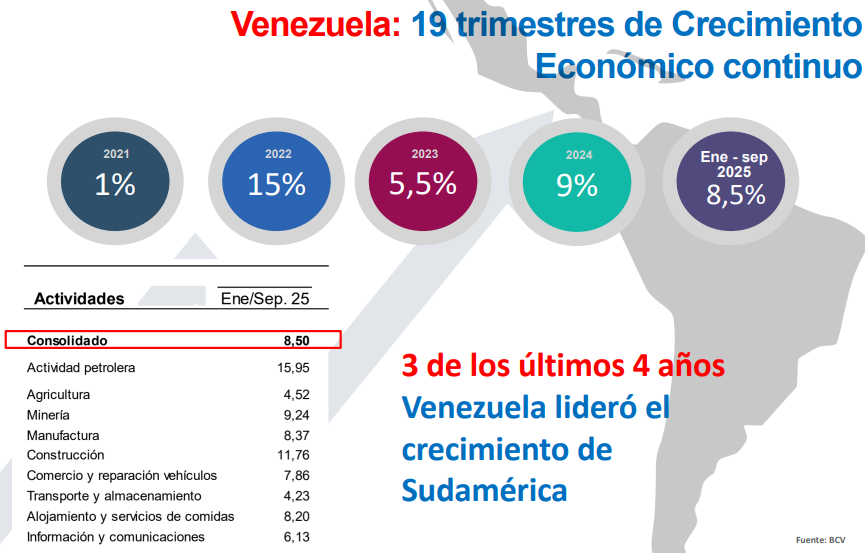
The acting president also presented a draft Organic Law for the Protection of Socioeconomic Rights, explaining that the law will protect consumers and guarantee the quality of goods and services. She highlighted 19 quarters of sustained growth—almost five years’ worth—and an 8.5% increase in the country’s GDP in 2025.

Venezuela’s 2021-2025 GDP growth, with sectorial 2025 desegregated growth. Source: BCV.

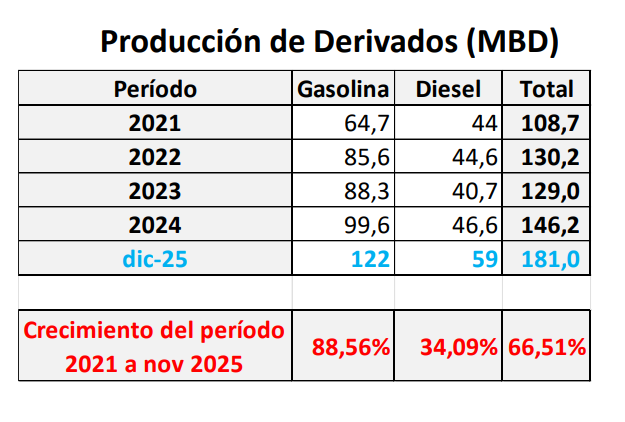
She reported to the assembly that over the course of the past year, Venezuela did not import fuel, and that Venezuelan oil workers achieved a production of 1.2 million barrels of oil per day (bpd).

“Thanks to the CPP model, an investment of nearly US$900 million was achieved in the hydrocarbon sector in 2025,” she added.

Oil sub-products production comparison between 2021 and 2025 in million of barrels per day.

Rodríguez introduced a draft reform to the hydrocarbons law, in order to incorporate production models from the Anti-Blockade Law. The move is intended to ensure investment flows are incorporated into new or unexploited fields where infrastructure does not yet exist. Additionally, she announced a draft Organic Law for the Expediting of Procedures.

“I have asked the legal teams to implement the anti-blockade model,” she said, “which will allow us to deactivate any existing regulation when a procedure is preventing investment or hindering citizens.”

Achievements in security and public services
Rodríguez highlighted the consolidation of “direct democracy” through the national people’s power model, noting that more than US$280 million was invested in 35,000 communal projects, executed through the autonomy of communes and communal councils.

On the issue of internal security, Rodríguez announced that Venezuela had reached a figure of three homicides per 100,000 inhabitants. She compared this to Ecuador’s rate of 70 homicides per 100,000 and the regional average of 16, emphasizing that it demonstrates “the commitment of the Bolivarian Government to the security of the people.”

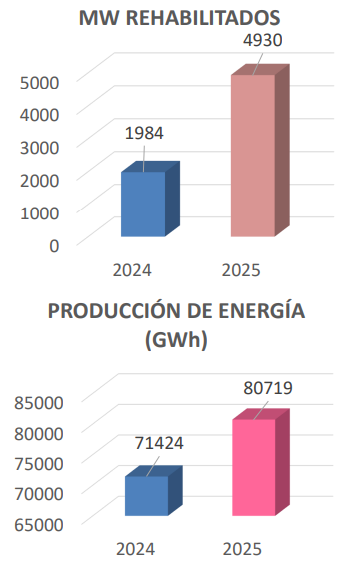
Recovered electricity capacity in MW and overall energy production in Venezuela, compared between 2024 and 2025.

Regarding public services and social metrics:

• Energy: 5,000 megawatts were added to the National Electric System (SEN), more than doubling the 2024 power levels.
• Water: A 110% growth was recorded in water services.
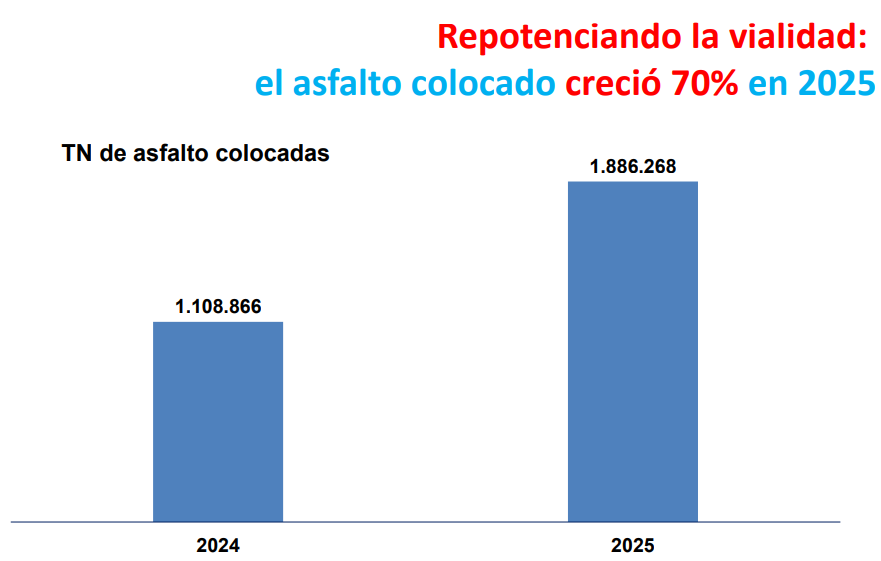
• Infrastructure: Asphalt paving increased by 70%, using materials from Lake Guanoco.
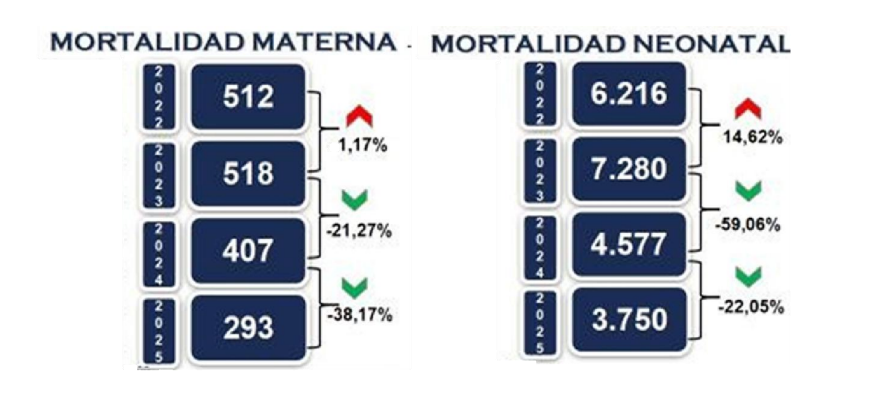
• Health: Maternal and infant mortality rates decreased significantly.
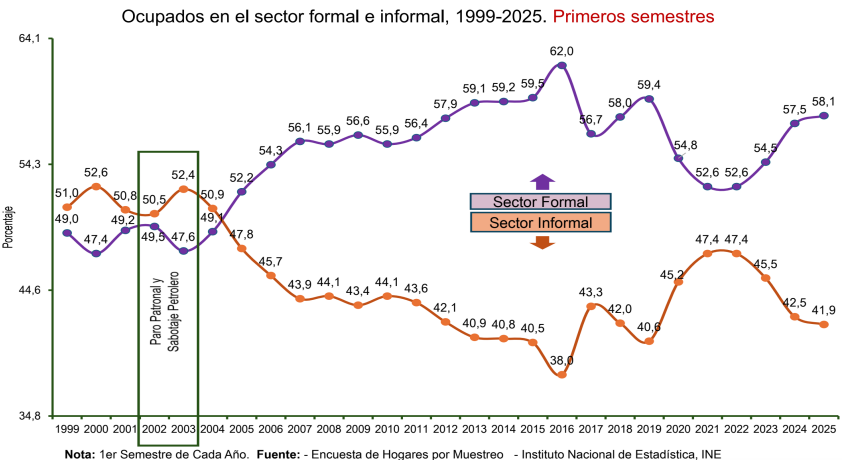
• Employment: The administration recorded growth in formal employment as the economy continues recovery.

Delivery of asphalt in Venezuela, 2024-2025 comparison.

Evolution of formal work vs. informal work in Venezuela over several years.

Evolution of maternal and newborn mortality rate in Venezuela between 2022 and 2025.

International relations
“Venezuela has every right to maintain relations with China, Russia, Iran, and Cuba,” Rodríguez reaffirmed, noting that the agenda of energy between Venezuela and the US is not new. “We are not reinventing the wheel; we continue to shape our energy cooperation with the US and other countries.”

Rodríguez also addressed the possibility of traveling to the US in her current capacity. “If one day I have to go to Washington as acting president, I will do it standing, walking, not crawling,” she stated firmly. “I will do it with the tricolor flag. It will be standing, never crawling or dragging myself. That is what holds true to the Venezuelan people standing tall.”

Machado-Trump meeting fiasco
Analysts note that Rodríguez’s speech served as a rebuttal to the low-profile and unproductive meeting between far-right politician María Corina Machado and US ruler Donald Trump on the same day.

White House press secretary Karoline Leavitt stated in a press conference that Trump’s assessment of Machado as a figure to lead a transition in Venezuela has not changed after the meeting. Leavitt also confirmed that Trump evaluated Machado’s profile based on current socio-political realities and believes the 2025 Nobel Peace Prize recipient cannot govern the nation, as she lacks internal support and respect.

Venezuelan far-right politician María Corina Machado exits from the White House’s back door after meeting President Donald Trump in Washington, Thursday, January 15, 2026. Photo: Pablo Martinez Monsivais/AP.

“The president’s assessment is based on the reality on the ground,” Leavitt confirmed. “His opinion has not changed so far.”

This reality clashes with mainstream media reports and statements from some European politicians, claiming Machado remains the primary option for an alleged transition in Venezuela. It also contradicts “creative interpretations” by far-right activists who suggested Trump’s initial assessment only referred to a lack of Machado’s military support.

Machado’s arrival at the White House on Thursday was widely reported as a fiasco of protocol. She was not received by any US officials, entered through a regular entrance, and the visit lacked an official photo with Trump or any formal farewell protocol.

The far-right Venezuelan politician later confirmed that she gifted the Nobel Peace Prize medal to Donald Trump.

Special for Orinoco Tribune by staff

OT/JRE/AU


From Orinoco Tribune – News and opinion pieces about Venezuela and beyond via This RSS Feed.
1350


This article by Karla Mora originally appeared in the January 15, 2026 edition of El Sol de México.

César Cravioto, head of the Mexico City Government Secretariat, reported that within the framework of the Cabinet Against Dispossession program, which has been operating since April 2025 due to the growing number of cases, has achieved the restitution of 94 properties to their rightful owners, another 10 have been seized, and, as a result of monitoring the cases, six people have been arrested.

During the Mexico City Security Report, the official stated that there were 4,071 neighborhood assistance requests, of which 399 files were opened for the investigation of cases of dispossession, and of these, in 290 there were actions by the secretariat, although he did not specify what they were.

“I want to mention in this program that we are also adjusting some procedures of the program against dispossession. We had just one inter-institutional meeting last Tuesday, and we will have another one next Tuesday, to fine-tune this program and ensure it has the best results in 2026,” he said.

He acknowledged the work done by agencies such as the Legal Counsel, the Judiciary, the Public Registry of Property, among others, as it is an interdisciplinary task.

The Citizen’s Assistance Desk Against Property Dispossession, primarily of homes, operates on Tuesdays in the Zócalo. In this way, residents of Mexico City who have been affected by this crime, who are at risk, or who have been threatened, can receive help and advice every Tuesday at this location.

The post Mexico City Landgrabs: 94 Properties Recovered, Six People Arrested appeared first on Mexico Solidarity Media.


From Mexico Solidarity Media via This RSS Feed.

view more: ‹ prev next ›