351
Latin American Publications!
120 readers
10 users here now
A community for Latin American publications.
NOTE: All the publications in this feed are Latin American in origin; that does not mean they only report on Latin American news.
founded 5 months ago
MODERATORS
352
353
354
This article by Jesus Estrada originally appeared in the March 9, 2026 edition of La Jornada, Mexico’s premier left wing daily newspaper.
Chihuahua, Chihuahua. Demanding that the federal government address points in their petition related to regulating the food market and the marketing of crops, which were presented last December and continue to be ignored, members of the National Front for the Rescue of the Mexican Countryside (FNRCM) will demonstrate on highways and railway lines on March 20.
Eraclio Rodríguez Gómez, one of the organization’s leaders, stated in an interview with La Jornada that the government only fulfilled its promises regarding water, but other issues remain unresolved, such as establishing an agricultural development bank, removing basic grains from the Free Trade Agreement, and guaranteeing prices.
“When corn reached almost 8 pesos per kilogram, a kilogram of tortillas cost 27 pesos; today, corn costs between 3.30 and 3.50 pesos, at best, and tortillas cost exactly the same. This tells us that the government is very closely tied to big business, favoring them with its profits.”
He explained that these are demands related to the creation of a national agriculture, that the Secretariat of Agriculture and Rural Development (SADER) should have a different vision, “not one that depends on imports and exports, but on national needs, with goals for the country.”
This, he considered, “would give us a different field, because we cannot continue developing an agriculture conditioned by the prices set by the Chicago stock exchange, which rather than regulating is a totally speculative market.”

Eraclio Yako Rodríguez Gómez is a former Morena deputy & was previously President of the Commission for Rural Development and Conservation, Agriculture and Food Self-Sufficiency of the Chamber of Deputies
“The support from SADER arrived late”
Members of the FNRCM criticized the fact that the support from SADER to market basic grains such as yellow corn arrived late and only partially, with 600 pesos per ton provided by the federal government and 150 pesos paid by the state administrations of Chihuahua and Tamaulipas.
They complained: “We have an attempt at subsidies when most yellow corn producers have already had to sell, because they had many commitments to cover and the government let time pass; they helped until there is not much grain left in the warehouses, at least in Chihuahua, there is less than half of what was produced last year.”
Rodríguez Gómez stated that “the overdue payments for corn and wheat have not been fully resolved; very little progress has been made, and with the current prices for the harvest still in storage, the proposal they’re making is very poor. There’s no way a farmer can sell their crop with such a low price per ton on the market; many will go straight to bankruptcy.”
“The proof that there is no progress is that the price of a kilogram of tortillas remains between 25 and 30 pesos, which is paid by the final consumer; therein lies the government’s failure, which has not been able to bring order to the market,” he warned.
Eraclio Rodríguez described as a failure of the SADER the fact that farmers sell their crops at extremely low prices, while marketing companies, the masa and tortilla industry and intermediaries (coyotes), generate large profits.

“Profits are for business owners”
He stated that “when corn reached almost 8 pesos per kilogram (between 7.60 and 7.80 pesos), a kilogram of tortillas cost 27 pesos; today, corn costs between 3.30 and 3.50 pesos, at best, and tortillas cost exactly the same. This tells us that the government is very closely tied to big business, favoring them with its profits.”
The leader of the national front pointed out: “We don’t want subsidies, because in the end that money will end up in the hands of big business; we ask that if corn is worth 7 pesos per kilogram, tortilla business owners pay that amount, because they want to pay the price of tortillas as if corn were worth 8 pesos.”
Rodríguez Gómez questioned: “Where is the government’s hand, then? Julio Berdegué (head of the Secretariat of Agriculture and Rural Development) is lying when he says he seeks to regulate the market, but he has been a liar since the beginning of this federal administration; that is nothing new to us.”
-

President Sheinbaum Responds to Trump & Shield of the Americas Militarization
March 9, 2026March 9, 2026
The Mexican President addressed comments made by the US President at the Shield of the Americas Summit, a sordid gathering of regional sycophants & lumpen-criminals held in Miami, one of the world’s worst cities.
-

Mexican Farmers Announce Nation-Wide Blockades for March 20th
March 9, 2026March 9, 2026
Citing insufficient support, bankruptcies, crop-dumping by the US, and abandoning Mexican food sovereignty in USMCA negotiations, farmers say the government’s ties to big business has pushed them to this national action.
-

Morena National Council President Urges Party to Eradicate Opportunism Before 2027 Elections
March 9, 2026March 8, 2026
The Governor of Sonora asked the National Council to take care of Morena and the Transformation, and made it clear that in the face of that objective, “we are all indispensable.”
The post Mexican Farmers Announce Nation-Wide Blockades for March 20th appeared first on Mexico Solidarity Media.
From Mexico Solidarity Media via This RSS Feed.
355
1
Morena National Council President Urges Party to Eradicate Opportunism Before 2027 Elections
(mexicosolidarity.com)
This article by Nestor Jimenez and Fernando Camacho originally appeared in the March 7, 2026 edition of La Jornada, Mexico’s premier left wing daily newspaper.
The president of the National Council of Morena, Alfonso Durazo, stressed to the members of this body that, heading into the 2027 elections, opportunism and personal political aspirations must be set aside, while warning that political projects fail due to internal weaknesses and temptations arising from petty calculations.
Before the members of the Morena party who make up the highest body of the party – second only to its National Congress – and with the attendance of many of the aspirants for the candidacies for governorships and federal deputies for next year, the Governor of Sonora also asked them to take care of Morena and the Transformation, and made it clear that in the face of that objective, “we are all indispensable.”
At this moment, he stressed, “there is no room for ambiguity. What is at stake, I repeat, is not a position or a political situation. What is at stake is the progress of the second phase of the Fourth Transformation led by our President, Claudia Sheinbaum.”
The Morena party’s leadership met this Saturday at a hotel on Paseo de la Reforma to approve the guidelines for defining the 2027 candidates. During the opening of the session, Durazo stated that “transformation projects fail not only due to external attacks, but also due to internal weaknesses, due to the temptations that arise from the petty calculations of some of its members.”
He pointed out that the complexity of the upcoming electoral process is “evident” and warned that “there are no more rosy campaigns. On the contrary, they are full of poison.”
Given these conditions, he added that “unity is not an organizational luxury, it is a strategic condition to successfully face the demanding electoral horizon that 2027 is already outlining.”
He believed that the rules to be approved this Saturday should help strengthen internal autonomy and guarantee fair, equitable and transparent processes, “so that no one, even in defeat, harbours a feeling of injustice within themselves.”

Photo: La Jornada, Yazmín Ortega Cortés
Accompanied by governors from the party and members of the National Executive Committee, Durazo affirmed that Morena is currently riding a wave of success, but indicated that this wasn’t always the case. “In these prosperous times, it’s necessary to emphasize one of its founding principles: here in Morena, there are no public offices, only public responsibilities, and we mustn’t forget that.”
And when we stray from the ethical principles that gave rise to our work, he added, “people stop believing; when we act opportunistically, people stop believing; when everything revolves around personal ambition, people stop believing; when it’s just a matter of ‘you get out so I can get in,’ people stop believing. Closing these gaps is an essential condition for the consolidation of the project.”
Following this, he called on the members of Morena to process what he defined as legitimate internal aspirations, “without fragmenting ourselves, without weakening ourselves and without putting the people’s trust at risk,” since when we walk divided, “the same old people win, the elites who historically hijacked power to subject it to their particular interests win.”
He advocated for selecting candidates by evaluating electoral competitiveness, track record, consistency, ethical performance, and commitment to the project, and concluded that the rules that are approved represent an ethical and political message that will be sent to society.
With this new phase of work within the political institute, he emphasized that “the fate of a personal political aspiration is not at stake here. Anyone who thinks so is profoundly mistaken. What is at stake here is the strength of Morena in the coming years. We are a social force that today has an even greater responsibility: to demonstrate that the Transformation does not depend on a single individual, but on an organized, disciplined, and politically responsible movement.”
At the same time, he advised those seeking candidacies, “that in their journey they should never undermine the very institution that has provided or will provide them with political support for their aspirations. No one will gain anything by denigrating fellow candidates, much less the movement and its governments. I remind you that the movement needs us all and that in politics the shortest distance between two positions is not necessarily a straight line. If we are loyal to it, the movement will generously guarantee us political life well beyond 2027.”
He also asked them to understand that party discipline does not mean uniformity, but rather honoring the agreements made by the National Council, “authentic unity is not achieved by sacrificing consistency. We understand unity in its most demanding sense, not that of an uncritical unity or one built on forced silences.”
Emphatically, he reminded them twice that Morena is no longer an opposition party, “but a key element of the country’s governance,” and urged the council members to understand their responsibility in that context.
Durazo placed the electoral reform initiative as a priority, because “it is not just a proposal from President Claudia Sheinbaum and her agenda with allies in the 2024 campaign, but it would lay new foundations.”
He called on the national councilors to “understand that taking care of Morena is taking care of the transformation, that taking care of internal politics is taking care of sovereignty, that taking care of the principles of our movement is taking care of the future of Mexico, that taking care of the coalition with our sister parties, the Green Party and the Workers Party, is not a simple sum of votes, but a strategic understanding to strengthen the capacity of our movement to drive the national transformation.”
The session is expected to last for at least a couple of hours, with the meeting continuing behind closed doors.
-
President Sheinbaum Responds to Trump & Shield of the Americas Militarization
March 9, 2026March 9, 2026
The Mexican President addressed comments made by the US President at the Shield of the Americas Summit, a sordid gathering of regional sycophants & lumpen-criminals held in Miami, one of the world’s worst cities.
-
Mexican Farmers Announce Nation-Wide Blockades for March 20th
March 9, 2026March 9, 2026
Citing insufficient support, bankruptcies, crop-dumping by the US, and abandoning Mexican food sovereignty in USMCA negotiations, farmers say the government’s ties to big business has pushed them to this national action.
-
Morena National Council President Urges Party to Eradicate Opportunism Before 2027 Elections
March 9, 2026March 8, 2026
The Governor of Sonora asked the National Council to take care of Morena and the Transformation, and made it clear that in the face of that objective, “we are all indispensable.”
The post Morena National Council President Urges Party to Eradicate Opportunism Before 2027 Elections appeared first on Mexico Solidarity Media.
From Mexico Solidarity Media via This RSS Feed.
356
1
Mexico City’s Cooperativa de Salud Panamédica, Women-led Health Cooperative Celebrates 19 Years
(mexicosolidarity.com)
This article by Jaime Quintana Guerrero originally appeared in the March 8, 2026 edition of Desinformémonos.
A women-run health cooperative, which celebrates 19 years of providing medical care this March 12, promotes cooperativism and the solidarity economy as basic principles, and offers its services to the south of Mexico City.
It is a cooperatively planned and managed organization of healthcare professionals. Its specific area of focus is health promotion and disease prevention, and its objective is to promote the right to health. It currently consists of twelve collaborating members who serve approximately one hundred people monthly.
In the context of International Women’s Day, Andrea Ríos, a dental surgeon and president of the Panamédica Health Cooperative, explained in an interview with Desinformémonos: “Ninety percent of us are women.” She pointed out that one of the problems they’ve faced is the enforcement of internal agreements. She gave the example of rules that were established regarding roles and fines for not cleaning the cooperative’s initial physical spaces. “The men didn’t want to do it and preferred to pay the fine; the problem wasn’t whether you were a man or a woman, the problem was that you were a member, and that was an agreement you had to comply with,” she explained.
“The social and solidarity economy is a complex way of life and organization because everything is horizontal,” Ríos explains. “We all come from a background where we’re taught about bosses, employers, and employees; it’s hard for us to change our mindset. Cooperatives offer that: we’re people who are more aware or more empathetic towards others; we don’t seek profit, but we do seek to live well,” he explains.
Since 2007, the Panamédica Health Cooperative has maintained its autonomous structure, avoiding the influence of partisan organizations. It originated in the south of Mexico City through a loan agreement with the neighborhood administration of the Villa Panamericana Housing Unit’s Social Center, located near the National Autonomous University of Mexico (UNAM).

Photo: Panamédica Health Cooperative
However, explains Sofía Jiménez, who is currently the treasurer of the Board of Directors, “we had to change locations to have greater autonomy, since that space belongs to the residents of the Pan American Village and there was also a conflict of interest due to the political parties. There were internal conflicts where we were caught in the middle; we had to leave a place where we had many patients and seven years of work.”
In a second phase and in a different space, Sofía Jiménez recounts, the mutual scheme was initiated, based on the fair distribution of expenses and risks, with an advance payment for a service. This model was learned from schemes existing in Argentina, which the Mexican cooperative members visited. “It was weakened by the pandemic; however, the seed remained,” she explains.
Dr. Sofía Jiménez, who also served as president of the cooperative, recalls that “a group of students from health-related disciplines—doctors, dentists, and psychologists—organized the construction of a primary care clinic in a self-managed and autonomous manner to work on promotion and offer service to the community.”
“We have a vision,” says psychologist Sofia, “here the doctor is not placed above, as in this hierarchy, but is part of that process of taking care of your health.”
The cooperative offers services such as dental care, psychology, medicine, homeopathy, nutrition, optometry, physiotherapy, and some alternative therapies. “In each of our services, we try to take an interdisciplinary approach; that is, if a patient comes to the medical department and has an earache, they probably also need dental treatment,” explains Andrea Ríos, a dental surgeon and president. Or, for example, “if someone is clenching their teeth a lot, they might be stressed; so we try to refer them to the psychology department as well.”
Among some of the external situations in which they have provided support, recalls Sofía Jiménez, is the attention given to the parents of the 43 students from the Ayotzinapa rural teachers’ college, who were given medical attention in the first days, as well as the support given to victims of the housing units in Taxqueña after the earthquake.
In these 19 years of existence, women have acquired greater responsibility and leadership in the care of the space and the collective, an organic change within the cooperative.
“We went to big cooperative events, where there are large cooperatives, many men and very few women. We started to get involved there; despite many things, there is more awareness of being able to make that change, of being able to transform how we relate to each other, but sometimes we don’t realize it and we can fall into repeating the same patterns,” reflects Sofía Jiménez, treasurer of Panamédica.
One of the problems, the cooperative members believe, “is the issue of power and respect for agreements,” and another fundamental one, for a woman, mother and cooperative member, “is taking care of themselves.”
One of the important issues, the interviewees agree, is the care of the community and the patient. They point out that they are working on integrating this issue through training workshops for health promoters. “There are a lot of issues that affect us, both for the care of the caregiver and for the care of the people being cared for.”
“Now we want a school for caregivers and health promoters to be created from within the cooperative itself; that is the path we are on, taking care of those who take care of us,” concludes Andrea Ríos, president of the Panamédica Health Cooperative.
-

Mexico City’s Cooperativa de Salud Panamédica, Women-led Health Cooperative Celebrates 19 Years
March 8, 2026March 8, 2026
Serving the south of the city, the cooperative promotes the right to health, and serves approximately 100 people every month, honouring the principles of the social and solidarity economy.
-

Anti-Fuel Theft Program Stalled
March 8, 2026March 8, 2026
Two months after Mexico’s requirement to carry a QR code & GPS came into effect, only 3,725 registrations have been issued for an estimated 1.2 million units that transport fuel.
-

Monopolies like Nestlé Used COVID to Discredit Breast Milk: Study
March 8, 2026
The infant formula industry in Mexico took advantage of the pandemic to promote itself over breastfeeding with false information & unethical practices.
The post Mexico City’s Cooperativa de Salud Panamédica, Women-led Health Cooperative Celebrates 19 Years appeared first on Mexico Solidarity Media.
From Mexico Solidarity Media via This RSS Feed.
357
This article by Juan Carlos Rodríguez originally appeared in the March 3, 2026 edition of El Sol de México.
While the theft and smuggling of hydrocarbons in Mexico is measured in millions of liters, the National Energy Commission’s (CNE) program to help contain this illicit activity is progressing in dribs and drabs.
Two months after the requirement came into effect for all hydrocarbon, LP gas and petroleum product transport units to carry a QR code and GPS geolocation systems, only a third of the vehicles have complied with this regulation.
In Mexico, it is estimated that there are around 1.2 million units that transport fuels ; however, only about 3,725 QR codes have been issued, according to information obtained by El Sol de México through a request via the National Transparency Platform.
Regarding liquefied petroleum gas, 1,373 QR codes have been provided, of which 1,182 correspond to distribution permits and 191 to transport permits ,” explains the CNE in its response, as of February 4 of this year.
In the area of petroleum products, 2,352 QR codes have been granted, of which 252 are distribution permits and 2,100 are transport permits by means other than pipelines.
In total, these permits cover some 360,000 delivery vehicles, tank trucks, tank ships, semi-trailers and tractor-trailers that, since January 1 of this year, should carry the markings to monitor their routes, as well as loading and unloading operations.
On September 23, the Director General of the CNE, Juan Carlos Solís Ávila, published in the Official Gazette of the Federation an agreement ordering that all vehicles that transport or distribute fuels must carry identification data in order to prevent illegal activities.
The marking system includes semi-trailers, tank trucks, tractor-trailers, tank cars and delivery vehicles associated with each permit, allowing for effective tools for detecting illicit conduct, as well as improving the traceability of transported products, the agreement states.
Likewise, the commitment considered it essential that all vehicle units associated with the transportation and distribution activities of petroleum products, LP gas and petrochemicals by means other than pipelines have a global positioning system (GPS) , which allows real-time monitoring of the vehicles.
This technological tool not only allows the verification of permitted activities, but also contributes to providing greater security and certainty to the people who carry out this activity in order to “mitigate the negative impacts caused by the theft of vehicle units, as well as by the diversion of products and the improper use of authorized vehicles,” the document highlights.
Originally, a 15-day period was given to process and acquire the sticker and the code that includes vehicle data and a QR code. However, given the complexity of the operation, the deadline was extended to December 31, 2025. But even with the extension, the process has been slow.
And while the distribution of stickers has been staggering, the distribution of GPS devices is even worse. This publication requested an estimate from the National Electoral Council (CNE) of the number of vehicles already equipped with geolocation systems, but no information is available.
“This Hydrocarbons Unit does not currently have the requested information; this is because the integration of statistics that break down said data is in the implementation phase,” the agency stated.
El Sol de México also asked the CNE the number of units and/or permit holders that have been sanctioned for not complying with the new requirements to prevent fuel theft, but the data is not available either.
“This Hydrocarbons Unit does not have the requested information, since the Verification Unit is the area that, within the scope of its supervisory, verification and sanctioning powers, can have it.”
Last November, Petróleos Mexicanos (Pemex) considered that illicit activities related to fuels, including so-called fiscal fuel theft, are likely to persist, according to the report it sent to the United States Securities and Exchange Commission (SEC).
In its third-quarter report, the oil company listed several risks, such as theft, diversion, and manipulation of crude oil, natural gas, and refined products from its pipeline network.
Pemex added that these acts include the illegal extraction of hydrocarbons, such as clandestine taps on its pipelines, and the illegal trade of fuels, such as those brought into the country through tax evasion, a practice known as fiscal fuel theft.
Juan Carlos Rodríguez is a reporter with three decades of experience chasing uncomfortable stories.
-
Mexico City’s Cooperativa de Salud Panamédica, Women-led Health Cooperative Celebrates 19 Years
March 8, 2026March 8, 2026
Serving the south of the city, the cooperative promotes the right to health, and serves approximately 100 people every month, honouring the principles of the social and solidarity economy.
-
Anti-Fuel Theft Program Stalled
March 8, 2026March 8, 2026
Two months after Mexico’s requirement to carry a QR code & GPS came into effect, only 3,725 registrations have been issued for an estimated 1.2 million units that transport fuel.
-
Monopolies like Nestlé Used COVID to Discredit Breast Milk: Study
March 8, 2026
The infant formula industry in Mexico took advantage of the pandemic to promote itself over breastfeeding with false information & unethical practices.
The post Anti-Fuel Theft Program Stalled appeared first on Mexico Solidarity Media.
From Mexico Solidarity Media via This RSS Feed.
358
This article by Montserrat Antúnez originally appeared in the March 8, 2026 edition of Sin Embargo.
Mexico City. Companies such as Nestlé, Reckitt Benckiser, and Abbott took advantage of the COVID-19 pandemic to promote their infant formula products with false information. Some courses and donations to the Mexican government were part of their strategies to discourage breastfeeding and regulations on the subject, concluded a study published in the scientific journal International Breastfeeding Journal.
“It’s a serious matter. These industries took advantage of the fear we had as a population, not knowing how the virus was transmitted, and used it to position and sell their products, which are not equivalent to breast milk. They are a substitute for specific cases of infants, but not an ideal food for babies,” explained Christian Torres, coordinator of Conflict of Interest and Industry Interference at the organization El Poder del Consumidor and one of the six authors of the article titled The Corporate Political Activity of the Breast Milk Industry in Mexico during the COVID-19 Pandemic, which was published in early 2026.
The research, which analyzed corporate behavior between 2020 and 2022, identified Nestlé as the top-selling brand in Mexico and the one that implemented the most aggressive Corporate Political Activity (CPA) strategy. Its strategy included a “Support Plan” with donations of products and medical equipment, as well as the management of coalitions with government institutions such as the Secretariat of Foreign Affairs, the Mexican Social Security Institute (IMSS), the Secretariat of National Defense, and the National System for Integral Family Development (DIF).
“As part of its actions, in 2020, Nestlé launched the ‘ Nestlé COVID Emergency Support Plan,’ which reported monetary donations of 7.1 million pesos; the distribution of 100 million food packages with Nestlé brand products, including commercial infant formulas, to more than 50 institutions, hospitals, and civil society organizations; and in-kind donations or aid through its various brands. Mexican Economic Development (FEMSA) and YZA Pharmacy organized donation campaigns for commercial infant formulas, inviting the public to participate,” the investigation reads.
In addition to promoting itself on social media as a company that supports the healthcare sector, it disseminated messages and blog posts that raised doubts about whether a mother with COVID-19 should breastfeed and suggested formula as a “safe” option. It spread the false idea that its chemical products could offer specific protection against the virus that breast milk did not.
The Enfamil brand, manufactured by Mead Johnson Nutrition, a subsidiary of Reckitt Benckiser, published a study on its website showing that babies fed with commercial formulas during the first 12 months of life had better development of motor skills than those fed with other types of formulas.
“Our interviewees shared the fact that, during the COVID-19 pandemic, the industry disseminated information about the supposed increase in immunity associated with the consumption of CMF [Commercial Infant Formula], taking advantage of the uncertainty surrounding the pandemic,” the research mentions.
Similarly, the researchers added that in Mexico, training was provided to health professionals “positioning CMF [Commercial Infant Formula] products as a solution to be used during the COVID-19 pandemic. This took advantage of the widespread fear among mothers, fathers, and caregivers, with the claim that CMF could improve the immunity of babies and young children.”
Oscar Reséndiz Lugo, lead author of the study, explained that the direct impact of the strategies used by infant formula companies is to discourage breastfeeding and to position themselves in the eyes of policymakers and the public.
“If you put all those components into the entire political arena, what happens is that self-regulation is still allowed for these types of industries; that is, they formulate their own regulatory codes, they propose their own regulatory strategies, and they can conveniently establish more precise issues that promote the advertising of their products ,” Reséndiz Lugo mentioned.
Since 1974, the World Health Assembly has recognized that women are ceasing to breastfeed their babies due to the influence of unethical marketing practices for breast milk substitutes. Therefore, in 1981, it adopted the International Code of Marketing of Breast-milk Substitutes, which Mexico signed and committed to implementing. However, practices contrary to the provisions of this instrument are still being observed.
Oscar Reséndiz insisted that Mexico still does not have a robust legal framework that allows it to sanction companies that do not comply with the international code.
The research also indicates that excessive exposure to formula advertising, the distribution of free samples, inadequate labeling, and industry influence on health professionals, the main promoters among mothers, persist in Mexico.
Similarly, she highlighted that in the country only 34.2 percent of children receive exclusive breastfeeding in the first six months of life, a figure below the international goal proposed by the World Health Organization to increase the rate to 50 percent by 2025.
-
Monopolies like Nestlé Used COVID to Discredit Breast Milk: Study
March 8, 2026
The infant formula industry in Mexico took advantage of the pandemic to promote itself over breastfeeding with false information & unethical practices.
-

Miami Weiss: The Peak of Genuflection
March 8, 2026
The most striking aspect of Trump’s lumpentreffen is that all of the leaders in attendance use tough-on-crime rhetoric while simultaneously carrying extensive criminal records.
-

Trump Wants Major Surrender from Mexico on USMCA
March 8, 2026
Mexico is both at the table and on the menu, as the US pressures Mexico to open up strategic sectors that had been recovered since AMLO’s election.
The post Monopolies like Nestlé Used COVID to Discredit Breast Milk: Study appeared first on Mexico Solidarity Media.
From Mexico Solidarity Media via This RSS Feed.
359
This editorial by the La Jornada editorial board originally appeared in the March 8, 2026 edition of La Jornada, Mexico’s premier left wing daily newspaper. The views expressed in this article are the authors’ own and do not necessarily reflect those ofMexico Solidarity Mediaor theMexico Solidarity Project*.*
President Donald Trump hosted his counterparts from Argentina, Javier Milei; Bolivia, Rodrigo Paz; Costa Rica, Rodrigo Chaves; Dominican Republic, Luis Abidaner; Ecuador, Daniel Noboa; El Salvador, Nayib Bukele; Guyana, Irfaan Ali; Honduras, Nasry Asfura; Panama, José Raúl Mulino; Paraguay, Santiago Peña; and Trinidad and Tobago, Kamla Persad-Bissessar, along with the president-elect of Chile, José Antonio Kast, at his golf course in Doral, Miami.
The attendees, handpicked for their ideological affinity and political subservience to the magnate, did not attend the presentation of the so-called Shield of the Americas as equals sharing concerns and viewpoints, but rather as subordinates receiving orders and thunderously applauding their boss’s every whim, even when he stands before ten Spanish speakers and tells them, “I’m not going to learn your damn language.” At the reception, Trump declared that the “consensus” is that the only way to defeat organized crime and the nonexistent narco-terrorist groups is to “unleash the power of our armed forces,” for which he will deploy “the supreme power of the United States,” which, thanks to him, is “once again” the world’s leading military power. In reality, it has never ceased to be so, nor has it experienced any substantial increase in its capabilities under Trumpism; only the level of willingness to use unilateral and arbitrary force has changed.
Beyond the Republican’s blunders and his obsession with blaming Mexico for the insatiable consumption of illicit substances in American society, the most striking aspect of the meeting is that each of the attending leaders uses tough-on-crime rhetoric while simultaneously carrying an extensive criminal record. Milei has twice promoted cryptocurrency scams; he placed José Luis Espert at the top of his congressional list, even though it was already public knowledge that Espert received $200,000 from drug trafficker Fred Machado; he sold his party’s candidacies; and he allowed his sister to collect “commissions” from suppliers of the National Disability Agency. Paz was indicted for corruption, embezzlement, and awarding contracts detrimental to the state for promoting projects with serious irregularities and inflated prices when he was mayor of Tarija. Chaves has dozens of open cases against him for corruption, including abuse of power, embezzlement, influence peddling, and illegal campaign financing. He was sanctioned and demoted by the World Bank after a pattern of sexual harassment of female subordinates was proven. Noboa, who maintains Ecuador under a state of emergency and cultivates an image of a gangster willing to do anything against drug trafficking, has justified the constant discoveries of cocaine shipments on ships belonging to his family’s shipping company. The Specialized Prosecutor’s Unit against Corruption Networks (UFERCO) in Honduras accuses Asfura of structuring a money laundering scheme, embezzlement of public funds, and fraud from his position as mayor of Tegucigalpa. The list of offenses extends to the rest of the Latin American and Caribbean leaders, and, of course, the host is the first US president convicted of a serious crime. Thus, it is clear that the Shield of the Americas has nothing to do with combating crime, but rather with advancing the imposition of the Monroe Doctrine.
A couple of days before the summit, Costa Rica’s president-elect, Laura Fernández, described Mexico as “a prime example of where we don’t want to end up” in terms of violence, organized crime, and drug trafficking. Fernández served as Minister of the Presidency and Minister of National Planning and Economic Policy in the Chávez administration, whose agenda she wholeheartedly endorses. If the future president truly wants to spare her country the immense suffering endured by ours over the past two decades, she should consider that the security crisis began when a politician from her own far-right political persuasion did what she is now preparing to do: open Mexico wide to US intelligence agencies, subordinate internal decisions to Washington’s interests, ignore the socioeconomic roots of crime, and wage war against her own citizens, in which state violence became the measure of success for a control strategy disguised as security. The lessons of the Calderón administration are also valid for the rest of the rulers (and the ruled) who still see or pretend to see in the White House’s “war on drugs” an offensive against criminal structures and not the mechanism of imperialist domination that it is.
-
Monopolies like Nestlé Used COVID to Discredit Breast Milk: Study
March 8, 2026
The infant formula industry in Mexico took advantage of the pandemic to promote itself over breastfeeding with false information & unethical practices.
-
Miami Weiss: The Peak of Genuflection
March 8, 2026
The most striking aspect of Trump’s lumpentreffen is that all of the leaders in attendance use tough-on-crime rhetoric while simultaneously carrying extensive criminal records.
-
Trump Wants Major Surrender from Mexico on USMCA
March 8, 2026
Mexico is both at the table and on the menu, as the US pressures Mexico to open up strategic sectors that had been recovered since AMLO’s election.
The post Miami Weiss: The Peak of Genuflection appeared first on Mexico Solidarity Media.
From Mexico Solidarity Media via This RSS Feed.
360
1
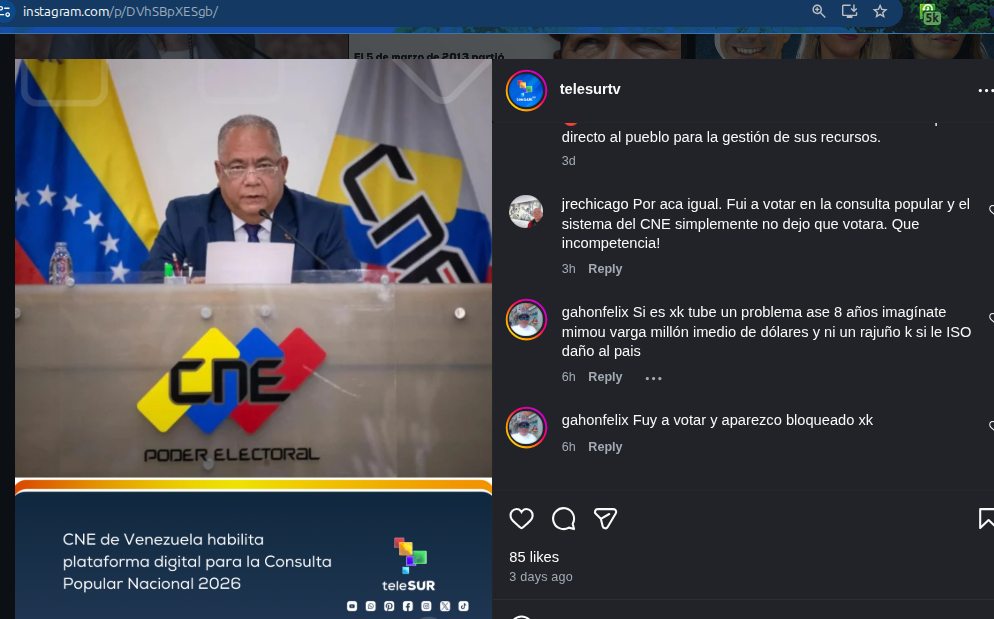
Venezuela Celebrates International Women’s Day With First Popular Consultation of 2026
(orinocotribune.com)
361
362
This article by Nancy Flores originally appeared in the March 7, 2026 edition of Revista Contralínea. The views expressed in this article are the authors’* own and do not necessarily reflect those ofMexico Solidarity Mediaor theMexico Solidarity Project.*
The first official round of review of the United States-Mexico-Canada Agreement (USMCA) begins on March 16; prior to this, President Donald Trump requested the elimination of 54 non-tariff barriers , including issues related to energy, food, mining, pharmaceutical and technological sovereignty, as –in his opinion– these limit the capabilities of the trade relationship.
The requests from the US government – made by Trump himself in July 2025, when he granted Mexico an extension on the 30 percent tariffs he sought to impose across the board – aim to overcome the “difficulties” faced by US companies in having profitable businesses or expanding them, especially in areas of exclusivity for the Mexican State or definitively prohibited.
According to the 2025 National Trade Estimate Report on Foreign Trade Barriers of the President of the United States on the Trade Agreements Program, the US Presidency considers the following as non-tariff barriers: restrictions on private investment in the energy sector; the ban on genetically modified corn; fracking and open-pit mining; the nationalization of lithium; the gradual denial of permits to import glyphosate and other pesticides; the reduction of permits for planting genetically modified cotton; restrictions on the import of fresh potatoes; and the dominance of the private company Telmex-Telcel in the telecommunications market, among other items.
When asked about this by Contralínea –in her press conference on February 3–, President Claudia Sheinbaum stated that there would be no concessions on sovereign issues, and added that most of the 54 non-tariff barriers had already been addressed.

“There are 54 [non-tariff barriers announced by the United States government] that have been under discussion for some time now, several months. Almost all of them have been resolved. And there are some where we can’t do exactly what they say. For example, regarding… they said: ‘barriers are being put up in the electricity sector.’ So we said: ‘well, no.’ [Because] there’s simply a new Constitution, there’s a new law that establishes a 54-46 ratio; there’s a 46 percent opportunity for private investment.”
The President confirmed to Contralínea that one of the barriers the Trump administration asked to be removed is related to the Calica mine case. “There is indeed the issue of Vulcan—it’s called that—which is the area where they had a limestone mine, which President López Obrador [canceled]. They exceeded the environmental impact limits; they overexploited the area. It was declared a Protected Natural Area. They have a dispute related to the Treaty, and they are looking for a mechanism, if there is a solution: that they could mine in another location that is not a protected area, with all the established environmental criteria, and that the area, which is ultimately their property, could be used for other purposes. A port they have there could have other uses. So, they are working on that; there is no agreement yet on that front.”
Sheinbaum Pardo added that among the 54 matters reviewed were “ some competition issues related to the new competition agencies , the National Antitrust Commission. And some other issues like that. […] The entire coordination is handled by the Ministry of Economy. But we never give in on anything that we consider to violate our sovereignty, our laws, or our project.”
“But wasn’t the majority going in that direction, that is, to put our sovereignty at risk?,” the president of the Republic was asked.
“No, no, not at all. And it had a lot to do with clarifications of issues that ‘were supposed to be violating the Treaty,’ and which were shown not to be violating the Treaty.”
Mexico’s “non-tariff barriers,” according to Trump
The 2025 National Trade Estimate Report on Foreign Trade Barriers reveals the areas in which the Donald Trump administration has pressured Mexico in the context of the upcoming review of the USMCA. Among these, the alleged barriers to investment in the energy sector stand out. These include prioritizing Pemex’s oil exploration , restricting private participation in the electricity sector to 46 percent (54 percent is reserved for the CFE), and definitively prohibiting fracking. In the mining sector, the US government criticizes the fact that only the state-owned company LitioMX is authorized to exploit this strategic metal.
These strategic areas, linked to issues of national sovereignty, were recovered following the arrival of the so-called Fourth Transformation (first, during Andrés Manuel López Obrador’s six-year term, and now with President Sheinbaum). Even the US report itself acknowledges this: “Since December 2018, Mexico has implemented an energy policy focused on restoring the primacy of its state-owned electricity company, the Federal Electricity Commission (CFE), and the state-owned oil and gas company, Petróleos Mexicanos (Pemex) .”
It adds that “private companies operating in Mexico are often unable to participate effectively, or even at all, in the Mexican energy sector due to frequent delays, unexplained or unjustified rejections, and inaction regarding applications for new permits or modifications to existing permits.” It criticizes the fact that, in June 2022, the Ministry of Energy announced a new policy requiring users of the gas transportation network to source their natural gas from Pemex or the CFE, which led “several” U.S. companies to withdraw from the Mexican energy market. And in July 2022, the United States requested consultations with Mexico under Chapter 31 of the USMCA regarding these measures.
However, the oil sector is not entirely closed to US investment: a report from the US Department of Commerce, dated February 12, 2016, indicates that private operators who secured blocks during the 2015-2018 bidding rounds continue exploration and development activities, including drilling campaigns, seismic surveys, and the construction of offshore platforms in the Gulf of Mexico. “ US companies are key players and are actively seeking technology, equipment, and service partners to help meet production timelines and improve efficiency in both deepwater and onshore operations.”
In addition, “Pemex’s 2025-2030 investment plan calls for the development of 18 new fields, the construction of 15 platforms, and drilling in existing shallow-water and onshore fields, which will maintain demand for platforms, derricks, subsea systems, and well services.” The Department of Commerce even indicates that these intermediate projects present opportunities for U.S. suppliers of equipment, engineering, and EPC services. As an example, it cites Mexico’s plans to install more than 14 pipelines (175 kilometers), build and expand storage terminals, and modernize its refining network, including six existing refineries and the near-complete construction of the Dos Bocas refinery in Tabasco.
“These projects require pumps, compressors, control systems, and construction services, and are subject to 25 percent local content requirements (increasing to 35 percent by 2025). U.S. companies with competitive technology and local partnerships are well-positioned to participate, particularly in projects to enhance desulfurization capacity and meet the growing demand for cleaner fuels in Mexico.”
Areas that the US seeks to free up for IP
However, the US Presidential report on non-tariff barriers complains that in October 2024 – already with President Claudia Sheinbaum – Mexico ratified a constitutional amendment to reclassify CFE and Pemex as public companies, instead of productive companies, “in order to undermine the participation of private companies, including US companies, in the Mexican energy market.”
He adds that in January 2025, President Sheinbaum “presented a package of reforms with six bills related to energy that, among other things, include as a principle guaranteeing the prevalence of the CFE and its maintenance of at least 54 percent of the average energy sent to the grid, requiring the participation of the CFE in at least 54 percent of any ‘mixed investment’ electricity generation project and establishing a preference for the CFE over private entities in the generation and marketing of electricity.”
It also expresses its rejection of the likely ban on fracking (extraction of liquid and gaseous hydrocarbons through hydraulic fracturing), considered not only as a highly polluting technique, but also as a waste of clean water.
The United States also complains about Mexico’s public policy on mining, which prohibits open-pit mining, and about the nationalization of lithium—both promoted by the current administration. According to the Trump administration, the legislative amendments stipulate that “the exploration, exploitation, and use of Mexican lithium [remains] under the exclusive control of a newly created state-owned company, LitioMx, and exclude private companies from obtaining concessions, licenses, contracts, permits, and authorizations to carry out these activities.”
The US Presidency also attributes restrictions to the USMCA due to barriers to investment in transportation infrastructure , arguing that this area is completely closed to foreign investment. Furthermore, it questions the 49 percent foreign ownership limit for express courier companies, land for agricultural, livestock, and forestry purposes, as well as for port management services.

Threat to Food Sovereignty
Another area in which the Trump administration has shown interest is related to Mexico’s food sovereignty. Identifying sanitary and phytosanitary barriers that supposedly limit the USMCA, the 2025 National Trade Estimate Report on Foreign Trade Barriers points to the US Presidency’s dissatisfaction with the ban on genetically modified corn and expresses opposition to Mexico’s Biosafety Law, which places limits on genetically modified products.
Furthermore, the USMCA panel on genetically modified corn, which ruled against Mexico in December 2024 in the dispute opened by the United States, after the government of President López Obrador published a decree to prohibit human consumption of that genetically modified grain, and thereby protect the main reservoir of that food, refers to the USMCA panel on genetically modified corn.
Constituted in accordance with Chapter 31 (Dispute Settlement) of the USMCA, the panel determined that some elements of the Decree on glyphosate and genetically modified corn – published in the Official Gazette of the Federation on February 13, 2023 – cannot be applied “as they are not based on an adequate risk assessment, scientific evidence and relevant international standards.”
Regarding this, the report from the U.S. President’s Office on non-tariff barriers states: “In June 2024, the United States participated in a hearing before the dispute settlement panel. In December 2024, the panel issued its final report, agreeing with the United States on all seven legal claims under the USMCA. On February 5, 2025, Mexico issued a measure declaring ineffective the measures that the U.S. Trade Representative successfully challenged in the USMCA dispute. The United States will continue to closely monitor Mexico’s compliance with its USMCA commitments to ensure that its agricultural biotechnology measures are science-based and provide U.S. corn producers with the market access that Mexico agreed to grant under the USMCA.”
In that same section, it rejects the gradual ban that our country seeks to implement on glyphosate and other highly toxic pesticides and agricultural chemicals. It also complains about the limitations on its exports of fresh potatoes and the restrictions on permits for U.S. companies to plant genetically modified cotton in Mexican territory.
The Other Alleged Barriers
As part of the alleged limitations to the USMCA, the U.S. government also identifies customs and trade facilitation barriers. In this regard, it notes that Mexico frequently notifies new customs or tax requirements only two weeks before they take effect, leaving U.S. exporters little time to adapt their systems and comply with the change.
It also calls for the elimination of restrictions applied at some ports to the entry of goods: “The USMCA prohibits arbitrary limits on the number of ports in which a customs broker may operate. However, Article 161 of Mexico’s Customs Law limits a broker’s operations to four ports if they are not part of a customs agency. The United States continues to urge Mexico to amend the law to allow brokers to operate at any port where they can perform their duties.”
Furthermore, it cites barriers to market access for medical devices, supplies, and pharmaceuticals. On this issue, it notes that COFEPRIS should expedite the permitting process.
Regarding intellectual property protection, the U.S. government is urging Mexico to expedite the registration of patents and trademarks, but also to curb the sale of counterfeit or pirated goods. As an example of these sales, it notes that “the El Santuario and San Juan de Dios markets (in Guadalajara), as well as Tepito (in Mexico City), are listed in the 2024 Notorious Markets Review (Notorious Markets List) for the sale of pirated and counterfeit products.”
Additionally, the Trump administration points out that barriers still exist to electronic payment, insurance, and telecommunications services. In the latter category, it complains about the dominance of a private company of Mexican origin: Telmex-Telcel (América Móvil), which it accuses of monopolizing the market.
In this regard, he points out: “despite the profound reforms of the telecommunications sector in 2013 and 2014, new market entrants still have to compete with the dominant traditional provider that has maintained a market share of almost 70 percent, and which was designated as a ‘preponderant economic agent’ by the IFT.”
Although it does not refer to Telmex-Telcel by name, it does point out that “the entrenched position of this dominant provider, particularly in the mobile services market, demonstrates the constant need for rigorous application of the regulations that the IFT adopted to address its status as a preponderant economic agent.”
Therefore, he criticizes the constitutional reform of December 2024 to eliminate autonomous bodies, since it replaces the IFT with a new antitrust competition agency, which could benefit Telmex-Telcel.
-
Trump Wants Major Surrender from Mexico on USMCA
March 8, 2026
Mexico is both at the table and on the menu, as the US pressures Mexico to open up strategic sectors that had been recovered since AMLO’s election.
-

Zionist Diego Olstein Expelled from UNAM
March 8, 2026
This statement was released by the Inter-University and Popular Assembly for Palestine on March 7, 2026. Yesterday, March 6, 2026, students from the Faculty of Philosophy and Letters and other faculties of the UNAM (National Autonomous University of Mexico) decided to boycott, cancel, prevent, and expel Diego Olstein from our facilities. We did so consciously…
-

Mexican Public Education at Risk Again
March 8, 2026March 8, 2026
Marx Arriaga’s firing is a part of an attempt to reverse progress, undo the advances made by AMLO’s administration & to try to privatize and commodify public education once again.
The post Trump Wants Major Surrender from Mexico on USMCA appeared first on Mexico Solidarity Media.
From Mexico Solidarity Media via This RSS Feed.
363
This statement was released by the Inter-University and Popular Assembly for Palestine on March 7, 2026.
Yesterday, March 6, 2026, students from the Faculty of Philosophy and Letters and other faculties of the UNAM (National Autonomous University of Mexico) decided to boycott, cancel, prevent, and expel Diego Olstein from our facilities. We did so consciously and politically because of his public stance in favor of Zionism and against the pro-Palestinian university organization.
Diego Olstein is a historian trained at the Hebrew University of Jerusalem, an Argentine citizen by birth and an Israeli by choice, who in 2024 published an open letter against the pro-Palestinian encampment at the University of Pittsburgh. In that text, he openly opposed the student movement that demanded an end to the genocide in Gaza. He demanded that the encampment condemn October 7 as if there were a parity of forces between the resistance of the people occupied for almost eight decades and a colonial, military, and genocidal state sustained by U.S. imperialism.
In that same letter, Olstein defended the idea that taking a stand against Zionism is tantamount to discriminating against Jews. In doing so, he reproduced a central lie of Israeli hasbara: the equation of Judaism with Zionism, used for decades to politically shield Israel, portray the Zionist state as a victim before the world, and delegitimize all solidarity with Palestine.
He also attacked the slogan “From the river to the sea, Palestine will be free” and defended the so-called two-state solution, ignoring that as long as the State of Israel exists as a colonial, expansionist, racist, and supremacist enclave, there will be no real possibility of Palestinian liberation. The two-state policy has served for decades to administer apartheid and indefinitely postpone the freedom of the Palestinian people.
In the current context, giving space to an avowed Zionist and a public opponent of the pro-Palestinian university movement means normalizing colonialism, illegal settlements, and genocide under the guise of academic pluralism. The Palestinian call for Boycott, Divestment, and Sanctions (BDS) should be enough to prevent figures of this kind from receiving political or academic legitimacy in a public institution sustained by the Mexican working class.
Furthermore, this invitation comes after the authorities responded tepidly last year to student protests against the Faculty’s ties to Zionism, denying links and responsibilities, only to then open institutional space to a figure who has publicly spoken out against the pro-Palestinian university student organization.
From the Inter-University and Popular Assembly for Palestine, we demand that the Faculty of Philosophy and Letters and the College of History be held accountable for this
Invitation to the student community, workers, and professors of the faculty who have spoken out against Zionism countless times. We also demand that our spaces be free of apartheid, Zionism, and any other form of racial supremacism.
If the College of History wants to open serious historiographical debates on Palestine, colonialism, and memory, and wants to invite Israeli historians, then invite critical and anti-Zionist voices like Ilan Pappé, Shlomo Sand, or Palestinian historians and humanists like Walaa Alqaisiya, Nur Masalha, or Rashid Khalidi. Translate their works, discuss them in class, and foster critical thinking about discourses of racial supremacism, so far removed from a humanist education.
The public university cannot continue to function as a platform for Zionism.
We call for university and popular organization against Zionism, the imperialist advance, and the normalization of supremacist and fascist ideologies in our spaces.
Zionists out of UNAM
From the river to the sea, Palestine will be free.
Inter-University and People’s Assembly for Palestine
-
Trump Wants Major Surrender from Mexico on USMCA
March 8, 2026
Mexico is both at the table and on the menu, as the US pressures Mexico to open up strategic sectors that had been recovered since AMLO’s election.
-
Zionist Diego Olstein Expelled from UNAM
March 8, 2026
This statement was released by the Inter-University and Popular Assembly for Palestine on March 7, 2026. Yesterday, March 6, 2026, students from the Faculty of Philosophy and Letters and other faculties of the UNAM (National Autonomous University of Mexico) decided to boycott, cancel, prevent, and expel Diego Olstein from our facilities. We did so consciously…
-
Mexican Public Education at Risk Again
March 8, 2026March 8, 2026
Marx Arriaga’s firing is a part of an attempt to reverse progress, undo the advances made by AMLO’s administration & to try to privatize and commodify public education once again.
The post Zionist Diego Olstein Expelled from UNAM appeared first on Mexico Solidarity Media.
From Mexico Solidarity Media via This RSS Feed.
364
This statement was released by the Partido Popular Socialista de México on February 15, 2026.
Editor’s note: Mario Delgado Carrillo is Mexico’s current Secretary of Public Education, who previously supported President Enrique Peña Nieto’s neoliberal education reforms when Delgado was a member of the Partido de la Revolución Democrática. Marx Arriaga is a Mexican civil servant who worked in the Secretariat of Public Education and was responsible for educational materials, including public school textbooks of the New Mexican School, which were heavily criticized by the Mexican right wing for their content and for being inspired by the pedagogy of Paulo Freire, as well as by the CNTE (class-conscious teachers union) and other elements of the left for being a top-down imposition, and not incorporating the knowledge of Mexican teachers. Marx Arriaga was appointed by President AMLO in 2021, and was removed by Mario Delgado in mid-February.
Mario Delgado Carrillo, enemy of the “New Mexican School,” must be relieved of his post.
Public education in our country has been contested by progressive and revolutionary forces and conservative and counter-revolutionary forces throughout our history. A reform by progressive and revolutionary forces is followed by a counter-reform by opposing forces, and vice versa.
In the contemporary period, beginning in 1982, changes began in the superstructure, in the legal order: Constitutional Articles 27, 28, 3, 123, and 130, fundamentally, underwent counter-reforms that modified the base, the economic structure on which the Mexican State rested, moving from state capitalism to a dependent market economy (neoliberal State); in the case of education, as the role of the State changed, its orientation also changed.
Why does this dispute occur? Because education can be a weapon for emancipation, for the liberation of our people, or it can serve for their domination, to subjugate them. For this reason, education has never been neutral; it has always responded to the interests of the sector of the social class that holds the government, that is at the head of the State.
Therefore, the fundamental problem of education in all historical stages and for all peoples has been the following: What kind of human being should be formed? Another problem that follows: Who educates? The State or private individuals?
In Mexico, starting in 1982, the nationalist sector of the ruling bourgeoisie was displaced by another sector with a neoliberal mentality dependent on the directives of the big bourgeoisie and the instruments of foreign domination: OECD, World Bank, IMF, IDB, World Bank, even USAID.
Thus, public education in our country changed its orientation; it ceased to be a weapon of emancipation and became an instrument of domination at the service of big capital, both national and foreign, so that Mexicans would only learn to read, count, and obey, in addition to promoting and strengthening private education; that is, they privatized and commodified it.
They turned education into a commodity, into a business; therefore, it ceased to be a social right and became a privilege.
Despite the constitutional reforms, imposed by neoliberal governments from 1982 until that of Enrique Peña Nieto, promulgated on February 25, 2013, five advanced theses remained in Article Three of our Constitution, against the will of reactionary sectors: one on the orientation of teaching; another on the concept of democracy; another on the doctrine of nationalism; another on human relations; and, finally, another on the educational function of the State.
If these theses are analyzed, it will be concluded that they all converge on a single purpose: to establish the qualities of the type of human being that should be formed, which also corresponds to the nation-building project that emerged from the Mexican Revolution. It also raises the objective of coverage, stating that all education provided by the State will be free. No developed or underdeveloped capitalist country has a statute on education like ours
Peña Nieto’s education reform can be considered the culmination of all neoliberal reforms in education, because its aim was to eliminate the teaching profession and transform its high function into a kind of occasional job that anyone could do and, therefore, work without labor rights.

With the arrival of Andrés Manuel López Obrador to the Presidency, he promised as a campaign promise to overturn Peña Nieto’s reform. He did so, but only partially. He made positive changes, but they were still limited. However, he charted the course for what he called the New Mexican School, progressively changing the orientation of the curricula at different educational levels and, logically, also introducing new content for the free textbooks
This unleashed the fury of conservative and counterrevolutionary forces, both internal and external, because not only were there these changes, but the New Mexican School no longer promoted private education and ended the lucrative business of the large publishing companies that printed billions of free textbooks and all kinds of educational materials, in addition to other profitable businesses involving public officials and national and foreign businesspeople.
However, a serious mistake made by the two progressive governments we have had, both that of López Obrador and that of Dr. Claudia Sheinbaum Pardo, is having placed at the head of the Secretariat of Public Education (SEP) two figures openly opposed to public education, two individuals with a neoliberal mentality who are not distinguished by their honor and honesty: Esteban Moctezuma Barragán, first, and now Mario Delgado Carrillo
The latter has been carrying out a subversive campaign, installing public officials from his own faction, establishing links with counterrevolutionary political forces and with representatives of large commercial enterprises. His purpose is to recover, by any means necessary, the spaces, businesses, and privileges they lost during the administration of President López Obrador.
Hence the viciousness with which Dr. Marx Arriaga Navarro was treated, who, as Director of Educational Materials at the SEP (Ministry of Public Education), spearheaded the reform of the educational content of free textbooks and who advised that their printing should once again be a task for the State
So it’s not just the dismissal of the official outside the bounds of legality, but what lies behind this decision: an attempt to reverse progress, undo the advances made by the previous administration, and try to privatize and commodify public education once again. In short, to turn public education back into a means to dominate and subjugate our people and, moreover, into a big business.
We hope that President Claudia Sheinbaum will not allow it.
Partido Popular Socialista de México

-
Trump Wants Major Surrender from Mexico on USMCA
March 8, 2026
Mexico is both at the table and on the menu, as the US pressures Mexico to open up strategic sectors that had been recovered since AMLO’s election.
-
Zionist Diego Olstein Expelled from UNAM
March 8, 2026
This statement was released by the Inter-University and Popular Assembly for Palestine on March 7, 2026. Yesterday, March 6, 2026, students from the Faculty of Philosophy and Letters and other faculties of the UNAM (National Autonomous University of Mexico) decided to boycott, cancel, prevent, and expel Diego Olstein from our facilities. We did so consciously…
-
Mexican Public Education at Risk Again
March 8, 2026March 8, 2026
Marx Arriaga’s firing is a part of an attempt to reverse progress, undo the advances made by AMLO’s administration & to try to privatize and commodify public education once again.
The post Mexican Public Education at Risk Again appeared first on Mexico Solidarity Media.
From Mexico Solidarity Media via This RSS Feed.
365
366
By Joe Emersberger – Mar 7, 2026
Since January 3, when the US bombed Caracas, killed over 100 people, and kidnapped President Nicolas Maduro and his wife, acting President Delcy Rodríguez has cordially hosted numerous US officials in Caracas, and now fully restored diplomatic relations with Washington.
At gunpoint, the US now decides who can receive Venezuelan oil and how much oil revenue Venezuela can receive. On Truth Social the other day, Trump essentially patted the acting president of Venezuela on the head telling her she was doing a fine job. Delcy (as everyone calls her) replied on X by thanking the genocidal monster, rapist and probable pedophile. It seems likely that Delcy will soon host Trump himself in the city where he very recently spilled Venezuelan and Cuban blood—perhaps without Trump even bothering to release Maduro and his wife from prison beforehand.

Delcy’s foreign minister, Yvan Gil, made a disgraceful statement after the US initiated a war of aggression against Iran on February 28. The statement—which was promptly deleted—failed to name the US and “Israel” as aggressors, but criticized Iran for how it defended itself. The statement was essentially rebuked by elements of the Chavista movement (named after former President Hugo Chavez) that was President Maduro’s, and now Delcy’s, support base.
Iran’s government has been a courageous ally of Venezuela’s for many years. It has played a significant role in helping Venezuela survive the murderous sanctions the US has imposed since 2017. In 2015, Obama imposed illegal economic sanctions that were damaging, but Trump made them truly lethal.
In spite of how stomach-turning and infuriating it has been to witness Delcy hand over so much of Venezuela’s sovereignty to the dictatorship in Washington, I don’t think she is a traitor, an idiot or a coward.
Examining Delcy’s options
I can’t say people are crazy for believing that Maduro was sold out by Delcy, or that she and others are simply saving their own skin. But I don’t think that is what happened. Trump threatened that Delcy would suffer a fate worse than Maduro’s if she didn’t follow his orders. But it isn’t merely Chavista leaders who are threatened more than ever in the post-Gaza genocide world: it’s all of Venezuela.
Delcy could have boldly refused to make any concessions. Trump would then have imposed a total Naziesque blockade on Venezuela like he has done to Cuba—except that in Venezuela’s case it would have been to prevent all oil from leaving Venezuela. Trump could also have continued to periodically bomb Venezuela—perhaps assassinating or kidnapping more Chavista leaders. Again, these would have been horrific outcomes for all of Venezuela, not just Delcy and her top people.
Trump’s spurning of his fellow fascist Maria Corina Machado, who would have relished the task of murdering millions of Chavistas with US support, suggests that Trump would not have risked entangling the US in a Vietnam-like quagmire in Venezuela. But even if full scale US invasion and direct occupation were off the table, that would not have spared Venezuela from other military attacks. Who was going to stop Trump from doing that? It’s a key question to which I’ll return.
Comparing Venezuela to Cuba
Despite being subjected to a savage oil blockade by Washington, Cuba’s response to the U.S. and Israeli attacks on Iran was very courageous. It gave full solidarity to Iran and condolences over the murder of Ayatollah Khamenei. Cuba’s government seems to calculate that it has only two options: fight and die, or surrender and die. So it appears that as of now Cuba is willing to go down fighting for its sovereignty.
But Cuba doesn’t have anything like Venezuela’s vast oil and mineral wealth with which to entice Trump into a deal that buys it time to wait for better conditions to develop. Egomaniac Trump, who is notoriously susceptible to flattery, will ignore that under Hugo Chavez the US was Venezuela’s largest customer for oil.
Historical analogies, past humiliations
In a very thoughtful piece Manolo de Los Santos compares the concessions Delcy has made to the humiliating Brest-Litovsk Treaty that the USSR signed with Germany in 1918. Another good historical analogy might be when former Haitian President Aristide agreed to absurd concessions in 1994 so that the US would order a military junta to step down. But the analogy that works best for me is the Molotov-Ribbentrop pact (known as the Nazi-Soviet pact).
Stalin had failed for several years to form a united front against the Nazis with the western imperial states, so he cut a side deal with Hitler that bought the USSR more time to prepare for an inevitable Nazi invasion. It also forced the European powers to shoulder some of the burden of fighting Germany.
Unlike Cuba in the 1960s and 1970s, Venezuela does not have a powerful ally willing to make US aggression against it a very dangerous red line for the US to cross. Of course, help from Russia and China was essential to Venezuela defeating US economic sanctions. But that kind of help simply isn’t enough after October 7, 2023 when the US/Israeli-led West discovered that it could carry out a live streamed genocide and get away with it.
The US and “Israel” (they’re interchangeable) are the Nazi menace of today. It must be defeated militarily and that burden has fallen disproportionately on the people of West Asia. Russia has taken on NATO in Ukraine but its effectiveness as an anti-imperial force is significantly weakened by its ties to “Israel.” China has not even cut commercial ties with the Israelis. And both Russia and China did not veto a UN Security Council resolution that put the perpetrators of genocide in Gaza in charge of their victims.
Oil-rich Russia has yet to try to break the oil blockade on Cuba. Other oil-rich states in the Americas: Brazil, Mexico and Canada haven’t either. Such a spectacle of cowardice (in Canada’s case complicity) reveals how lacking Venezuela is in the kind of allies it needs—and everyone needs—against the US today. We should not blame Stalin for failing to get other governments into a powerful military alliance against the Nazis. We should not blame Delcy for not having sufficiently powerful and committed allies against the US.
Dangers ahead
Venezuela has released a great many people who were arrested for being involved with US-backed subversion. Delcy’s government is also seeking a replacement for Attorney General Tarek William Saab, who since 2017 has been key to Venezuela defeating riots aimed at overthrowing the government. Will riots flare up again, and will Delcy deal with them effectively if they do?
Recall that Saab replaced the traitorous Luisa Ortega Diaz whose permissiveness might have led Maduro to be overthrown had she not been ousted.
Another danger is that Delcy’s concessions to the US lose her popular support and allow an allegedly “moderate” opposition candidate to be elected President. To be relaxed about so-called moderate anti-Chavistas in power would be extremely foolish. Some of the most vicious rightwing tyrants in Venezuelan and Latin American history took power after campaigning as moderates or even as leftists.
If a kidnapper places a gun to our head, if we believed we had any non-suicidal options, we would choose them. We’d choose to cooperate with the kidnapper and hope to find a chance to eventually escape his control. That’s what I think Delcy is trying to do.
From Orinoco Tribune – News and opinion pieces about Venezuela and beyond via This RSS Feed.
367
This column by Lídice Guerra originally appeared in the March 8, 2026 edition of El Sol de México.
Mexican working women have far more in common with working-class women around the world than with the oligarchic ladies of our respective countries. Despite geographical differences, the daily reality of working-class women worldwide is similar because capitalism shapes our living conditions.
Waitresses in Spain, farmworkers in India, migrant workers in the United States, unemployed women in Germany: we all struggle to make ends meet so that money is enough to feed the family, pay the rent or support a household: only 47 percent of women have a stable job, even though they are 75 percent of heads of household.
Being a mother puts us under greater economic, social, and psychological pressure: the burden of childcare and caregiving—the work that keeps society functioning—is an individual rather than a collective responsibility, because we do not have access to social security or the socialization of care, and we are forced into informal or part-time jobs and economic dependence on our partner—when we have one.

The superstructure of capitalist society perpetuates our conditions of oppression, discrimination, and violence: low-paying jobs, no right to retirement or pensions, and constant threat of sexual violence, human trafficking, and femicide. But in this particular era, monopolies are the executioners of the proletariat worldwide.
Agribusiness giants like Driscoll’s, Nestlé, and Monsanto exploit farmworkers, drive up the price of fertilizers and seeds, and suffocate farmers and small producers with ridiculously low purchase prices; supermarket chains hoard and speculate on the prices of basic products.
Extractive monopolies— mining, oil and gas pipelines—dispossess women in rural communities by devastating their territories and natural resources; they cut down forests and pollute rivers, destroying nature in their insatiable thirst for profit. For resisting this dispossession, more than 2,200 women defenders of the land and the environment have been murdered or disappeared worldwide since 2012.
Disputes over resources and trade routes erupt between monopolies and imperialist states, causing more than 61 armed conflicts worldwide and diverting public budgets toward exorbitant military spending—which reached a new global peak of $2.7 trillion in 2024—instead of allocating funds to social needs such as health, education, and pensions. Nearly 700 million women and girls live directly within the sphere of influence of these conflicts, where they suffer death, mutilation, rape, torture, and unspeakable suffering. This is the case of Israel’s war of extermination against Palestine, which, according to a study cited by UN Special Rapporteur Francesca Albanese, has caused 680,000 deaths, 79.7 percent of whom are women, girls, and boys.
The superstructure of capitalist society perpetuates our conditions of oppression, discrimination, and violence: low-paying jobs, no right to retirement or pensions, and constant threat of sexual violence, human trafficking, and femicide.
Unemployment and poverty, environmental destruction and wars caused the migration and forced displacement of 60 million women and girls, with a high risk of suffering extreme violence and human trafficking, deaths, abuses at the hands of immigration police.
In stark contrast to the hardships and suffering endured by working women, every country boasts its list of the richest men and its list of the most powerful women, and the profits of the monopolies they head continue to grow obscenely, while our rights regress and our living conditions deteriorate. Equality is an illusion under these circumstances.
On March 8th, we, the working class, must respond decisively to the war declared against our rights and our lives by the IMF, the World Bank, NATO, the USMCA, by monopolies, and by governments that serve their interests, not ours. Let us unite against the root of inequality and the perpetuation of all forms of oppression and violence, both old and new— that is, against the capitalist system, which sacrifices the needs of the majority to sustain the enrichment of a few. Let us say no to exploitation, no to violence, no to war, no to barbarity; because it is either their profits or our lives.
-
Trump Wants Major Surrender from Mexico on USMCA
March 8, 2026
Mexico is both at the table and on the menu, as the US pressures Mexico to open up strategic sectors that had been recovered since AMLO’s election.
-
Zionist Diego Olstein Expelled from UNAM
March 8, 2026
This statement was released by the Inter-University and Popular Assembly for Palestine on March 7, 2026. Yesterday, March 6, 2026, students from the Faculty of Philosophy and Letters and other faculties of the UNAM (National Autonomous University of Mexico) decided to boycott, cancel, prevent, and expel Diego Olstein from our facilities. We did so consciously…
-
Mexican Public Education at Risk Again
March 8, 2026March 8, 2026
Marx Arriaga’s firing is a part of an attempt to reverse progress, undo the advances made by AMLO’s administration & to try to privatize and commodify public education once again.
The post The Illusion of Equality appeared first on Mexico Solidarity Media.
From Mexico Solidarity Media via This RSS Feed.
368
2
Communist Party Marxist-Kenya Leader Booker Omole Released on Bail, Others Arrested
(orinocotribune.com)
369
370
3
Women’s Brigades From 22 Countries Demand Freedom for Venezuelan Presidential Couple
(orinocotribune.com)
371
This column by Gloria Muñoz Ramírez originally appeared in the March 7, 2026 edition of La Jornada, Mexico’s premier left wing daily newspaper.
They hadn’t even buried one classmate when another was killed, which keeps the student community of the Autonomous University of the State of Morelos (UAEM) on strike and in the streets, even with the anonymous threats they have received for mobilizing: “for every faculty we take over, they are going to make a girl disappear,” they were warned.
Their frustration outweighs their fear. They know that if they don’t protest, the cycle of femicides against young women, whether university students or not, will continue, and that “today it’s them, but tomorrow it could be anyone.” Kimberly Joselin Ramos Beltrán, a student at UAEM, was reported missing on February 20th at the Chamilpa campus and was found dead on March 2nd near the institution. Meanwhile, Karol Toledo, an 18-year-old law student at the Higher Studies School of Mazatepec, also part of UAEM, disappeared on March 2nd after attending classes and was found dead on March 5th in the municipality of Coatetelco.
The image of a group of young women carrying white cardboard coffins covered with graffiti demanding justice for their companions precedes the mobilizations of this Sunday, March 8, which, within the framework of International Working Women’s Day, in Mexico has become the day of the murdered woman, the searching mother, the disappeared young woman, the harassed worker, the abused girl, the murdered defender and journalist.
Far from being a safe haven, the university has become a space of vulnerability for female students. Young women have reported theft, lack of streetlights, arbitrary fees, and sexual harassment by professors, staff, and students. “We can’t all get here,” they shout in the streets of a state governed by a woman (Margarita González); at a university whose rector is another woman (Viridiana Hernández León), whom they accuse of negligence and indifference. Being a woman in a position of power is no guarantee of anything.
Embracing the struggle of the UAEM students is the responsibility of the rest of society. Not abandoning them is a moral imperative. This March 8th is not just about marching, but about standing with them.
-
Trump Wants Major Surrender from Mexico on USMCA
March 8, 2026
Mexico is both at the table and on the menu, as the US pressures Mexico to open up strategic sectors that had been recovered since AMLO’s election.
-
Zionist Diego Olstein Expelled from UNAM
March 8, 2026
This statement was released by the Inter-University and Popular Assembly for Palestine on March 7, 2026. Yesterday, March 6, 2026, students from the Faculty of Philosophy and Letters and other faculties of the UNAM (National Autonomous University of Mexico) decided to boycott, cancel, prevent, and expel Diego Olstein from our facilities. We did so consciously…
-
Mexican Public Education at Risk Again
March 8, 2026March 8, 2026
Marx Arriaga’s firing is a part of an attempt to reverse progress, undo the advances made by AMLO’s administration & to try to privatize and commodify public education once again.
The post Morelos On Strike appeared first on Mexico Solidarity Media.
From Mexico Solidarity Media via This RSS Feed.
372
373
2
IRGC Deploys New-Generation Missiles in Latest Wave of Operation True Promise 4
(orinocotribune.com)
374
375