Latin American Publications!

123 readers
117 users here now

A community for Latin American publications.

NOTE: All the publications in this feed are Latin American in origin; that does not mean they only report on Latin American news.

founded 3 months ago
MODERATORS
301


Demanding the release of Venezuela’s President Nicolás Maduro and First Lady Cilia Flores, South Africa’s largest trade union marched to the US consulate in Johannesburg on Saturday, January 24.

“In defending Venezuela, we defend the sovereignty of all nations,” concluded the memorandum read aloud outside the consulate by Irvin Jim, general secretary of the over 460,000 members-strong National Union of Metalworkers of South Africa (NUMSA).

“It is Venezuela today … It will be South Africa tomorrow,” Jim warned in his address to the demonstration. US President Donald Trump, who has bombed parts of Nigeria after concocting a false story about a “Christian Genocide” in the country, has also been spinning tales about a “White Genocide” underway in South Africa.

“This is not a joke,” NUMSA warned in a statement. “Donald Trump can easily use the lie of a White genocide in South Africa to invade South Africa, capture South Africa’s president and transport him to a jail in the US, and declare that he is now in charge of our country and all its natural wealth, whilst controlling all trade and natural wealth … After the US criminal military invasion of Venezuela, it is foolish to ignore” this threat to South Africa.

“There is a madman in the White House”

“There is a madman in the White House. There is a fascist in the White House,” NUMSA’s president, Andrew Chirwa, said in his opening address to the demonstration. “Today, it is Venezuela that was attacked by this international criminal. Tomorrow it is” Cuba, Iran, Nigeria,  South Africa. “All over the world this man” is baying “for blood.”

In parallel, the Trump administration is also attempting to strangle South Africa’s economy, threatening to exclude it from the African Growth and Opportunity Act (AGOA), which provides tariff-free access to the US market, on which the country’s automotive sector is heavily dependent.

“Our members and workers across various sectors are losing jobs” because “he has imposed 30% tariffs against South Africa,” Jim added in his speech.

Stressing the need for “an anti-imperialist front to mobilize the workers” across party and union affiliations, Jim said that NUMSA “will soon be convening a political colloquium”, inviting all progressive political parties. “It is about time to unite the working class … behind a  revolutionary agenda,” as South Africa faces increasing US aggression.

South Africa punished for taking the genocidal state of Israel to the ICJ

South Africa, the union maintains, “is being punished by Trump for taking the genocidal state of Israel to the International Court of Justice (ICJ).” Reaffirming that “this was the correct position … in defense of the people of Palestine,” NUMSA called on the South African government not to cave in to the pressure by Leo Brent Bozell III, Trump’s new ambassador to South Africa.

At his Senate confirmation hearing, he had stated that if appointed, “I would press South Africa to end proceedings against Israel,” and the ICJ itself to stop what he deemed a “lawfare” against Israel.

“If he continues to insult our national sovereignty … by demanding that South Africa must withdraw its case in the ICJ against Israel,” NUMSA insists, “the South African government must act swiftly, and ensure that he packs his bags and leaves the country.”

The South African government must also “continue to demand the release of Venezuela’s President Nicolás Maduro and Comrade Cilia Flores in all international forums,” added the memorandum, which was also copied to the Minister of International Relations.

Demanding that the football governing body “cancel all World Cup matches in the US this year,” a copy of the memorandum was also sent to the FIFA President.

It further called on the African Union (AU) and the BRICS to urgently convene and formulate a coordinated and collective response to the US imperialist aggression.

“No country is safe from America’s greedy appetite”

Recalling the European leaders defending unipolarity under the cover of “rules-based order” at last year’s G20 summit in South Africa, the US had boycotted Alex Mashilo, spokesperson of the South African Communist Party (SACP) said in his address to the protest: “Little did they know that just after a few weeks, that unipolar power will turn against them and demand Greenland.”

Under “the mad Trump administration”, NUMSA emphasized in its statement, “no country is safe from America’s greedy appetite”.

​The US has now even “become extremely dangerous to itself” and “its citizens”, with Trump “brutalizing the American people daily” using “his personal ‘Gestapo’ police commonly known as ICE.”  ​

Expressing “solidarity with American citizens who are being brutalized by ICE,” NUMSA insisted, “This is a moment when all people of the world, including well-meaning US citizens and all South Africans, must unite” against imperialism.

Source: People’s Dispatch

The post ‘It Is Venezuela Today. It Will Be South Africa Tomorrow,’ NUMSA Trade Union Warns appeared first on Venezuelanalysis.


From Venezuelanalysis via This RSS Feed.

302


This article by Merry Macmasters originally appeared in the January 27, 2026 edition of La Jornada, Mexico’s premier left wing daily newspaper.

The life of muralist David Alfaro Siqueiros (1896-1974), related to the great social movements of three-quarters of the 20th century, including several imprisonments in Lecumberri Palace, will serve as bait to attract the attention of young people and the general public towards research and the importance of safeguarding documents.

The exhibition Siqueiros, Imprisoning the Flame: Traveling Exhibition of the General Archive of the Nation, of around 30 writings, such as the “public version” of the file prepared on the occasion of his last confinement, in 1960, accused of the crime of “social dissolution”, and of photographs, will open on February 4 in the Teresita de Barbieri Library of the Institute of Social Research (IIS), of the National Autonomous University of Mexico (UNAM).

The exhibition was originally organized by the General Archive of the Nation (AGN) in 2019, and consisted of more than 200 documents.

The exhibition aims to spark young people’s curiosity and “foster a connection that leads them not only to consult and use secondary sources, but also to research primary sources in archives such as the AGN,” says Karina Villegas Terán, who coordinated the exhibition with Jorge Alberto Mejía Ruiz, head of the IIS library. The figure of Siqueiros, his intellectual and political trajectory, and above all, the aesthetic power of his work, “provide us with an exceptional opportunity to generate this connection.”

Imprisoning the Flame offers a chronological and thematic reading of moments in the life of the artist and activist that are “intimately linked to his admissions to Lecumberri, as well as to the political and social life of the country.”

Photographs included in the book They Called Me the Colonel show a young, revolutionary Siqueiros. The exhibition continues with his involvement in the Spanish Civil War, through images captured during his participation on the Republican side.

There are also records, upon his return to Mexico, of his imprisonment for his role in the failed assassination attempt against Leon Trotsky.

The main focus of the exhibition is on the 1950s and 60s, with images mainly of the railway movements, the arrests of leaders such as Demetrio Vallejo and, finally, his imprisonment in 1960 which earned him four years in Lecumberri prison until he received a presidential pardon in 1964.

“From our perspective, young people are sometimes distanced from art and libraries, which they see as something foreign. Bringing this exhibition here allows visitors to handle documents such as the file from his last prison stay, and also to explore the library specializing in social issues.”

The historian adds that the exhibition not only addresses Siqueiros’s time in prison, but also serves as a “pretext for learning about 20th-century Mexican history. By reviewing the artist’s story, we also learn about the life of the country.”

For Villegas Terán, the muralist is “the embodiment of art brought into the politics of the nation’s reconstruction after the Mexican Revolution.” Like other figures of the last century, he had a cause: “to serve the country. We want to attract young people so they can learn about this.”

According to Mejía Ruiz, the exhibition is a way to “bring Siqueiros back to the university.” He notes that Siqueiros is the author of the mural New University Symbol (1952-1953), located on the east façade of the Rector’s Tower at University City, which was restored last year to improve its physical stability and recover its aesthetic appeal. Mounting an exhibition is a way to “energize” the library and, consequently, the entire IIS (Institute of Social Research).

Talía Santana Quintero, the institute’s technical secretary, notes that its library is specialized; therefore, “sometimes young people feel intimidated to approach it.” An exhibit invites them to take photos and see the artist not only in a “vulnerable state,” but also in a state of “joy, painting and writing.”

Siqueiros, Imprisoning the Flame will be exhibited from February 4 to March 20, Monday to Friday, from 9 a.m. to 6 p.m. at the Institute of Social Research of the UNAM (Maestro Mario de la Cueva circuit, no number, City of Research in Humanities, University City).

The exhibition includes parallel activities to be announced. Admission is free.

The post UNAM Launches Muralist David Alfaro Siqueiros Exhibit appeared first on Mexico Solidarity Media.


From Mexico Solidarity Media via This RSS Feed.

303


By Misión Verdad – Jan 26, 2026

January 3 marked a breaking point in the recent political history of Latin America. The military action carried out by the United States against Venezuela was a large-scale operation with dense doctrinal content and inaugurating a new phase of open intervention in the region.

This event starkly exposes a shared responsibility: the passivity of Latin American governments, the absence of a common strategic vision, and the inability to build effective consensus to deter illegal actions of this nature.

Countries that today condemn the aggression—such as Brazil, Chile, and Uruguay—have chosen silence, ambiguity, or political distance for years, relinquishing any defense of the principle of regional sovereignty.

Regional fragmentationThe fragility of the regional framework had already become evident in 2023 during the South American Presidents’ Summit, convened by Brazil.

At that event, which initially seemed promising, President Nicolás Maduro issued an explicit call to move beyond sterile ideological disputes and advance toward real mechanisms of integration grounded in a state-centered and long-term vision.

“Let us set aside this ideologization and take steps forward, with a vision of statecraft and responsibility, so that this initiative… becomes the beginning of a new stage—hopefully one of true unity,” said President Maduro at the time, clearly anticipating the risks of a fragmented region facing external pressure.

That suggestion, however, collided with a political reality marked by ambiguity and timidity.

While Brazilian President Luiz Inácio Lula da Silva oscillated between gestures of rapprochement and statements that downplayed the nature of Venezuela’s political system, he stated:

“Our region has allowed ideologies to divide us and interrupt efforts at integration,” said Lula. “We have abandoned our channels of dialogue and existing mechanisms of cooperation. As a consequence, we have all lost.”

Others, such as Gabriel Boric of Chile, opted for public disagreements that were more infantile than strategic.

“I respectfully expressed that I had a disagreement with what President Lula said yesterday, in the sense that the human rights situation in Venezuela was a narrative construction,” Boric said during the meeting.

These positions—detached from an understanding of the geopolitical chessboard—ultimately revealed the lack of preparation of certain leaderships to confront global-scale power dynamics. The result was incomplete, declarative, and fragile integration, incapable of providing effective backing in critical moments such as those that unfolded during the first year of the Trump administration.

The same logic was reproduced in the broader multilateral arena.

Brazil’s decision to veto Venezuela’s entry into the BRICS was a strategic error of far-reaching consequences, aggravated by the way it was executed.

Lula, unable to travel to Kazan for health reasons following a domestic accident that led to his hospitalization, could not personally assume the political cost of the decision and was forced to delegate the operation to his technical and diplomatic team.

From that position, the Brazilian government blocked Caracas’s inclusion in BRICS. The argument was previewed by Brasil’s special advisor for international affairs, Celso Amorim, who told CNN that the BRICS “needs countries that can contribute,” a direct and explicit reference to Venezuela, ignoring the country’s economic and commercial constraints under sanctions and blockade.

Brazil chose to prioritize a narrow reading aligned with Western balances rather than closing ranks with its resource-rich neighbor.

This action signaled regional disengagement that weakened Latin American cohesion and facilitated the subsequent advance of the US strategy, as it sent a signal of regional vulnerability that Washington quickly capitalized on.

Reactions on the day of the attackOn the day of the attack, Latin American governments’ reactions revealed a wide spectrum of positions:

  • Mexico: President Claudia Sheinbaum “strongly” condemned the US attack, noting that it violated the UN Charter and urging the UN to “act immediately” to preserve peace.
  • Honduras: President Xiomara Castro referred to the operation as a “military aggression” and described the abduction of the president and first lady as an affront to the sovereignty of Latin American peoples.
  • Cuba: Miguel Díaz-Canel labeled the attack “criminal” and called for an urgent response from the international community. Like those of Mexico and Honduras, his statement was direct.
  • Argentina: President Javier Milei celebrated the attack, calling it “excellent news for the free world,” showing explicit alignment with the Trump administration.
  • Chile: Newly elected José Antonio Kast described the attack as “great news for the region” and emphasized the need to coordinate the safe return of Venezuelans.
  • Ecuador: President Daniel Noboa limited himself to saying that “all narco-Chavista criminals eventually get what’s coming to them,” framing the attack within a domestic anti-Chavista narrative without acknowledging its illegality or the violation of sovereignty.
  • Peru: President José Jerí welcomed a “new era of democracy and freedom” in Venezuela and announced measures to facilitate the return of Venezuelan migrants.

It took a full 20 days after the aggression for President Lula, markedly out of sync, to publicly express his indignation over the US intervention in Venezuela and the abduction of President Nicolás Maduro and First Lady Cilia Flores.

Taken together, these statements showed a mix of rhetorical acrobatics, functional neutrality, outright rejection, or explicit alignment with the Trump administration—highlighting the inability of several governments to adopt a firm, cohesive regional stance in defense of sovereignty against US aggression.

The ‘Trump Corollary’ in a fragmented continentExactly one month after the publication of the 2025 National Security Strategy (NSS), the United States carried out its first major military action in the Americas.

The January 3 attack was the operational debut of a doctrine formally announced and politically embraced by the Trump administration—a direct translation of a strategic framework into practice, sending an unmistakable signal to the continent about a new phase in the exercise of US power.

The NSS explicitly redefined US security and foreign policy priorities. It formalized the Trump Corollary to the Monroe Doctrine and justified the alignment of military, economic, and coercive instruments to neutralize “threats,” displacing international law as a regulatory framework.

In this new scheme, the classical notion of state sovereignty is replaced by a functional sovereignty, measured by the degree of alignment with Washington’s strategic priorities.

Thus, an asymmetric and conditional sovereignty is introduced in which the United States reserves for itself the status of the only fully sovereign subject in the continent, while the rest of the nations are treated as derivative, subordinate, and revocable sovereignties.

Colombian President Gustavo Petro spoke directly to this reality: “I know perfectly well that what Donald Trump has done is abhorrent. They have destroyed the rule of law at the global level. They have urinated bloodily on the sacred sovereignty of all of Latin America and the Caribbean.”

In practice, each state’s validity becomes subject to technical assessments of risk, governability, and geopolitical utility.

The text itself states that the destiny of the hemisphere must be controlled exclusively by the US and thus must exclude both extra-hemispheric powers and multilateral institutions. This formulation turns the continent into an expanded zone of strategic jurisdiction.

Within this framework, the attack on Venezuela functioned as a founding act of this new doctrinal phase—a show of force aimed even at gauging regional reactions.

That this debut occurred in a fragmented continent, without effective mechanisms of collective defense and with governments unable to articulate a common response, was no accident. The political balkanization of Latin America—born of short-sighted decisions and inward-looking readings—created the ideal scenario for this strategy to be applied without immediate regional costs.

ConclusionWhat happened sets a precedent that redefines the rules of the Latin American game and exposes the accumulated cost of regional fragmentation.

It is a continent marked by governments that failed to grant due historical and strategic importance to the schemes of integration and cooperation repeatedly proposed by Venezuela—conceived not as ideological alignments but as mechanisms of collective protection against external aggression.

As with Gaza, the condemnation by regional leaders arrives late, when the damage has already been done, and the precedent established.

History repeats itself: only after open aggression does indignation emerge—an indignation that could earlier have been translated into political and diplomatic containment.

“Surely unity is what we lack to complete the work of our regeneration,” Simón Bolívar once said. 200 years later, his words still carry a tragic truth.

US Militarization of Latin America is Expanding at Breakneck Speed

(Misión Verdad)

Translation: Orinoco Tribune

OT/CB/SLUs


From Orinoco Tribune – News and opinion pieces about Venezuela and beyond via This RSS Feed.

304


Cabello denied any links to NGOs in carrying out the prisoner releases.

The secretary general of the United Socialist Party of Venezuela (PSUV), Diosdado Cabello, reported this Monday that to date, 808 citizens who committed crimes in the country have been released from detention and, after a thorough review, have been set free.

“A decision was made that is not new, it dates back to December, involving a number of people who were detained, and we are counting on them getting to work, not that they continue guarimbeando, not that they continue killing people, burning people alive, or promoting intolerance, and those kinds of things,” he stated.

He emphasized that this action was suggested by President Nicolás Maduro. “We are carrying out a review requested by Acting President Delcy Rodríguez and requested by President Nicolás Maduro for coexistence and peace in this country, internally.”

Cabello made the information public during the customary press conference of the ruling party, where he denied any connection with NGOs in carrying out the releases. “No NGO has anything to do with any release,” he said. “I tell this to the families: when Foro Penal, when Provea sends you an invoice to charge you, do not pay them anything because they have nothing to do with these decisions.”

In this regard, he described as extortionists and blackmailers NGOs that are seeking to take credit for the releases and attempting to bill families for the supposed procedures. “There is no list here proposed by an NGO, but they want to charge the families; they are mafiosos, they are extortionists. We did not meet with any NGO for this,” said Cabello.

In this sense, he warned the families of detainees “not to let themselves be deceived or extorted.”

“They have nothing to do with the so-called NGOs, which for the most part are centers of extortion and blackmail against the families of detainees,” he added. “Whoever has a lot of money, let them pay them. But they did nothing for the release of their relatives.”

 “We have insisted that there are no political prisoners here,” added Cabello. “There are people who committed crimes and they are being reviewed… whoever committed homicide, no [they will not be released]; drug trafficking, no; pedophilia, no.”

On the other hand, he stated that the government said it will request the UN High Commissioner for Human Rights to verify the list of releases. “Here, there are people who committed crimes and they are being reviewed,” said Cabello. “We have nothing to hide… The acting president said it: let the High Commissioner come.”

Washington Subsidized NGOs in Venezuela to Fabricate ‘Governability Crisis’ (+USAID)

(Últimas Noticias)

Translation: Orinoco Tribune

OT/CB/SL


From Orinoco Tribune – News and opinion pieces about Venezuela and beyond via This RSS Feed.

305


The CIA is quietly working to establish a permanent US presence on the ground in Venezuela, CNN reported on Tuesday.


From Presstv via This RSS Feed.

306


After a series of reporting in US corporate outlets suggesting that the Mexican government was considering cutting off oil to Cuba and a pressure campaign from the ultra-right in the US, Mexico’s PEMEX has repotedly cancelled a shipment of oil destined for Cuba at the end of January.

Mexican President Claudia Sheinbaum, who had spent the past month touting Mexico’s long-standing aid for Cuba through multiple governments and over decades and suggesting the oil shipments would continue as a matter of humanitarian solidarity, this morning in her press conference evaded the question, suggesting the responsibility for the cancelled shipment lay in the hands of the state oil company, PEMEX.


“It is a sovereign decision and Pemex makes its decisions; selling or giving for humanitarian reasons has to do with a sovereign decision of many years, it is not recent.”

“So, is the media lying about the oil shipments being suspended?,” the President was asked.

“It is a sovereign decision and it is made when necessary,” the President said, without elaborating. According to Bloomberg reporting yesterday, Pemex has decided to cancel a shipment of crude oil to Cuba that was scheduled for this month.

The post Betrayal? Cuba Oil Shipment Apparently Cancelled, Sheinbaum Evasive, Says “Sovereign Decision” appeared first on Mexico Solidarity Media.


From Mexico Solidarity Media via This RSS Feed.

307


Caracas (OrinocoTribune.com)—On Monday, Venezuelan Acting President Delcy Rodríguez led a meeting within the context of the public consultation of the partial reform of the Organic Hydrocarbons Law, which has received 80 proposals from all sectors of the country. During the meeting, she stated that Venezuela must become an oil production powerhouse, asserting that merely possessing the largest oil reserves on earth is not enough. She also responded firmly to recent statements by US Treasury Secretary Scott Bessent.

Orlando Camacho, Venezuelan deputy and president of the Parliamentary Energy Commission, provided an overview of the preliminary results from the PDVSA headquarters in Caracas. This process follows the National Assembly’s (AN) approval of the draft in its first discussion.

“As stated in the rules of debate regarding the public consultation, I want to inform you that we have received 80 proposals from the hydrocarbons commission today,” Camacho announced to the acting president and representatives from both the public and private energy sectors.

Camacho stated that this law fulfills an obligation to the people and the business sector active in Venezuela, aiming to incorporate values that strengthen legal protections for investors. He also took the opportunity to debunk misinformation in the media regarding the ownership of resources.

“Of course, we have seen some media outlets talking about ‘privatization,’ but no, the company remains exactly the same: the ownership of the deposit belongs to Venezuela, and it is all Venezuelan,” Camacho clarified. “What we are going to incorporate is the proposal that the president brought forward, which is to copy everything that has been done through the Anti-Blockade Law and incorporate it into this new reform of the Organic Hydrocarbons Law.”

Camacho further noted that the country does not need to contribute funds, as resources will come from local and international private investors. He highlighted that these investments will reach remote areas of the country to develop roads, housing, and public services.

Acting president’s key statements
During the meeting, Acting President Rodríguez condemned recent statements made by US Treasury Secretary Bessent, calling them “irrelevant and offensive.”

Bessent had made comments “clarifying” that while the US does not control Venezuela, it controls its policy. He claimed the US would begin lifting sanctions soon and would “order” elections in due time, while vilely suggesting María Corina Machado would be the right choice.

Rodríguez reaffirmed Venezuela’s sovereignty and the principle of self-determination. “The people of Venezuela do not accept orders from any external factor. We have a government, and this government obeys the people,” she stated.

She emphasized the deep connection between the Venezuelan people, their authorities, and their institutions, noting her honor in representing citizens in the current situation. “We have no external factor to obey,” she reiterated.

Regarding personal threats against her, Acting President Rodríguez stated: “We are not afraid, nor are we afraid of respectful relations with the United States, but they must be based on respect—respect for international law, minimum human respect in interpersonal relations, and respect for the dignity and history of Venezuela.”

Returning to the legal reform, she stated that Venezuela must transition from being the country with the largest oil reserves to becoming a large producer.

“Let Venezuela be a giant. Let us be giant oil producers, because it is enough to have the title of having the largest reserves and not have that translate into development for Venezuela. Enough is enough,” she said, adding that the main goal of the reform is to guarantee the economic and social happiness of the Venezuelan people.

“Today, we have an obligation to the country, which is to guarantee the future, to guarantee the social and economic happiness of the Venezuelan people,” the Chavista leader added. “With this reform, we hope to attract significant flows of international investment as well as national investment, because we have always opened the doors to international investment and the national private sector.”

National Assembly president
Before the acting president’s speech, National Assembly President Jorge Rodríguez stated that Venezuela continues to reach emblematic milestones in the oil industry. He noted that the country hit the mark of 1.2 million barrels per day at the end of 2025, a goal he expects will be far exceeded after the passage of the Hydrocarbons Law reform.

Delcy Rodríguez: Venezuela’s Diplomacy Will Resolve Differences With US

“We will not stop congratulating and thanking the oil industry workers, because amid the greatest difficulties, amid the greatest vicissitudes, we achieved what seemed impossible,” Rodríguez said during the meeting with business leaders on Monday, January 26. “We have closed the year 2025 with 1,200,000 barrels of daily production.”

He further announced that the first article of the reformed Hydrocarbons Law will expand the scope of the energy sector.

“The Hydrocarbons Law, in its first article, broadens the scope to include all products—not only oil and fuels, but all oil derivatives,” he explained.

Special for Orinoco Tribune by staff

OT/JRE/SF


From Orinoco Tribune – News and opinion pieces about Venezuela and beyond via This RSS Feed.

308


Bogotá, Colombia — On Saturday, January 24th, and Sunday, January 25th, over one hundred current and former politicians, ambassadors, trade unionists, activist luminaries, and representatives from grassroots and youth organizations across the Western Hemisphere (and some from the Eastern) attended the Progressive International’s two-day summit, Nuestra América. The urgent gathering was a much-needed response to intensifying U.S. imperial aggression in Latin America.

In keeping with its founding mission to “unite, organize, and mobilize the world’s progressive forces,” the Progressive International (PI) convened the event following the illegal invasion of Venezuela and the kidnapping of President Maduro and First Lady Celia Flores. The speed and efficiency with which it was assembled testify to the urgency of the moment, the organizing capacity of the facilitators, and, above all, the felt necessity for regional unity in the face of an ever-more-brazenly expansionist Yankee regime.

The speed and efficiency with which it was assembled testify to the urgency of the moment, the organizing capacity of the facilitators, and, above all, the felt necessity for regional unity in the face of an ever-more-brazenly expansionist Yankee regime.

PI’s stated goals for the summit were to “articulate a shared diagnosis of the present conjuncture and lay the foundations for coordinated action in defence of peace, sovereignty, and democratic self-determination” in a region recently racked by extrajudicial killings of fishermen in the Caribbean and threats of further military action from Donald Trump and his cabinet against Colombia, Mexico, and Cuba—not to mention two centuries of aggression, coercion, coups d’etat, financial strangling and hostage-taking, and outright military incursions from the north.

The summit kicked off on Saturday at 9 AM with speeches by PI’s Co-General Coordinator (and U.S.-born) David Adler and Colombia’s Minister of Foreign Affairs, Rosa Yolanda Villaciencio. The tone of the preliminaries shifted between buoyant camaraderie—Adler, to laughter from the room, referred to himself as a “gringo” or “preferred gringo”—and a gravity befitting the seriousness of the moment. Villaciencio’s remark that “the world is changing, or more precisely, the world has already changed,” referring to the no-holds-barred turn U.S. imperialism has taken, was a stark but necessary reminder of the magnitude of the stakes at hand.

There are many ways to judge the success of such a summit: its perception by the public, the distinction of its attendees, the productivity of the deliberations, the breadth and depth of the resolutions, etc. I return to Adler’s opening speech, his words (delivered in impeccable Spanish) and aspirations, as the metric of choice:

What the delegates did commit to in the San Carlos Declaration—those resolutions enshrined in writing—were less “concrete pathways for action” and more like the wooden planks used as guide rails when pouring the concrete. That is not to discount the agreed-upon resolutions as insignificant. On the contrary, they represent a sound and comprehensive platform from which to launch future action.

“I trust that these days will allow us to move forward with clarity, honesty, frankness, and determination. That we will leave the capital of Bogotá not only with words, but also with commitments, not only with diagnoses, but also with common actions.”

The question, then, becomes: Did the delegates leave Bogotá having made not just statements but also commitments? Not just diagnostics but also plans for common action? Or, better still in PI’s own words, did they engage in “a tactical exploration of concrete pathways for action”?

To answer that solely by examining the final product of the day-and-a-half of deliberations—the San Carlos Declaration, named after the Palacio de San Carlos where the summit was held—would be unfair, even misleading. The vast majority of Saturday was spent in closed-door discussions where delegates brainstormed and debated proposals free from press scrutiny. Having spoken with a number of delegates, it seems a great deal was discussed regarding material plans for regional cooperation that were not reflected in the Declaration in any tangible way.

Uruguayan Senator Bettiana Díaz reads the San Carlos Declaration Photo: Seth Garben

What the delegates did commit to in the San Carlos Declaration—those resolutions enshrined in writing—were less “concrete pathways for action” and more like the wooden planks used as guide rails when pouring the concrete. That is not to discount the agreed-upon resolutions as insignificant. On the contrary, they represent a sound and comprehensive platform from which to launch future action. For instance, the promises to:

  • “Pursue coordinated engagement in multilateral forums…”
  • “Establish mechanisms for enhanced hemispheric coordination and mutual support…”
  • “Defend the rights of Latin American migrants…”
  • “Defend workers’ rights…”
  • “Support the documentation and analysis of coercion and disinformation…”
  • “Strengthen regional dialogue”
  • “Examine options for greater financial and trade autonomy…”
  • “Promote cooperation on energy and food sovereignty…”
  • “Revitalize regional integration efforts by exchanging experiences, identifying areas of convergence, and pursuing cooperative initiatives…”

…among others, are all important and timely. However, to claim these commitments rise to the level of material action or solid planning would be disingenuous.

In truth, the only firm organizational step outlined in the Declaration was to schedule the next Nuestra América summit in Havana, Cuba—no doubt to the delight of Cuban Ambassador to Colombia, Carlos de Cespedes. The ambassador applauded the declaration and the international support that birthed it, but in the same breath insisted on the importance of giving form to those commitments so that “they do not stay confined to the document.”

Cuba’s illustrative history of embodied solidarity—exemplified in the export of medical brigades to epidemic-stricken countries and the forty martyred Cuban soldiers who died defending the Maduros, to name a few—adds irrefutable ballast to the ambassador’s remarks. We can only hope his admonition is realized, and as soon as possible.

^From Left to Right: Cuban Ambassador to Colombia Carlos de Céspedes, Harol González Duque Director de la Academia Diplomática, Colombia Minister of Foreign Affairs Rosa Yolanda Villavicencio Mapy, David Adler Photo: Seth Garben

In retrospect, perhaps it is too much to ask of delegates that they prepare a detailed, ready-to-implement declaration in under 24 hours. However, hearing from some of them about the closed-door deliberations at the very least reveals an appetite for such swift action and uncompromising conviction.

Two other delegates confirmed the proposal was indeed brought up, noting though that specifics remain in development. Should it set sail, it could, like the Sumud Flotilla before it, elevate the cause of international solidarity for Latin America and put on full display the terrorist lengths the U.S. is willing to go to in order to retain regional dominance (as if that were needed).

“One of the proposals at the conference today,” a delegate who preferred to remain anonymous told me, “was to extend the Gaza flotilla strategy into the Caribbean. They’re planning a flotilla to Cuba because Trump is talking about a full naval blockade….” Two other delegates confirmed the proposal was indeed brought up, noting though that specifics remain in development. Should it set sail, it could, like the Sumud Flotilla before it, elevate the cause of international solidarity for Latin America and put on full display the terrorist lengths the U.S. is willing to go to in order to retain regional dominance (as if that were needed).

Another remarkable proposal came from Colombian Education Minister Daniel Rojas, who closed out the third panel of speakers (in the unenviable position following the crowd favorite María José Pizarro’s rousing speech) at Saturday night’s public forum at the Teatro Colón. Harking back to Hugo Chávez and his plan, Rojas floated the idea of a shared Latin American currency as what he views as one of the potential “concrete and real mechanisms of integration.”

“It is important that our generation advances [these] mechanisms. And this is related to what is happening in the rest of the world. We are talking now, for example, about how the African Union is considering making the African currency backed by the African continent’s own assets and resources to counter the hegemony of the dollar.”

Such a plan (extensive and idealistic as it may be) would surely satisfy the declaration’s commitment to “examine options for greater financial and trade autonomy,” but similarly was absent from that resultant text. Not surprisingly, for, as Rojas concedes, neither the political will nor the might to confront and circumvent corporate power structures is present at the present time. That said, it was one of the few tangible remedies I heard over the course of the summit, and should not go without commendation.

Nor need we project too far into the future to see how some of the declaration’s objectives are already being given shape by some of the delegates’ own countries, namely Mexico, which has taken up the mantle as Cuba’s largest exporter of oil after the U.S. hog-tying Venezuela and in defiance of mounting Yankee pressure to desist. Though recent reporting from (hegemonic mouthpiece) Reuters would appear to cast doubt on the relationship, Morena party member and delegate Veka García reiterated President Claudia Sheinbaum’s commitment to continued energy support for Cuba, saying that “The president has said no one will interfere with the decisions [to export oil] that have been made.”

This is all to say: though the declaration may have opted for more thematic, high-level calls for regional solidarity rather than outlining specific courses of action (that likely would have enjoined delegates and their respective countries and organizations to efforts they’re not necessarily prepared for) the proposals considered over the course of the weekend demonstrate the existence of a willingness to entertain such plans, a requisite ingenuity to craft them plans, and an eagerness to implement them.

Senator María José Pizarro Rodríguez and Education Minister José Daniel Rojas Medellin Photo: Seth Garben

And, as one of the younger—if, at 24 years old, not the youngest—delegates to Nuestra América, Juan Álvarez of Juventudes Revolucionarias de Panamá (JR) summarized, if with some detectable disappointment, the declaration is only “a first step.”

“At the institutional level, you can never expect a radical solution. That’s how liberal democracy works: it will never give you a direct confrontation or direct preparation for conflict—which I feel is what we should be doing.”

Yes, but que bajón!

Further action, Álvarez stressed, reflecting his and his organization’s Marxist-Leninist spirit, would depend on organizing the masses, on raising their class consciousness and their appetite and readiness for militancy, to confront the growing but not inexorable threat of rapacious U.S. colonial acquisition. The masses must, as Álvarez says, be made aware that the US has their sights on their sovereignty and very explicitly intends to convert their territories into future colonies, and that they must act accordingly. This point is foregrounded in the declaration, when it recognizes that “intergovernmental coordination, while indispensable, will remain insufficient without the popular power of social movements, peoples organisations, trade unions, and youth.”

That does not, however, as Adler mentioned to me before departing the Palacio de San Carlos on Sunday afternoon, absolve the PI coordinators from their own organizing work. “What we accomplished today,” says Adler, “firmly was to establish a plan of action for Nuestra America as an initiative.”

And it’s not light work either, as Adler assures me:

“The task for the next week, basically, is to take all the proposals that were tabled here and agreed by the delegates in the closed door sessions, and put them on paper as a calendar of actions that are going to continue to convene these forces, whether it’s from the trade union perspective, heavy emphasis here on trade unions as the front line in the fight against fascism, whether it’s these more diplomatic, coordinated diplomatic interventions.”

So indeed, there are still many proposals to be aired that will (hopefully) give teeth to the valiant if, as of yet, mere aspirational resolutions put forth in the San Carlos Declaration. This reporter, along with the region and entire world, will be waiting attentively to see that calendar and how the proposals develop, if only to confirm the Hegelian formula that the seed of this significant document contains the whole power of the tree—nay, the forest—of Latin American resistance to Yankee barbarism.

Seth Garben is a writer, poet, musician, filmmaker, playwright, and activist/organizer based in the US and Mexico City. He is a member of the Democratic Socialists of America and a core team lead with immigrant rights group Danbury Unites for Immigrants. He composes and performs music in Mexico City and internationally as Goldy Head.

The post Solidarity Après la Lettre Dispatch #1 appeared first on Mexico Solidarity Media.


From Mexico Solidarity Media via This RSS Feed.

309


This Sunday, Venezuelan Acting President Delcy Rodríguez led a high-level working meeting with the vice ministers of hydrocarbons and the board of directors of Petróleos de Venezuela (PDVSA).

The main objective of the meeting was to evaluate and enhance the energy sector’s production plan for 2026. During the session, the necessary operational tactics were coordinated to sustain the growth of the country’s primary industry, focusing on healthy recovery and the optimization of national refineries.

This joint effort seeks to guarantee the nation’s energy sovereignty, understood as the pillar that sustains the social well-being of all Venezuelans. Rodríguez emphasized that the Bolivarian Government’s commitment to recovering crude oil extraction and processing levels is unwavering.

The authorities present agreed that administrative efficiency and technological innovation will be the key tools for achieving the goals set in the annual production schedule, thereby ensuring the stability of the internal economic system.

The meeting also provided an opportunity to review progress on the logistical infrastructure supporting hydrocarbon activity across the country’s various basins. It was emphasized that each barrel produced translates directly into investment in social programs, health, and education, fulfilling the strategic vision of wealth redistribution. With these actions, the executive branch reaffirmed its productive role and its management capacity in the face of the challenges posed by the current global energy market.

A key point of the meeting was the analysis of the partial reform of the Hydrocarbons Law, which has already received initial approval from the National Assembly. This legal amendment is designed to integrate projects under the Anti-Blockade Law, thereby attracting international investment funds to strengthen the industry’s financial structure.

Objectives of the Partial Reform of Venezuela’s Hydrocarbons Law

As Acting President Rodríguez explained, these changes aim to safeguard the inalienable nature of natural resources, ensuring that their extraction always benefits the Venezuelan people, in line with the legacy of Commander Hugo Chávez.

She stated that the objective of the partial reform of the Hydrocarbons Law is to attract national and international investment to transform subsoil resources into improvements in wages, public services, health, and food. She assured that the plan to export fuel in 2026 is maintained within the reform, and she announced the signing of the first contract for the export of natural gas from Venezuela.

Rodríguez gave an overview of recent oil production:

  • Venezuela reached a production of 1,200,000 barrels per day at the end of December 2025.
  • The country did not have to import fuel during 2025, thanks to the fully functioning national refining system.
  • She highlighted the success of the Productive Participation Contracts (CPP). For example, a field that produced 23,000 barrels per day in April 2024 ended 2025 at 110,000 barrels per day.

The strengthening of PDVSA is strictly aligned with the 7 Transformations mandated by President Nicolás Maduro within the Homeland Plan. Under this premise, the hydrocarbons sector is positioned as the central axis of national development for this year, designated the “Year of the Admirable Challenge.” The goal is clear: to transform the potential of subsoil resources into a tangible industrial reality that will drive GDP growth and strengthen the national currency against external pressures.

The PDVSA board of directors and the ministers reaffirmed their commitment to meeting the expansion targets set for the end of this cycle. They agreed to maintain constant monitoring of the shared investment projects stemming from the new legal framework. Acting President Rodríguez closed the meeting by reiterating that the oil industry is the heart of the country’s economic resilience and that its success is fundamental to consolidating Venezuela’s status as a powerful nation.

(Últimas Noticias)

Translation by Orinoco Tribune

OT/AS/SF


From Orinoco Tribune – News and opinion pieces about Venezuela and beyond via This RSS Feed.

310


By Suleyman Karan – Jan 23, 2026

A coordinated rebellion is quietly reshaping global finance – one that aims not just to escape dollar tyranny, but to bury it.

“American hegemony helped provide public goods: open sea lanes, a stable financial system, collective security, and support for frameworks for resolving disputes … We participated in the rituals and largely avoided calling out the gaps between rhetoric and reality … This bargain no longer works. Let me be direct: we are in the midst of a rupture, not a transition.” – Canadian Prime Minister Mark Carney, special address at the World Economic Forum (WEF), Davos 2026

The era of the dollar’s unchallenged global supremacy is fraying at the edges. What was once a cornerstone of global finance and trade is now a contested domain, as a growing number of states search for alternatives to the currency long used to enforce western diktats. The US dollar’s centrality to cross-border transactions and its role as the world’s reserve currency are no longer guaranteed – and this shift is no longer theoretical.

For decades, the dollar served as a universal medium of exchange, store of value, and unit of account. But these benefits came with steep costs. The system’s dependence on a single state’s policies and its reliance on intermediary conversions generated layers of risk and friction. Today, those risks have become obstacles to the expansion of global trade. And as emerging economies gain confidence and weight, Washington is being forced to cede its monetary throne.

The dollar still reigns, but its grip is loosening
The dollar continues to dominate cross-border transactions, whether in current accounts or financial markets. It remains a trusted store of value for both institutional investors and individuals. But the tide is turning. Since the onset of the COVID-19 pandemic, central banks and private capital have steadily reduced their dollar holdings, redirecting value into gold and other tangible assets.

While the dollar is still used for standardizing global accounting, the utility of artificial intelligence (AI) and technological innovation now allows for currency baskets – like those composed of the BRICS nations (Brazil, Russia, India, China, and South Africa) – to easily substitute many of the dollar’s functions. In short, the era when no credible alternative existed is over.

BRICS and the rise of counterweight currencies
As the Global South expands its share in global trade and GDP, the practical use of non-dollar currencies is gaining traction. Within the BRICS bloc, transactions are increasingly being conducted in national currencies.

SWIFT (Society for Worldwide Interbank Financial Telecommunication)—the western-dominated messaging network used by banks for cross-border payments—remains dominant, but alternatives are gaining ground. Data shows that by May 2025, China’s yuan, which accounted for just 2 percent of global payments, already facilitated 50 percent of BRICS-internal trade.

While the BRICS payment system is still far from global acceptance, its presence is growing. And behind this momentum lies a strategic understanding: true monetary sovereignty cannot coexist with dependency on hostile financial systems.

CBDCs: A digital leap toward multipolar finance
The greatest barrier to building multipolar alternatives is not political will but infrastructure. Replacing SWIFT requires secure, scalable, and interoperable platforms. Here, central bank digital currencies (CBDC) – blockchain-based digital versions of national currencies issued and regulated by central banks – offer a transformative pathway. Unlike cryptocurrencies, CBDCs are fully backed and controlled by sovereign monetary authorities, combining digital speed with state oversight.

Beijing is leading the charge. The People’s Bank of China has expanded its Cross-Border Interbank Payment System (CIPS), an alternative to SWIFT designed for yuan transactions and increasingly integrated with CBDC platforms.

According to its estimates, CBDCs can reduce transaction costs by up to 50 percent and clear cross-border payments in seconds. SWIFT, by contrast, depends on a slow, layered correspondent banking model that can take days and imposes heavy fees.

Digital yuan surges past $2 trillion
This is why China’s digital yuan (e-CNY) has grown by over 800 percent since 2023, exceeding $2.3 trillion in transaction volume by the end of 2025. To increase domestic adoption, China is employing a strategy that preserves the sovereignty and regulation of e-CNY while incorporating interest-bearing features and stablecoin-like functionality.

Project mBridge – short for “multiple CBDC Bridge” – is a joint initiative developed by the Bank for International Settlements Innovation Hub and the central banks of China, Hong Kong, Thailand, and the UAE. It enables real-time, cross-border payments using CBDCs on a shared blockchain platform without the need for correspondent banks or SWIFT messaging.

In 2025, mBridge processed $55.49 billion in transactions – a 2,500-fold increase from early 2022 trials. Over 95 percent of its volume is in e-CNY, challenging early forecasts that CBDCs, and especially China’s, would suffer from public skepticism and limited use cases.

Five years after its launch, e-CNY remains the world’s largest central bank digital currency experiment. And its success is reshaping assumptions about who can set the pace in financial innovation.

West Asia’s fintech frontlines
The shift is not confined to East and South Asia. In West Asia, the UAE is taking the lead in digital payments. A new platform backed by China and tested by the central banks of the UAE, Saudi Arabia, Hong Kong, and Thailand has already executed more than 4,000 cross-border transactions. The UAE’s Ministry of Finance recently completed the first state transaction using wholesale digital dirhams.

Beijing’s designation of First Abu Dhabi Bank as its second yuan-clearing institution in the Emirates marks a deeper step in regional monetary integration. Unlike previous appointments of Chinese institutions abroad, this move elevates a local bank, signaling both strategic trust and intent to build regional nodes of financial autonomy.

This builds on earlier shifts, including the landmark 2023 deal in which the UAE and China settled a liquefied natural gas (LNG) trade in yuan – the first of its kind and a symbolic rupture from the petrodollar system.

BUNA and the architecture of monetary autonomy
The Arab Regional Payment Clearing and Settlement Organization, known as BUNA, is another critical piece of the emerging payment architecture. Headquartered in the UAE and operated by the Arab Monetary Fund, BUNA is a cross-border and multi-currency payment platform created to facilitate trade and investment flows within and beyond the Arab world.

It enables central and commercial banks to send and receive payments in multiple currencies across the Arab region and with global partners. Monthly transaction volumes have grown into the thousands, and BUNA continues to expand participation. While its long-term strategy includes interoperability with other regional and global systems, such as India’s UPI or China’s CIPS, no fixed timeline or confirmed list of new currencies has been officially announced.

Ren Haiping, Deputy Head of Strategic Research at the China Center for International Economic Exchanges, has noted that expanding BUNA’s currency reach – including adding the rupee and yuan – could improve financial market infrastructure and deepen cooperative economic ties, including cross‑border trade and investment linkages between participants.

This is echoed by broader Gulf initiatives like AFAQ, the Gulf Instant Payment System launched by the Gulf Cooperation Council (GCC), which connects member-state banks and facilitates real-time cross-border transactions without relying on dollar-clearing banks. AFAQ is designed to create a unified regional payment ecosystem that offers fast, secure, and efficient settlement of transactions within the Arab states of the Persian Gulf.

BRICS Plans ‘Multi-Currency System’ To Challenge US Dollar Dominance: Understanding Russia’s Proposal

No monetary revolution without institutional transformation
Despite China’s digital advances, no single state can anchor a new global system alone. The transformation will require institutional architecture – a clearinghouse like the postwar European Payment Union (EPU), which helped stabilize intra-European trade by settling imbalances multilaterally rather than bilaterally in scarce US dollars.

The New Development Bank (NDB) within BRICS is best positioned to lead this. But entrenched global power dynamics – not just financial inertia – remain the real obstacle. Under the US government of President Donald Trump, Washington escalated both economic and military pressure to stifle such shifts. Its weaponization of sanctions in Venezuela and Iran was a clear warning.

Trump openly frames dollar dominance as a matter of national security, and even a legitimate ‘casus belli.’ This mindset persists in both US political parties and has become a cornerstone of Atlanticist policy.

Dollar still dominates finance – but the cracks are widening
Despite losing ground in trade, the dollar still dominates cross-border finance. In 2024, global goods and services trade reached $33 trillion – about a third of global GDP. Yet according to the Bank for International Settlements, daily FX turnover stood at $7.5 trillion – more than five times the annual trade volume. That market remains overwhelmingly dollar-based.

In 2022, the dollar featured in 88 percent of all FX transactions. By April 2025, its share had even risen slightly to 89.2 percent. The euro declined to 28.9 percent (from 30.6 percent in 2022). The yen remained stable at 16.8 percent. Meanwhile, the yuan rose to 8.5 percent – a steady climb since 2013. Yet much of the dollar’s dominance now comes not from strength, but from weakness elsewhere: the euro and pound’s decline has only reinforced its position.

From bypassing SWIFT to building the future
China knows it cannot dismantle dollar dominance alone. BRICS and the broader Global South must lead the charge. The architecture is already taking shape. By January 2025, countries including Russia, Iran, Venezuela, Saudi Arabia, China, the UAE, and Egypt had begun using the “petro-yuan” in cross-border energy transactions.

For Moscow, this shift is a direct response to sanctions and an effort to escape the grip of SWIFT and dollar-based trade. The move has worked – not symbolically, but materially. And as others follow, what was once a bypass strategy is becoming the nucleus of a new system.

An opening for the multipolar moment
The Greenland conflict is opening new opportunities for the Global South, as US geopolitical pressure and financial market risks may push Europe to reduce dollar dependence and move away from US assets. Investors may shift toward safe havens like the Swiss franc or strengthen economic ties with Beijing. These dynamics could accelerate the development of alternative payment systems.

This evolving crisis of dollar supremacy has exposed a deeper political rupture beneath the surface of shifting financial balances. The Global South is no longer willing to fund, facilitate, or remain vulnerable to an imperial system that serves its own economic subjugation.

New institutions are being born, old systems are fraying, and the illusions of inevitability that once upheld US financial primacy are shattering. The monetary order that emerges next will not be dictated from Washington, but forged in the shared interest of those long excluded from its spoils.

(The Cradle)


From Orinoco Tribune – News and opinion pieces about Venezuela and beyond via This RSS Feed.

311


Homelessness in Barcelona has surged to a record 1,982 people, exposing a deepening housing crisis and urgent calls for reform.

The number of people sleeping on the streets of Barcelona has reached a record high of 1,982 -a 43% increase since 2023- according to a report from the Arrels Foundation, which assisted 3,337 homeless individuals during 2025.

Beatriz, a spokesperson for Arrels, points out that even those earning the minimum wage are forced to choose between eating or keeping their accommodation, a structural crisis that current resources fail to mitigate.

Social organizations and activists demand fundamental solutions that go beyond temporary shelters and attack the root causes: universal access to housing and reform of a labor market that exploits without guaranteeing a livable life.

Early in 2025, Barcelona residents similarly condemned an overwhelming housing crisis fueled by a real estate model that places landlord profits above the right to decent housing. In interviews with teleSUR, citizens noted that prices had soared to historic highs, drastically out of alignment with average wages and creating profound uncertainty, particularly for the younger generation.

William, a migrant from Ghana who spent years living in public squares such as Catalunya Square, describes how the situation has drastically worsened: constant evictions are breaking up support communities, and without legal papers, the rental market remains inaccessible.

Durant el 2025 hem acollit 2.699 persones al nostre centre obert, un 5% més que el 2024. Un espai diürn obert els 365 dies de l’any per oferir protecció, descans i serveis bàsics. https://t.co/FRRJ2OujEL pic.twitter.com/MrueCTu25x

— Arrels Fundació (@ArrelsFundacio) January 15, 2026

The Tenants’ Union blamed speculation and warned about the fraud of 11-month temporary contracts, used by owners to bypass state regulations and facilitate the eviction of families to favor tourism or large international investors.

Civil organizations criticized the Spanish Government’s measures as insufficient, arguing they primarily protect property owners’ interests. In response, they called for an immediate cuts to rents and a ban on speculative sales.

During 2024, massive protests backed by unions like CC.OO. and UGT also took to the streets of Madrid and Barcelona to denounce that, while 3.8 million houses stand empty, workers must spend most of their income on rents reaching 1,800 euros per month.

(teleSUR)


From Orinoco Tribune – News and opinion pieces about Venezuela and beyond via This RSS Feed.

312


Mérida, January 26, 2026 (venezuelanalysis.com) – Delegates from governments, parliaments, and social movements across the globe gathered in Bogotá, Colombia, on January 25 for the inaugural “Nuestra América” summit.

Convened by the Progressive International at the San Carlos Palace, the emergency congress aimed to establish a unified strategy against what participants described as a “rapidly escalating assault” on Latin American sovereignty.

The high-level meeting, featuring 90 people from more than 20 countries, took place against a backdrop of heightened regional tensions and the Trump administration’s express intent to impose its dictates in the Western hemisphere.

The summit was triggered by the events of January 3, when US forces launched “Operation Absolute Resolve,” involving targeted bombings in Caracas and surrounding areas. The attacks killed over 100 people and drew near-universal condemnation from progressive forces who blasted the operation as a flagrant violation of the UN Charter.

The military incursion saw special forces kidnap Venezuelan President Nicolás Maduro and First Lady Cilia Flores. The pair will face trial in New York on charges including narco-trafficking conspiracy, to which both pleaded not guilty during the arraignment hearing on January 5. Venezuelan officials have repeatedly denounced the kidnapping and demanded Maduro and Flores’ release and return.

The “San Carlos Declaration,” adopted at the close of the Bogotá summit on Sunday, characterized the current moment as a “new age of colonial violence” driven by a “revived Monroe Doctrine and a new ‘Trump Corollary’”.

The text asserted that “the defense of sovereignty in the hemisphere is inseparable from the defense of international law at the global level,” calling for a “coordinated international solidarity” to halt US coercive actions.

“We, the delegates at the inaugural convening of Nuestra América in Bogotá, Colombia, affirm the shared horizon of: a hemisphere that governs itself, defends its peoples, and speaks in its own voice,” the document read. Delegates committed to a “common strategy” to “project Nuestra América as a force for sovereignty and solidarity.”

The gathering featured high-level bilateral exchanges, as well as working groups led by grassroots movements. The final statement emphasized the importance of popular power to defend working-class interests and build international solidarity.

In the coming weeks, the “Nuestra América” movement plans to intensify its diplomatic activity, with a second major meeting already scheduled to take place in Havana, Cuba.

Code Pink’s Latin America coordinator Michelle Ellner attended the Bogotá summit and told Venezuelanalysis that it is urgent to confront a US project of “hemispheric domination that combines military intervention, lawfare, and repression.”

“No country or movement alone can confront the US military and financial apparatus,” she argued. “But together, states, peoples and social movements can continue building an anti-imperialist movement that can sustain those who are currently fighting politically.”

Ellner noted that progressive movements have historically been fractured but that they need to go from “reaction to action.” The Venezuelan-US organizer explained that Code Pink and allied groups are coordinating legislative pressure and mobilizations within the US to challenge the “normalization of intervention.”

Acting government promotes “coexistence and peace”

In Venezuela, Acting President Delcy Rodríguez launched the “Program for Democratic Coexistence and Peace” on Friday during a televised broadcast.

According to Rodríguez, the initiative seeks to “heal the fractures” caused by political violence and “eradicate expressions of hate” that threaten national stability in the wake of the US’ recent attacks and threats.

The program is overseen by a diverse committee led by Minister of Culture Ernesto Villegas alongside several other cabinet members, former business leader Ricardo Cusanno, and various social activists.

The acting president emphasized the need for political dialogue among different Venezuelan political forces without meddling from Washington and other foreign actors. The government announced plans to present a new law to the National Assembly to institutionalize the initiative.

In recent weeks, Venezuelan judicial authorities have likewise released opposition agents, some of them having been accused of treason and terrorism, as well as people accused of involvement in the unrest that followed the July 2024 presidential elections. Caracas has reported 626 released and invited the UN High Commissioner for Human Rights to accompany the process.

Edited by Ricardo Vaz in Caracas.

The post Progressive Activists, Officials Condemn Venezuela Attacks, Call for Joint Action Against Monroe Doctrine appeared first on Venezuelanalysis.


From Venezuelanalysis via This RSS Feed.

313


The Progressive International convened an emergency summit, named ‘Nuestra América’, in Bogotá, Colombia on January 24th and 25th. This document is the founding declaration of that summit, which commits to coordinated action against coercion in the Americas.

Part 1

Reaffirming the purposes and principles of the Charter of the United Nations, including the sovereign equality of states, the prohibition on the use of force, and the sacred right of all peoples to self-determination,

Recognizing these as the principles that animated Simón Bolívar in his struggle for a free continent, José de San Martín in his vision of an independent and sovereign Americas, Benito Juárez in pursuit of lasting peace between its nations, and Jose Martí in his call to defend it from imperialist intervention;

Stressing that the present international conjuncture is marked by the erosion of those principles, as reactionary forces rise to reassert US domination over its neighboring nations and beyond through coercion, manipulation, and military intervention;

Alarmed that this project has been articulated explicitly under the banner of a revived Monroe Doctrine and a new “Trump Corollary,” which asserts the Americas as an exclusive sphere of control and treats sovereignty, democracy, and international law as impediments rather than obligations;

Noting with grave concern that this doctrine has already been operationalized through concrete acts, including but not limited to:

  • Financial intervention in Argentina aimed at conditioning economic policy and constraining democratic choice;
  • Electoral intervention in Honduras, including the pardon of convicted narco-dictator Juan Orlando Hernández and the campaign to appoint the National Party to the presidency;
  • Military intervention in Venezuela through a campaign of bombing in the capital Caracas that claimed civilian lives and 32 Cuban combatants who bravely and honorably confronted the hostile intervention of the United States and defended the kidnapping of Nicolás Maduro and Cilia Flores;
  • Strikes on civilian vessels in the Caribbean Sea and Pacific, carried out without due process and resulting in the extrajudicial killing of over one hundred fishermen and boat crews;
  • The unprecedented intensification of the economic, commercial and financial blockade and the increase in threats against Cuba with the objective of overthrowing the Revolution;
  • Expansionist designs on Greenland, where demands for its acquisition by the United States pay no heed to the sovereignty of its people or to their right of self-determination;
  • Systematic violation of the political, civil, and social rights of the more than fifty million migrants living in the United States—overwhelmingly of Latin American origin—who are subjected to detention, expulsion, and repression by state authorities, including the Department of Homeland Security and Immigration and Customs Enforcement;
  • Persistent threats and political attacks directed against the sovereign and democratic government of Mexico, led by its first woman president, Claudia Sheinbaum Pardo, aimed at discrediting a project of social transformation and undermining the dignity and self-determination of the Mexican people;
  • Support for lawfare as a weapon of political persecution, deployed against political leaders advancing sovereignty and regional integration, such as Lula Da Silva, Rafael Correa, and Cristina Fernández de Kirchner, including international escalation with OFAC sanctions against Gustavo Petro.

Recognizing that this escalation constitutes not only an unprecedented threat to the peoples of the Americas, but also a direct menace to the universal principle of self-determination, whose selective application undermines its validity everywhere;

Recalling the observation of President Gustavo Petro that Israel’s genocide of the Palestinian people in Gaza was but a premonition for all peoples who refuse subjugation, demonstrating how unchecked violations of international law migrate from one region to another;

Affirming therefore that signatories from within and beyond the Americas join this Declaration in the conviction that the defense of hemispheric sovereignty is inseparable from the defense of international law globally, and that only coordinated international solidarity can halt the present trajectory toward expanded imperial violence.

Part II

Affirming that collective action among sovereign states and their peoples is the only strategy capable of withstanding an assault organized under the Monroe Doctrine, and that fragmentation remains the principal condition upon which domination depends;

Recognizing that the contemporary instruments of coercion rarely present themselves as war alone, but as a composite of financial pressure, unilateral coercive measures, information warfare, punitive restrictions on trade and energy, calibrated diplomatic isolation and systematic assaults on workers and the trade union movement—designed to erode legitimacy, exhaust public capacity, and compel political outcomes;

Recognizing that universal access to quality public services—including education, health and social care, energy, water, and sanitation—is a necessary condition for a functional, equitable, and stable democracy, and that these services are essential to breaking the cycles of structural, social, and economic inequality that erode democratic participation and popular sovereignty;

Observing that the current United States administration has pursued a deliberate strategy of division through intimidation, coercion, and isolation, including financial sanctions, trade restrictions, energy blockades, and diplomatic pressure intended to fracture regional cooperation and impose outcomes from abroad;

Underscoring that no nation acting alone can reliably withstand the pressure exerted by the world’s largest military and financial apparatus, but that through cooperation nations can build the autonomy, resilience, and shared capacity necessary to endure and to develop under adverse geopolitical conditions;

Recalling that the peoples of the Americas have repeatedly advanced their freedom and stability when they have acted in concert, including in resistance to colonial legacies such as the continuing occupation of the Malvinas, and through the creation of regional and subregional mechanisms that expanded policy space, strengthened mutual support, and reduced exposure to external tutelage;

Recalling in particular the establishment of the South American Defense Council within UNASUR as an effort to develop regional coordination, confidence-building, and sovereign defense dialogue on the basis of non-intervention, thereby reducing dependence on doctrines, training pathways, and security architectures historically shaped by the United States, including those associated with the School of the Americas;

Recalling also the creation of the Community of Latin American and Caribbean States (CELAC) as a forum for Latin American and Caribbean multilateralism without external tutelage, providing a space for political coordination and common positions independent of the United States-dominated Organization of American States, in service of the region’s aspiration to be a Zone of Peace;

Recognizing that these experiences demonstrate a central lesson for the present conjuncture, namely that sovereignty is not preserved by isolation, but by deliberate cooperation that converts shared vulnerability into shared strength and transforms geographic proximity into political solidarity;

Emphasizing that intergovernmental coordination, while indispensable, will remain insufficient without the popular power of social movements, peoples organisations, trade unions, and youth—whose creativity and collective action shape the horizons of democracy— to defend sovereignty and advance the interests of the working class and also the emergence of a renewed solidarity movement within the Global North, capable of rejecting complicity, contesting militarism, and affirming in public institutions and civic life that aggression and coercion will not be carried out in its name;

Recognizing that this popular power depends on the capacity to think, learn, and act together, and that the production of critical knowledge, political education, and shared analysis is an essential dimension of any project of democratic transformation;

Stressing therefore that the strategy of Nuestra América must be understood as simultaneously diplomatic, economic, civic, popular, social and cultural: a common front that strengthens collective resilience, defends democratic choice and human rights from external coercion, and restores the primacy of international law through coordinated action across borders.

Part III

We, the delegates at the inaugural convening of Nuestra América in Bogotá, Colombia, affirm the shared horizon of: a hemisphere that governs itself, defends its peoples, and speaks in its own voice.

To advance that project, we hereby commit to a common strategy to resist coercion, build autonomy through democracy and integration, and project Nuestra América as a force for sovereignty among nations and solidarity among peoples.

To resist coercion, we commit to:

  1. Pursue coordinated engagement in multilateral forums, including the United Nations and its specialized agencies, to uphold the Charter, defend the prohibition on the use or threat of force, and resist efforts to normalize unilateral coercive actions.
  2. Establish mechanisms for enhanced hemispheric coordination and mutual support in response to sanctions, blockades, destabilization efforts, and sudden economic shocks, including the identification of shared needs, best practices, and pathways for cooperation.
  3. Advance solidarity and affirm sovereignty across the hemisphere—from Cuba to Venezuela, from Mexico to Colombia and beyond—by expanding medical, food, energy, and disaster-response cooperation; by developing collective approaches to mitigate the civilian impact of unilateral coercive measures; and by affirming that no challenge in our region will be met with invasion or militarized coercion, but with dialogue and cooperative, rights-based approaches to shared regional challenges.
  4. Support the documentation and analysis of coercion and disinformation, including unilateral measures, covert interference, and information warfare, in order to inform diplomatic engagement, legal strategies, and public understanding.
  5. Encourage collaboration among legal experts and institutions to share jurisprudence, assess avenues for legal challenge, and explore coordinated responses to unlawful coercion and extraterritorial enforcement.
  6. Defend the rights of Latin American migrants in the United States, oppose mass deportations, and advance the conditions of peace, prosperity, and democratic development in our region.
  7. Defend workers’ rights by promoting trade union and labor rights, including the right to organize, collective bargaining, and strike in our region so that no worker is forced to leave their homeland in search of dignity elsewhere.

To reassert our independence, we commit to:

  1. Strengthen regional dialogue on the protection of democratic processes, including the exchange of experiences on electoral accompaniment, safeguards for civic participation, and diplomatic responses to external interference or intimidation.
  2. Examine options for greater financial and trade autonomy, including regional clearing arrangements, contingency payment channels, and expanded South–South trade cooperation, with the aim of reducing exposure to political and economic coercion.
  3. Promote cooperation on energy and food sovereignty and the strengthening of public services by sharing information and exploring joint approaches to strategic reserves, public procurement and provision, infrastructure investment, public ownership, and sustainable agricultural production in the service of ecological development.
  4. Revitalize regional integration efforts by exchanging experiences, identifying areas of convergence, and pursuing cooperative initiatives that enhance collective bargaining power, protect public goods, and expand policy space.

To strengthen Nuestra América, we commit to:

  1. Sustain a living process of coordination among governments, movements, political forces, trade unions, and peoples, deepening this dialogue through convenings, shared initiatives, and ongoing channels of cooperation seeking to advance towards a citizenship of the Americas with guaranteed rights.
  2. Expand alliances with international resistance movements and foster dialogue with peoples of the Global North aimed at challenging complicity with aggression, opposing profiteering from coercion and war, and promoting adherence to international law and peaceful coexistence.
  3. Convene the next Nuestra América to Havana, Cuba, calling all peoples of the world to stand in solidarity with the Cuban people and their enduring struggle for the defence of their sovereignty and self-determination against US American designs and threats.

In this spirit — and in the face of great dangers — we will forge a future for the Americas that fosters unity, sovereignty, and peace over fear, violence, and foreign domination.

The post The San Carlos Declaration of the Nuestra América Emergency Summit appeared first on Mexico Solidarity Media.


From Mexico Solidarity Media via This RSS Feed.

314


Every day, President Claudia Sheinbaum gives a morning presidential press conference and Mexico Solidarity Media posts English language summaries, translated by Mexico Solidarity’s Pedro Gellert Frank. Previous press conference summaries are available here.

Popular Support Amid Disinformation

A Reporte Índigo survey places President Claudia Sheinbaum with a 77.5% approval rating at the start of 2026, a level of support that has held steady since October 2024.

Sheinbaum thanked the people and emphasized that direct communication with the population and being out in the field are key to maintaining the bond with society, amid the rise of fake news on social media.

End of Tax Privileges: Grupo Salinas Must Pay

The President confirmed that Grupo Salinas expressed its intention to pay the tax debt it owes to the Mexican State.

Since last Thursday, the period to comply with this obligation has been open, and it must be resolved this week. The President was clear: the Supreme Court has now ruled that Grupo Salinas’ injunction is invalid, and the definitive ruling from the collegiate courts is what counts.

End of Abuse: Profeco Targets Ticketmaster and Scalpers

The Federal Consumer Protection Agency (Profeco) announced sanctions against Ticketmaster for lack of clarity in BTS ticket pre-sales and sales. Resale platforms such as Stubhub and Viagogo will also be sanctioned. In response to abuses and excessive price hikes, a fine of nearly 400 million pesos (US$22.89 million) is being considered for ticket scalpers.

New Court, No Luxuries

The Supreme Court announced that, following the purchase of high-end vehicles for justices, the units will not be used and their return has been ordered. Sheinbaum noted that, beyond the administrative aspect, it is about a new Court with a new vision and close to the people.

A World Cup Played on the Ground

The World Cup doesn’t start in stadiums. It begins in schools, public fields, and communities. Soccer reaches public primary, secondary, and high schools, with participation from girls and boys, because sports are a right, not a privilege.

There will be inclusive tournaments for women, youth, people with disabilities, and children who have escaped life on the street, along with the recovery of sports spaces across the country.


The post People’s Mañanera January 26 appeared first on Mexico Solidarity Media.


From Mexico Solidarity Media via This RSS Feed.

315


This article by Jorge Salcedo originally appeared in the January 26, 2026 edition of El Sol de México.

During the morning press conference of President Claudia Sheinbaum, the head of the Federal Consumer Protection Agency (PROFECO), Iván Escalante, said that in the context of the BTS concerts that will take place in May, a legal infraction procedure will be initiated against Ticketmaster for the lack of clarity in the information provided to consumers.

He also announced that resale platforms will be sanctioned for engaging in abusive and unfair practices. The Attorney General indicated that the fines against the ticketing company could reach up to four million pesos ($230,000 USD).

A celebration of BTS member J-Hope’s birthday in Mexico City’s Alameda Central park.

The head of PROFECO announced that they are working on reviewing guidelines to regulate the advertising and sale of tickets for concerts, festivals, and shows, focusing on issues such as clear descriptions of the venue, dates, and times of events ; publication at least 24 hours before the first sale; maps and exact prices for each venue; price ranges; and specification of the ticket cost with the total amount to be paid, including all charges.

He mentioned that prior to the ticket purchase, complaints were identified and reports were received , and that no physical sales were identified at the GNP Stadium.

The goal of these guidelines, which were developed over the weekend, is to give people time to reflect before purchasing tickets for events, at least 24 hours in advance.

The post Mexican Government to Investigate Ticketmaster Monopoly for BTS Ticket Sales Irregularities appeared first on Mexico Solidarity Media.


From Mexico Solidarity Media via This RSS Feed.

316


This article by Álvaro Delgado Gómez originally appeared in the January 26, 2026 edition of Sin Embargo.

Mexico City. The National Action Party’s ( PAN ) membership drive, announced in October as part of its relaunch and aimed at attracting young people with raffles for iPhone 17 phones, has been a failure: In three months it has added only 3,500 new members, an increase of just 1 percent of its membership rolls.

Jorge Romero Herrera, President of the PAN, announced the recruitment campaign on October 18 and consolidated it in December, but even the main figures of the right have scorned this process: Vicente Fox, the first President of Mexico not from the PRI, did not reaffiliate and neither did Felipe Calderón, who formally resigned in 2018.

Even Xóchitl Gálvez snubbed the party that made her a presidential candidate in 2024, and federal deputy Margarita Zavala Gómez del Campo, Calderón’s wife, has not reaffirmed her support for the PAN either, even though she is part of its parliamentary group.

Those who did rejoin the PAN are Germán Martínez Cázares, who resigned in 2018 to become a senator for Morena and director general of the Mexican Social Security Institute (IMSS) at the invitation of Andrés Manuel López Obrador, and Javier Lozano Alarcón, who in that same presidential election returned to the PRI to support José Antonio Meade.

Maximiliano Cortázar Lara goes for a dip.

Both are friends of Calderón: Martínez Cázares was Secretary of Public Administration, while Lozano was Secretary of Labor, and now they join others from the same group in the PAN, such as Roberto Gil Zuarth and Maximiliano Cortázar Lara.

It was precisely after Martínez left as president of the PAN, due to the defeat of 2009, that César Nava —his successor also imposed by Calderón— began a campaign to recruit members that, according to him, added 371,377 new members in just two weeks to reach a total of 1,414,435.

Although the PAN’s membership list did indeed grow after Fox’s victory in 2000 and Calderón’s fraud in 2006, even including figures from the oligarchy such as María Asunción Aramburuzavala and Lorenzo Servitje Sendra, along with their respective families, it was drastically reduced from Gustavo Madero’s presidency onwards and became an instrument of control with the “register keepers” who still control the list of members.

Such was the factional logic of the internal groups that the PAN almost lost its registration in 2023, for having only 277,000 members, a little over 20,000 more than the 256,000 required by law.

On October 18, Jorge Romero Herrera, national leader of the PAN party, unveiled the new logo for his political organization. Photo: Facebook National Action Party.

That’s why, on October 18 of last year, after its resounding defeat in the 2024 election, the PAN announced an open-door policy and launched a membership drive. At that time, the number of members was 318,799, according to the National Registry of Members (RNM).

A month and a half after the relaunch of the PAN and the reaffiliation campaign, on December 2, the total was 320,187. Only 1,388 new members had joined, an average of 30 per day.

And two months after the start of the campaign, on Thursday, December 18, the total was 320,716, meaning that only 1,917 Mexicans had joined, an average of 32 per day.

That’s why, the day after Christmas, on December 26, Romero Herrera relaunched the re-affiliation campaign with a message on social media: “Dare to face the future, dare to take action.”

“We’re going to raffle off an iPhone 17 Pro every month for all young people, and it’s totally legal. That’s how our founders did it, they held raffles: for everything, refrigerators, TVs.”

But exactly three months after the start of the process, on January 18, 2026, only 3,545 people joined the PAN, an average of 38 per day. At that time, the party had a total of 322,344 members. That is, a mere 1.1% increase from its October membership.

To attract new members to the PAN, Jorge Romero Herrera enabled an application with which those interested can affiliate, but he also offered to raffle an iPhone 17 Pro smartphone every month to motivate the participation of young people.

“We’re going to raffle off an iPhone 17 Pro every month for all young people, and it’s totally legal, in case they want to join the app. That’s how our founders did it, they held raffles: for everything, refrigerators, TVs,” Romero argued, but in reality the raffles that the PAN held were to finance itself when it didn’t receive public money before the government of Carlos Salinas de Gortari.

There is no evidence in the official channels of the PAN about the raffle of iPhone smartphones for those who join their party, as offered by Romero Herrera, but what is a fact is that affiliations have only grown 1% in three months.

The PAN’s process of registering new members has been carried out in parallel with the similar campaign also being conducted by Morena, the party in federal government, which reported that it has already surpassed 11 million Mexicans.

Álvaro Delgado Gómez is a journalist who began his career as a reporter in 1986, and has worked in the newsrooms ofEl Financiero*,El Nacional, andEl Universal, as well as head of Political Information at the weeklyProceso. He is the author of many books, includingEl Yunque: The Far Right in Power;El Ejército de Dios; andEl engaño: Prédica y práctica del PAN.El amasiato: El acuerdo secreto Peña-Calderón y otras traiciones PANistasis his most recent book.*

The post PAN’s Desolate “Mass” Membership Drive appeared first on Mexico Solidarity Media.


From Mexico Solidarity Media via This RSS Feed.

317


This editorial by Manuel Pérez Rocha L. originally appeared in the January 26, 2026 edition of La Jornada, Mexico’s premier left wing daily newspaper. The views expressed in this article are the authors’* own and do not necessarily reflect those ofMexico Solidarity Mediaor theMexico Solidarity Project.*

Mexican social and civil organizations are striving to present alternatives to free trade within the framework of the current USMCA review. However, they are not listened to by our own government, nor are they even received. In contrast, every time Trump opens his mouth, he unsettles, insults, and confuses his friends and enemies about who they truly are. He knows he doesn’t need much trickery to create a distraction. He is the distraction. He has resorted to extreme measures. As Canadian Prime Minister Mark Carney said, “The old international order is over.”

Indeed, Trump is shaking off cumbersome rules for the American plutocracy and severing ties with every democratic multilateral institution, be it the UN or international agreements like the Paris Convention. He is, in effect, setting in motion a full-throttle neoliberalism. Meanwhile, the United States’ role and interests in the global capitalist financial system remain intact; Trump has not seriously threatened to withdraw from or dismantle the Bretton Woods system (IMF, World Bank), for example.

Although Trump is capriciously politicizing this year’s USMCA renegotiations, it’s positive that this neoliberal treaty, which is largely a repeat of NAFTA, is being questioned. Free trade agreements are indeed “free” to the extent that they grant capital freedom from obligations, regulations, and measures that interfere with its profits. For Trump, the “politicization” of the USMCA is a smokescreen to advance US corporate interests.

Ebrard famously remarked he wouldn’t submit to “that woman,” but that President?

Just last Friday, the bipartisan Defense of American Property Abroad Act was approved by the Congressional Transportation and Infrastructure Committee. This law, according to its co-sponsor, Texas Republican Representative August Pfluger, “sends a clear message: The United States will defend its companies and hold accountable countries that violate trade agreements or undermine property rights”. Pfluger cites, as the sole precedent, that supposedly “in May 2022, then-Mexican President Andrés Manuel López Obrador (AMLO) abruptly shut down Vulcan Materials Company’s operations with false accusations that the company was breaching its contract, and his government subsequently launched a relentless pressure campaign against Vulcan, which included multiple lawsuits and the deployment of military and law enforcement personnel to its facilities” (own translation). Meanwhile, Vulcan’s $1.9 billion lawsuit against Mexico remains pending at the ICSID.

At the same time, the largest US corporations and mining companies are demanding that the Trump administration restore the “legal certainty” privileges of NAFTA that were eliminated in the USMCA, which limited the rights to resort to investor-state dispute settlement (ISDS) claims to existing contracts of hydrocarbon and energy companies (see Business Roundtable Comments on the Operation of USMCA and the National Mining Association comments on USMCA).

Given this enormous pressure, the recent statements by the Secretary of Economy, Marcelo Ebrard, regarding the need to expand legal certainty for foreign investors, are noteworthy. Ebrard appears to be responding to and endorsing the business sector’s concerns about the current rule of law in Mexico (in his interview in La Jornada). He has maintained that it is essential for Mexico to maintain and strengthen the dispute resolution mechanism to avoid “hasty decisions that affect different industries.” What decisions is he referring to? He says that with this system (of dispute resolution) there is “an equal, symmetrical sphere for the three countries.” What symmetry is he talking about? “That it be as agile as possible and cover more areas so that this reduces uncertainty in the operation of the treaty.” What more areas? So that Mexico continues to receive a flood of lawsuits?

An article published by this newspaper states that “Ebrard mentioned that in the coming days they will deliver to President Claudia Sheinbaum the results of the consultation conducted in Mexico in preparation for the trilateral review, and subsequently send it to the Senate.” However, unlike the business sector, social and civil organizations have been excluded from this consultation. More than one hundred civil society organizations (CSOs) and experts in different sectors and matters related to NAFTA and the trilateral relationship, gathered at the USMCA Advocacy Assembly (Sin Maíz no hay País), have expressed, in a letter dated January 21, their concern and surprise at the cancellation of meetings previously agreed upon with the Ministry of Economy, “in a context in which key definitions of the renegotiation process of the Treaty between Mexico, the United States and Canada (USMCA) are advancing,” citing Ebrard’s statements regarding expanding the dispute resolution mechanisms.

They say that “the repeated rescheduling of this dialogue space is causing concern among the organizations that make up the assembly, particularly given the lack of effective channels of communication with the Ministry of Economy, despite the impacts that the current decisions will have on workers, communities, and the fulfillment of the Mexican State’s international commitments” (see full letter). The exclusion of Mexican CSOs continues a trend that has persisted for four decades since NAFTA was negotiated.

The eagerness to attract foreign investment without conditions, requirements, or controls (that’s what a free trade agreement is), and to grant supranational legal rights, is to further undermine our sovereignty. I echo the letter from the USMCA Advocacy Assembly, which “reiterates its willingness to engage in constructive dialogue and contribute proactively to an inclusive, transparent, and people-centered renegotiation process.” Is that too much to ask?

The post USMCA Review Needs to Include More Than Just Corporate Interests appeared first on Mexico Solidarity Media.


From Mexico Solidarity Media via This RSS Feed.

318


Iran is in the crosshairs of both Western corporate media and the U.S. and Israeli governments. What started as a peaceful protest against rising inflation and the cost of living quickly exploded into something much more dangerous: an attempt to topple the government.

Corporate media framed this as a democratic uprising against a viciously repressive regime, who mowed down protestors in their thousands in a desperate attempt to maintain its grip on power. Dozens of outlets, from The Times of London to The New York Post, described it as a “genocide” – a word seldom used to frame Israel’s actions in Gaza.

But under the surface, a different explanation was brewing, one of an attempted foreign-orchestrated regime change attempt. Both Israeli media and former CIA director, Mike Pompeo admitted as much, the latter tweeting that Mossad agents were in the crowds in Iran, directing the demonstrations.

Joining the MintCast today from Tehran is returning guest, Seyed Mohammad Marandi. Dr. Marandi is Professor of English Literature and Orientalism, University of Tehran. Born in the United States in 1966, he moved to Iran as a teenager, joining the Iranian Revolutionary Guard Corps and fighting in the Iran-Iraq War. He is a regular feature in media around the world, discussing politics in Iran and West Asia more generally.

Today, Marandi discussed the reality of the situation in Iran, the aftermath of the protests, and the Western sources fueling much of the violence.

One of those sources is Human Rights Activists in Iran (HRAI), an organization that claims the government has massacred 17,000 people in barely two weeks. HRAI is an NGO based in Fairfax, VA – only a stone’s throw from CIA headquarters in Langley. Worse still, it is directly funded by the CIA cutout organization, the National Endowment for Democracy (NED). In 2024 alone, the NED quietly channeled over $900,000 to HRAI.

Regime change in Tehran has been a top priority for Washington ever since the Iranian Revolution of 1978-1979 that overthrew U.S.-backed dictator, Shah Mohammad Reza Pahlavi.

Pahlavi himself had been kept in place by the CIA, who engineered a coup against the democratically-elected government of Mohammad Mossadegh (1952-53). Mossadegh, a secular liberal reformer, had angered Washington by nationalizing the country’s oil industry, carrying out land reform, and refusing to crush the communist Tudeh Party.

New Mossad Recruitment Ads Exploit Iran’s Unrest With Help From US Comedian

The CIA (the NED’s parent organization), infiltrated Iranian media, paying them to run hysterical anti-Mossadegh content, carried out terror attacks inside Iran, bribed officials to turn against the president, cultivated ties with reactionary elements within the military, and paid protestors to flood the streets at anti-Mossadegh rallies.

The shah reigned for 26 bloody years between 1953 and 1979, until he was overthrown in the Islamic Revolution.

The U.S. supported Saddam Hussein’s Iraq, who almost immediately invaded Iran, leading to a bitter, eight-year long conflict that killed at least half a million people. Washington supplied Hussein with a wide range of weapons, including components for chemical weapons used on Iranians, as well as other weapons of mass destruction.

Since 1979, Iran has also been under restrictive American economic sanctions, measures that have severely hindered the country’s development. During his first term, Trump withdrew from the Iran Nuclear Deal and turned up the economic pressure. The result was a collapse in the value of the Iranian rial, mass unemployment, soaring rents and a doubling of the price of food. Ordinary people lost both their savings and their long-term security.

Throughout this, Trump has constantly threatened Iran with attack, finally following through in June, bombing a host of infrastructure projects inside the country.

Protestors today, especially those in the Iranian diaspora in the West, are calling for the restoration of the monarchy under the shah’s son, Crown Prince Reza Pahlavi. Also prominent at these rallies are dozens of Israeli flags. Pahlavi has promised Iran will become an Israeli ally if he is placed on the throne.

Watch this important interview now, and gain a unique viewpoint rarely shared in corporate media.

(MintPress News)


From Orinoco Tribune – News and opinion pieces about Venezuela and beyond via This RSS Feed.
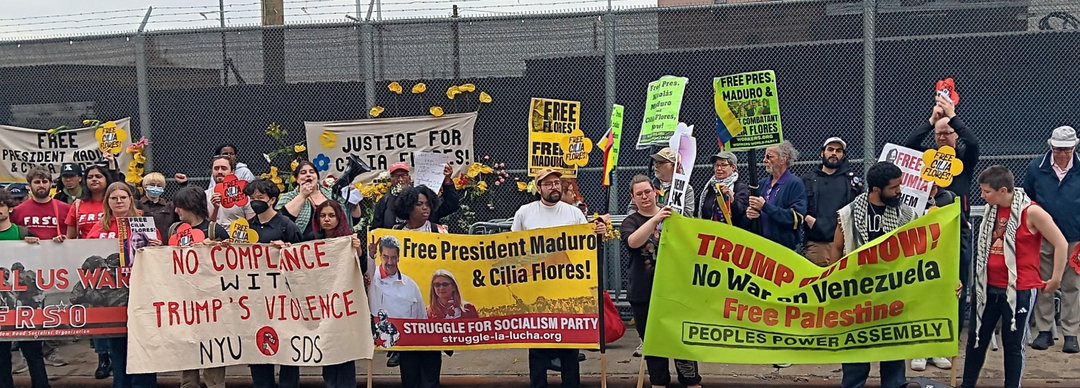
319


Venezuela’s interim president issues a sharp rebuke of Washington’s escalating pressure on her country.


From Presstv via This RSS Feed.

320


Venezuela’s Acting President Delcy Rodríguez, speaking at the Puerto La Cruz Refinery on Sunday alongside oil workers, stated that differences with the US will be resolved through “Bolivarian diplomacy,” emphasizing that the path to resolution will be strictly diplomatic.

Rodríguez said the Venezuelan government is prepared to address the situation directly by appealing to international conflict resolution mechanisms.

“We will face the US government head-on; we will resolve our differences, our historical controversies, through Bolivarian diplomacy,” the acting president said, while adding: “We are not afraid, because if there is one thing that should unite us as a people, it is guaranteeing the peace and tranquility of this nation.”

She added that Venezuela will not be intimidated by external pressures, calling for social cohesion: “We are not afraid, because if there is anything we must unite as a people, it is to guarantee the peace and tranquility of this homeland.”

During her speech, the Chavista leader recalled the impact of the US military attack on January 3, which resulted in the kidnapping of President Nicolás Maduro and First Lady and Deputy Cilia Flores. Rodríguez described the event as an unprecedented act of aggression in the region and labelled Maduro as a prisoner of war.

“The country had to face the darkest thing a human being can experience, which is war against a noble people, under totally unequal conditions,” she noted, stating that it was once unthinkable that “a South American capital would be militarily attacked by an external force.”

Delcy Rodríguez again urged the country’s political sectors to cease their dependence on foreign directives and prioritize internal dialogue to overcome the current crisis.

“Enough of Washington’s orders on policies for far-right Venezuelans; let Venezuelan politics resolve our differences and our internal conflicts,” she stated.

The acting president concluded with a call to practice politics “with a capital P, and with a V, for Venezuela,” insisting that national unity is the only way to safeguard the country’s sovereignty.

Hydrocarbons law reform
Rodríguez also stated that the partial reform of the Organic Hydrocarbons Law aims to optimize the exploitation of resources under principles of energy sovereignty, guaranteeing that subsoil wealth translates into “economic and social happiness” for the Venezuelan people, Telesur reported.

During the meeting, Rodríguez reaffirmed that Venezuela is not afraid of the global energy agenda. “We shouldn’t be afraid of the energy agenda, neither with the US nor with the rest of the world. Diversity in its international relations is Venezuela’s right,” she said while admitting that oil production was briefly affected by the illegal US oil blockade launched last December.

The leader emphasized that the country is moving forward with determination in the defense of its natural resources, while promoting strategic alliances that respect its independence.

“Let those barrels sitting in green fields be transformed into wages, food, and healthcare for our people. Let national and international resources be combined to develop our reserves,” she added, directly linking oil and gas production to social welfare.

One of the milestones highlighted by the acting president was the recent signing of the first contract for the export of natural gas, which positions Venezuela as an emerging power in this sector, beyond oil.

Former Manager of PDVSA: Trump’s Oil Viceroyalty Over Venezuela Is Fantasy (Interview)

“They didn’t believe it, but we’ve already closed a contract to export the first molecule of gas from Venezuela, and now we’re going for more,” she said, emphasizing that the goal is to transform the world’s largest crude oil reserves and the vast gas reserves of the hemisphere into tangible prosperity for the Venezuelan people.

“It is now up to us to become the country with the largest oil reserves in the world, with the largest gas reserves in this hemisphere; it is now up to us to become a true oil and gas producing powerhouse,” she said.

The legal reform in this sector ensures the continuity of Commander Hugo Chávez’s legacy regarding state ownership of natural resources. “The legacy of the Eternal Commander regarding resource ownership will remain untouched and intact within the new legal framework,” Rodríguez affirmed, calling for unity within the hydrocarbons sector and recognizing the fundamental role of the workforce in the industry’s recovery.

(Últimas Noticias) by Odry Farnetano with Orinoco Tribune content

Translation: Orinoco Tribune

OT/JRE/JB


From Orinoco Tribune – News and opinion pieces about Venezuela and beyond via This RSS Feed.

321


By Pablo Meriguet – January 23, 2026

Deprived of oil shipments following the US attack on Venezuela, Cuba has made moves to survive the economic blockade.

The January 3 attack on Venezuela by the US military profoundly transformed the dynamics in the region, especially in the Caribbean. Following agreements reached between the Venezuelan government led by Delcy Rodríguez and the Trump administration, Cuba was forced to quickly seek solutions to its economic crisis.

For more than 60 years of economic and trade blockade by Washington, Cuba has managed to survive thanks to the support of allied governments, which have provided support for the revolutionary process. During its existence, the USSR supported the island with machinery and goods in exchange for the sale of sugar and other products. After the fall of the USSR, Cuba has navigated a prolonged economic crisis thanks to the support of governments such as China and Vietnam, among others.

However, during the 21st century, Hugo Chávez and Venezuela became a lifeline for the Caribbean island. Despite threats from the United States and the tightening of sanctions against Havana, Venezuela decided to sell oil and other products in exchange for the various services that Cuban professionals could offer in the South American country.

However, the Trump administration seems determined to stifle the Cuban economy at all costs. According to reports, several of the Venezuelan oil tankers seized by US forces in the Caribbean Sea were bound for Cuba, sending a strong and clear message to the government of Cuban President Miguel Díaz-Canel.

“NO MORE OIL OR MONEY FOR CUBA — ZERO! I strongly suggest they come to an agreement BEFORE IT IS TOO LATE,” Trump said on Truth Social.

Now that Washington has forced the Venezuelan government to stop selling oil to Cuba, Havana has had to turn to other allies who have promised their help. Among them is China, which has pledged food and financial aid to the revolutionary government in Havana.

China’s aidBeijing’s aid includes the delivery of 60,000 tons of rice to Cuba, the first part of which arrived on the Caribbean island on January 20. Cuban Deputy Prime Minister Oscar Pérez-Oliva said: “We deeply appreciate and are grateful for this aid at a difficult time, when levels of aggression are rising, and the United States’ economic, commercial, and financial blockade against the Cuban people is intensifying in an unprecedented manner.”

For his part, Chinese Ambassador to Cuba Hua Xin said the aid “embodies the deep bonds of special friendship between the two nations.” He added: “We deeply understand that true friendship is revealed in times of greatest need… [China] has always been Cuba’s most steadfast partner… every grain of rice delivered today embodies the unwavering commitment of the Chinese people.”

In November last year, China sent six shipments of food by air. In 2025, Beijing sent essential supplies to the island, including solar lamps, roofing materials, and mattresses. In addition to aid, Chinese President Xi Jinping approved financial assistance amounting to USD 80 million.

Trump Admin Weighs Oil Blockade on Cuba for Regime Change: Politico

Russian diplomats visit Cuba
Russia has also maintained friendly ties with Cuba despite the collapse of the USSR. On January 21, Russian Interior Minister Vladimir Alexandrovich Kolokoltsev, accompanied by a delegation of Russian officials and military personnel, held talks with Díaz-Canel in Havana.

The Russian Interior Minister said that the meeting was held to exchange opinions and views on the complex global situation following the US attack on Venezuela.

This visit comes after Putin’s recent statement affirming that Russia “will continue to provide assistance to our Cuban friends, standing in solidarity with their determination to defend their sovereignty and independence by all means.”

As can be seen, Havana has made its moves to find a way to overcome the new obstacles that the Trump administration has placed in its path. Once again, the resilience and resistance of the Cuban people will be put to the test in the face of US power, which, since the beginning of the Cuban revolution, has done everything possible to destroy it.

(Peoples Dispatch)


From Orinoco Tribune – News and opinion pieces about Venezuela and beyond via This RSS Feed.

322


President Miguel Diaz-Canel says the drills are aimed at deterring potential aggression from the United States.


From Presstv via This RSS Feed.

323


Acting President Delcy Rodríguez led a Comprehensive Social Care Day in La Soublette sector of Catia La Mar, providing direct assistance to more than 5,500 families in the Catia La Mar 1 Communal Circuit, as part of the Venezuelan government’s efforts to recover from the damage caused by the US military aggression on January 3.

On Saturday, January 24, Rodríguez visited homes and spoke with families affected by the illegal US military attack of January 3, which left more than a hundred civilians and military personnel dead, damaged medical and scientific infrastructure and hundreds of homes, and resulted in the kidnapping of President Nicolás Maduro and First Lady and National Assembly Deputy Cilia Flores.

Surrounded by residents, the acting president emphasized that “there can be no economic peace without social peace” and underscored the government’s commitment to “bringing happiness to our people and guaranteeing the future of our children, guided by our Father Liberator Simón Bolívar.”

The Las Casitas sector of Catia La Mar, where Rodríguez made these statements, had been bombed by the US in the early hours of January 3, leaving homes completely destroyed and affecting 64 families.

La presidenta encargada de Venezuela, Delcy Rodríguez, visitó el urbanismo conocido como Las Casitas, en la avenida Soublette en La Guiara.
1/3 pic.twitter.com/eUvlQQpWU0

— Madelein Garcia (@madeleintlSUR) January 24, 2026

She pointed out that “these are civilian residential areas, inhabited by people who have no military status whatsoever and are not involved in security. It is a civilian population that was struck by missiles.”

After noting that “we have spent two weeks” working with the governor of La Guaira, José Alejandro Terán, and the national government “recovering homes,” she added that “we have instructed our teams to find housing immediately to ensure a roof over the heads of our children, which is the most important thing, and to heal the wound of anguish left by this attack.”

She added that this is important for the affected Venezuelan population, “who still feel the impact and anguish. I inform them that we are going to carry out social and health interventions to ensure the integrity of physical and mental health, because we know the people have been traumatized.”

At the same time, she reaffirmed that “we also know that the dignity of the Venezuelan people is our first line of defense in preserving our integrity as a people, our territorial integrity, and our national independence.”

She emphasized that “there is an urgent need for national unity to safeguard the peace and tranquility of our people. There can be no political or partisan differences when it comes to Venezuela’s peace. There can be no divisions. Venezuela must be a single national body.”

Referring to María Corina Machado thanking US President Donald Trump for the attack on Venezuela, Rodríguez said, “It is shameful to see a Venezuelan woman, who claims to be Venezuelan, go and thank people for the bombing and foreign military aggression against Venezuela. I do not think she is Venezuelan, because the Venezuelan people repudiate any form of aggression that causes suffering to our people.”

In conclusion, she declared, “From here, I call on all of Venezuela. I have said it since January 5, when I had to be sworn in because President Nicolás Maduro and First Lady Cilia Flores had been kidnaped. I swore by the children of Venezuela, by the youth; I swore to care for the people, and we must all take care of one another. And the only way we can all take care of each other is by knowing how to preserve and guarantee democratic coexistence in diversity.”

“Diversity exists, plurality exists, differences exist, but there are some supreme values, and one of them is the peace that must unite us, and the independence and dignity of Venezuela, which must unite us,” she added. “And I have seen many sectors that are politically divergent but are united in this position.”

Venezuela: Minister Cabello Urges National Unity and Loyalty to Acting President Rodríguez During Chavista Demonstration

Restoration works in Catia La Mar 1
Among the targets of the US bombing was the port of La Guaira, on the central Venezuelan coast. In Caracas and other affected areas, initiatives to restore infrastructure, social life, and provide psychological support to those affected by the military attack are also underway.

Alongside Héctor Rodríguez, minister for Territorial Socialism, and Governor José Alejandro Terán, the acting president inspected the reconstruction works and other recovery efforts in buildings and neighborhoods of Catia La Mar, greeted residents, and met with specialists, including doctors from various specialties, who are involved in providing support to the population.

65 roofs that were damaged in the January 3 attack have already been replaced while apartments and façades in various blocks in the area have been fully restored.

In La Soublette, a Sovereign Field Fair is ensuring food security by distributing protein-rich foods and essential products through Mercal, Pdval, and Alimentos La Guaira, with institutions such as the National Institute of Nutrition and Lácteos Los Andes joining in to strengthen the local food system. Similarly, entrepreneurs and the Workers’ Digital Bank mobile units are driving economic and financial activity in the community.

The government is also providing clinics with medical services and free medication distribution, recreational spaces, cultural activities, and the attention of Misión Nevado, consolidating a comprehensive approach that addresses the needs of more than 5,500 families in the Catia La Mar 1 Communal Circuit.

With these actions, the Venezuelan government reaffirms its commitment to social stability and the well-being of La Guaira residents, prioritizing reconstruction and direct material support for families affected by the invasion.

The Venezuelan people are recovering by working peacefully in unity. In addition to demanding the immediate return of President Maduro and Cilia Flores through ongoing mobilization, they call for respect for their rights to sovereignty, self-determination, and peace.

(Telesur)

Translation: Orinoco Tribune

OT/SC/DZ


From Orinoco Tribune – News and opinion pieces about Venezuela and beyond via This RSS Feed.

324


Left-wing Senator Iván Cepeda, who is close to Colombian President Gustavo Petro, remains in the lead in voting intention for the presidential elections on May 31, according to a poll released this weekend.

Cepeda, candidate of the Historic Pact, Petro’s coalition, has 30% of the electorate’s preferences, followed by lawyer Abelardo de la Espriella, of the far-right movement Defenders of the Homeland, with 22%, according to the survey by the Spanish firm GAD3 published by the Noticias RCN television channel.

📊 Nueva encuesta GAD3
Dos puntos a destacar:
1️⃣ Esta encuesta muestra un nivel alto de indecisos, superior al de mediciones previas.
2️⃣ La caída de Fajardo es el cambio más relevante del momento, una tendencia que también se observa en el mercado de apuestas.#Elecciones2026 pic.twitter.com/F69dzNETWH

— PoliData (@PoliticaConDato) January 19, 2026

The poll, which asked “if the presidential elections were tomorrow, who would you vote for?”, without suggesting names, shows Senator Paloma Valencia in third place with a distant 3%, from the Democratic Center party, founded by former president Álvaro Uribe (2002-2010), while the former mayor of Medellín, Sergio Fajardo, who appeared in third place in other polls as the standard-bearer of the center right, falls to seventh place, with only 1%.

A first survey, by the firm Invamer, showed Cepeda in first place on December 1, 2025 (31.9%), followed by De la Espriella (18.2%) and Fajardo (8.5%).

The second, from the Brazilian firm AtlasIntel, was released on January 10 and showed that the voting intention is led by De la Espriella (28%), followed by Cepeda (26.5%) and Fajardo (9.4%).

Iván Cepeda Wins Historic Pact Primary in Colombia to Become Presidential Candidate

All three polls agree that there will be a need for a second round on June 21, and in that case, today’s GAD3 poll points to a victory for Cepeda, although a large sector of the electorate remains undecided.

For a first ballot, Cepeda has 40% of the voting intention, compared to 32% for De la Espriella, while blank votes total 11%; those who would not vote, another 10%; and those who do not know or did not respond, 7%.

Cepeda, with 40%, would also win in the second round against Sergio Fajardo (25%), and if the rival were Paloma Valencia, he would beat her with 43% against the latter’s 20%, the poll adds.

GAD3 conducted the survey between January 13 and 15, and it has a margin of error of 2.83%.

(Telesur English)


From Orinoco Tribune – News and opinion pieces about Venezuela and beyond via This RSS Feed.

325


Caracas (OrinocoTribune.com)—This week Venezuela has received three new groups of repatriated nationals from the US under the Return to the Homeland Plan, signaling a sharp increase in returns following the resumption of migrant repatriation flights this year. The flights, which landed at Simón Bolívar International Airport in Maiquetía, La Guaira state, come as the nation continues to navigate the aftermath of the January 3 US military intervention.

Recent flight data and statistics
Since the start of 2026, four flights have arrived in Venezuela from the US, bringing 799 citizens back home. These arrivals, added to the 18,971 repatriations carried out by the end of 2025, bring the total figure to 19,770 repatriated migrants who have escaped wrongful detentions and racist persecution in the US.

The latest flights via the US-based airline Eastern were:

• Flight no. 100: Arrived on Monday, January 19. The flight brought 235 Venezuelans, including 16 women and 219 men.
• Flight no. 101: Arrived from Phoenix, Arizona, on Thursday, January 22, repatriating 183 citizens, of them 32 women and 151 men.
• Flight no. 102: Returned 182 Venezuelans from the US on Friday, January 23, including 23 women, 149 men, and 10 children.

View this post on Instagram

A post shared by Ministerio Relaciones Interiores, Justicia y Paz (@minjusticia_ve)

These arrivals follow Flight 99, which landed on January 16 with 199 Venezuelans, marking the first repatriation of the year. The resumption of these flights occurs in the wake of the January 3 attack perpetrated by the US regime against Venezuela, which included the kidnapping of President Nicolás Maduro and First Lady Cilia Flores.

While a mutually agreed-upon program has been in place since early 2025, the Trump administration unilaterally suspended the agreement in mid-December 2025. The final flight of that year, Flight 98, arrived on December 10 with 218 passengers.

Origins of the migration crisis and Venezuelan repatriation efforts
The mass migration of Venezuelans began after they were impacted by the profound economic crisis between 2015 and 2020, resulting directly from illegal US sanctions. This was followed by a sustained smear campaign and outbreaks of xenophobic violence in the US, which often included false allegations of criminality against migrants. Subsequently, the US government initiated mass detentions and deportations, frequently involving individuals who had no criminal records and were awaiting the resolution of immigration cases.

Every Venezuelan migrant returning under the Return to the Homeland Plan is received with established protocols that include immediate medical care, psychological support, and legal and socioeconomic guidance to assist their reintegration into the Venezuelan society. Since its inception in 2018, the program has provided a safe and dignified return for Venezuelans who have faced exploitation and xenophobia while living abroad.

US resumes extrajudicial killings
Meanwhile, the US Southern Command reported Friday that it carried out a new extrajudicial execution against a small boat in the eastern Pacific, following orders from US War Secretary Pete Hegseth.

The operation resulted in the deaths of two unidentified civilians, whom the US regime immediately labeled “narco-terrorists.” No public evidence has been presented to support such a designation. A third occupant of the boat survived the bombing. According to the official statement, the Coast Guard was asked to activate search protocols, though various analysts question the veracity of these rescue efforts following the fate of recent survivors.

This incident marks the 36th extrajudicial execution in the region since September 2 of last year. To date, according to Orinoco Tribune statistics, 122 civilians have been assassinated: 48 in the Caribbean Sea and 74 in the eastern Pacific.

Venezuela Receives 199 Migrants on First Repatriation Flight Since Trump’s December Suspension

Analysts explain that despite the US use of the narco-terrorism narrative to justify its aggression against Venezuela, 61% of the killings occured in the Pacific Ocean, with which Venezuela has no geographical proximity. Meanwhile, the remaining 48 victims in the Caribbean may include nationals of Colombia, Trinidad and Tobago, Venezuela, and the Dominican Republic, thus diluting Venezuela’s alleged responsibility in international narco-trafficking networks.

Between December 31 and January 23, no US extrajudicial killings were reported. This temporary cessation of hostilities coincided with the international outcry generated in the aftermath of January 3, when US forces attacked Venezuela to kidnap President Nicolás Maduro and his wife, Cilia Flores, in flagrant violation of national sovereignty and international law.

The international community is watching with growing concern as Washington uses the label of “confirmed intelligence” to act as judge and executioner on the high seas. US ruler Donald Trump has also threatened Mexico and Colombia with land strikes under this same narrative.

Special for Orinoco Tribune by staff

OT/JRE/SC


From Orinoco Tribune – News and opinion pieces about Venezuela and beyond via This RSS Feed.

view more: ‹ prev next ›